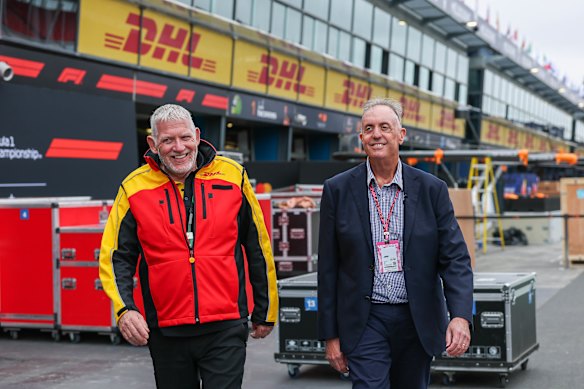

Simon Price has bloodshot eyes and the slightly grizzled appearance of a man who has just got the world’s biggest flying circus through a war zone with a couple of hours to spare.
Price is motor sport event manager for giant logistics company DHL Global Forwarding.
His job is to guarantee that the Australian F1 Grand Prix – like all the GP events he has overseen over the years – is ready to go when the starter’s flag is scheduled to drop in Melbourne.
That involves ensuring 1200 tonnes of high-tech race equipment, mobile garages, race cars, engines, fuel, tyres, spare parts, hospitality gear, scores of staff, F1 teams and all the other moving parts of the world’s fastest race are transported across the Earth and oceans to each grand prix venue right on time.
It’s happening 24 times this year across 21 countries and five continents.
And this year, with staff and race gear sitting in Bahrain, where F1 teams have been undertaking preseason testing, the US-Israeli attack on Iran very nearly brought all Price’s careful plans undone.
The Australian Grand Prix – the first of the season – will start on March 5. The first attacks on Iran came on March 1, closing Middle East airspace and causing chaos throughout the region.
Price said he and his team had no advance warning of missiles filling the skies.
It was, he said, “pure luck” that most air freighters carrying GP people and gear had departed hours before the conflict exploded. All the gear being taken by ocean freighters to Australia and the next two Asian grand prix venues – China and Japan – had already sailed.
Still, significant numbers of staff and racing team members were still “bouncing through the Middle East” on their way to Australia as the war machine revved up.
“They literally missed it [the outbreak of war] by about two hours, I think, really the actual kick-off,” Price said.
One planeload of critical high-tech equipment for one of the race teams, however, didn’t make it out before air traffic was grounded.
Frantic arrangements (“we have a lot of contacts”, said Price, a little mysteriously) meant an air freighter with the gear on board finally arrived in Melbourne on Wednesday afternoon.
“DHL contacts and the people there [in the Middle East] have managed to get that freight pulled out from the location it was in, put on an aircraft and sent down here. What’s on that craft? I don’t know exactly off the top my head, but it’s race-critical equipment for one of the racing teams,” he said.
Almost nonchalantly, he added: “We chartered a plane out of Dubai and we were allowed to punch through airspace.”
Other last-minute arrangements meant equipment and staff held in Europe were able to transfer from Middle East-bound routes to flights travelling to Australia via Asia.
Was Price ever concerned the necessary equipment and people wouldn’t arrive in time for Melbourne’s F1 event?
“Never,” he said, with the certainty of a man who chuckles that he gets to sleep “about 32 minutes a day”.
He tends to catch shut-eye on overnight planes between races.
The moment the F1 race is completed in Melbourne on Sunday, Price will be driven to Melbourne Airport to board an overnight flight to Shanghai and prepare for the Chinese Grand Prix, which begins on March 13.
Ocean freighters loaded with race equipment were arriving in China as he spoke, and others were on their way to Japan for its grand prix, starting on March 27.
The tiny gap between Melbourne’s and Shanghai’s events is not unusual.
The grand prix circuit this year has two triple-headers – races on three consecutive weekends – and six double-headers – races on two consecutive weekends.
The logistics required to mesh such a schedule together seamlessly involves 52 big trucks in Europe, ocean freighters and a small swarm of jumbo jets – DHL has moved from Boeing 747s into more efficient 777s.
Seeking to meet tough environmental targets, the company’s entire fleet of trucks uses biofuels, which the company says has reduced carbon emissions by an average of 83 per cent compared with diesel-driven counterparts.
Meanwhile, sleep for organisers like Price, for whom a war is simply part of an endless logistical puzzle, will surely be scarce.
The Bahrain circuit is already set up in readiness for its scheduled GP on April 10-12 – on the chance the war will have eased by then.
Price, who has kept the show on the road through previous conflicts, natural disasters and a pandemic, simply shrugs.
“We’ll see,” he said.
Get the day’s breaking news, entertainment ideas and a long read to enjoy. Sign up to receive our Evening Edition newsletter.
 Tony Wright is an associate editor and special writer for The Age and The Sydney Morning Herald.Connect via email.
From our partners
Disclaimer : This story is auto aggregated by a computer programme and has not been created or edited by DOWNTHENEWS. Publisher: www.smh.com.au