
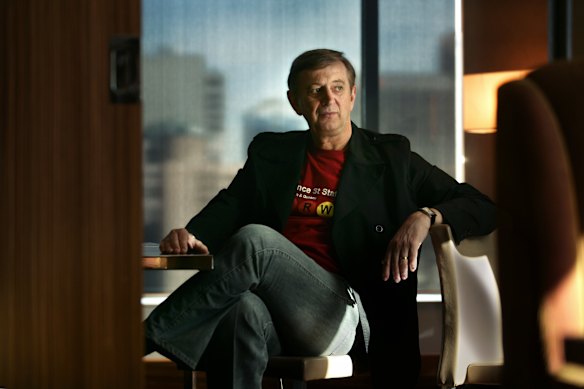
In leaving us, Dennis Cometti has left behind a precious trove of pithy, witty descriptions of the sporting action he called.
The one-liners were his calling card, so to speak. Everyone who followed the AFL – and possibly cricket or Olympics – had a favourite Cometti-ism.
One of the most memorable was the sentence Cometti deployed when Bulldogs terrier Tony Liberatore emerged from a scrimmage wiping his muddied eyes: “Liberatore went into that last pack optimistically and came out misty optically.”
The legendary Dennis Cometti died aged 76.Credit: Simon Schluter
The description of Ben Cousins evading Josh Carr, now Port Adelaide’s coach, was another that will endure. It followed the West Coast champion’s notorious decision to jump from his car and swim across the river. “Cousins runs away from Carr – not for the first time.”
These witticisms – Australian sports commentary’s answer to the quips of Oscar Wilde or Mark Twain – were not necessarily off the cuff. Many were devised beforehand as part of his precise preparation, as colleagues recalled, and then inserted at the right moment.
And, to borrow a word from his long-time co-caller and peer Bruce McAvaney, this was what made Cometti special. As with the great callers of any sport, he found the words for the moment.
“His timing was exceptional,” said David Barham, the television executive and ex-Essendon president, who worked with Cometti, McAvaney, Tim Lane, Ricky Ponting, rugby’s Gordon Bray and many of the best callers across AFL, cricket et al.
“He didn’t overdo it.”
A key to Cometti’s mastery of the art was his restraint. “When he used something, he didn’t hope it would work,” Barham observed. “He knew it would work.”
Cometti was blessed with the key attributes of a play-by-play commentator. He knew the game, and as Eddie McGuire noted, he had the linguistic talent to apply the words. He also had golden tonsils to rival those of John Laws, having worked as a radio DJ, possessing a rich, deep voice that could rise with emotion when necessary.
Best known as a caller of the game he played at a high level for West Perth (he spent a year at Footscray too in the VFL), which he coached in the ’80s, Cometti’s canon also included iconic moments in Olympic swimming, headed by his call of Kieren Perkins’ 1996 gold medal in the 1500 metres from lane eight.
In that same Atlanta Olympics, he called Susie O’Neill’s butterfly gold thus: “The heart of a lion, in the heart of Dixie.”
As AFL boss Andrew Dillon said, footy was lucky to have Cometti, given his ability to call multiple sports.
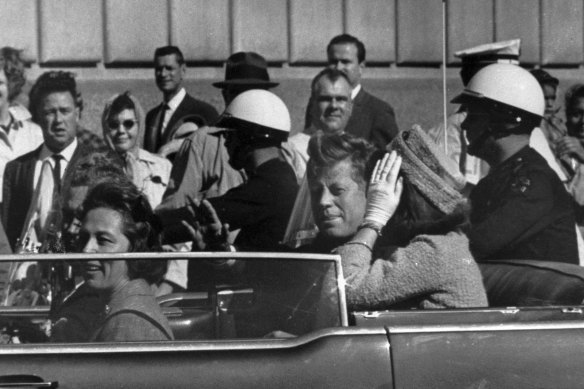
John F. Kennedy in Dallas, Texas, on the day of his assassination on November 22, 1963.Credit: AP
Cometti was a quirky character, with a sense of the ridiculous.
He was a John F. Kennedy assassination buff, having visited Dealey Plaza, the Texas Book Depository and the grassy knoll in Dallas where the president was slain in an attempt to unpack what had really happened. Adrian Barich, a long-time friend and colleague of Cometti’s at Seven in Perth, remembered how Cometti tried in vain to get his own documentary made on the JFK case.
He didn’t accept the lone gunman official finding.
Once, he contacted me in the hope that I might have access to archival material on “Big Bob” Johnson, the ex-Melbourne premiership hero and WAFL star who was the young Dennis’ favourite player.
Exceptional callers/commentators have their own trademarks. For McAvaney, it’s capturing and elevating drama (e.g. Cathy Freeman’s 400-metre gold) and deploying that vast reserve of facts he’s researched.
For Tim Lane, it’s precise use of language and adding a deeper context to what is unfolding.
Cometti’s defining traits were those humorous quips, but also the art of understatement. That he was economical with words enhanced their impact.
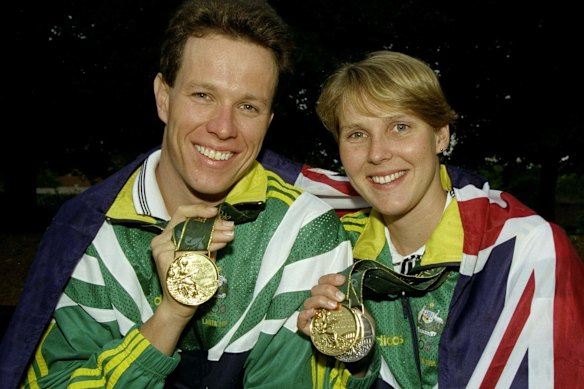
Kieren Perkins and Susie O’Neill show off their gold medals from the Atlanta 1996 Olympics.Credit: Australian Picture Library / Allsport
McGuire said Cometti called largely off the screen, rather than from the field, placing himself in the viewer’s position, though he would look up the field too to follow the play.
For those who don’t follow AFL, Cometti’s call of Perkins’ triumph, when swimming as the written-off champion in lane eight, might be the abiding memory of his brilliance behind the mike.
Cometti’s live call, which cannot have been scripted in advance – the result was too improbable – showed how a caller who excelled in clever quips could flick the switch to serious drama if required.
In 2018, Cometti was presented with a lifetime achievement award by the Australian Sports Commission. A room of dignitaries and journos watched, falling pin-drop quiet, as his call of the Perkins’ swim was replayed on the big screen.
Seated near the front of the room, Cometti closed his eyes and moved his lips, quietly repeating his own call to himself, as if in prayer.
“A great Australian is swimming away from this field. He was down-and-out yesterday, and suddenly he’s stood up,” the room heard, 22 years on. “One of the great swims of all time. Forget the time, this is all about courage.”
The passing of Dennis Cometti is a moment to reflect on how history is made, not only by athletes, but by those who consecrate and capture the essence of what we have seen, who make it special.
He might have left us. His words have not.
Most Viewed in Sport
Disclaimer : This story is auto aggregated by a computer programme and has not been created or edited by DOWNTHENEWS. Publisher: www.smh.com.au


