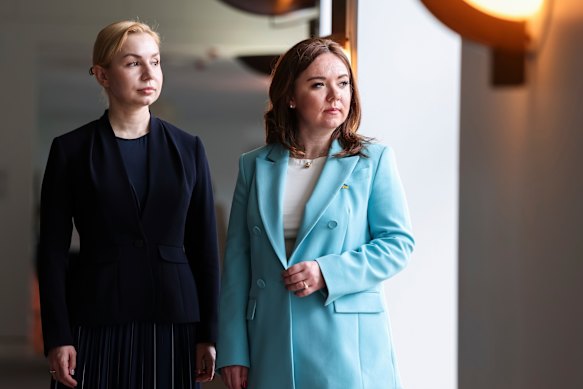

Senior Ukrainian MPs have used a visit to Canberra to warn that escalating conflict with Iran must not come at the expense of Western support for Kyiv, declaring that the outcome of Russia’s invasion will shape global security far beyond Europe.
The delegation, led by Galyna Mykhailiuk, a representative of Volodymyr Zelensky in Ukraine’s parliament, is meeting federal government and opposition figures this week to press the case for sustained military aid, tighter sanctions on Moscow and deeper defence industry co-operation.
Their visit coincides with rising tensions throughout the Gulf after Iranian drone attacks on several states, prompting concerns that Western weapons stockpiles and diplomatic focus could be diverted from Ukraine at a critical stage of the four-year war.
“We are very much grateful for every single piece of support that was provided by the government, by the parliament, by people of Australia,” Mykhailiuk said at Parliament House.
“When you have no means of survival and you go in front of the Russian invader, bravery is not enough. The fact that democratic nations provided us with military and financial support helped us to preserve our independence, humanity and freedom.”
President Zelensky has offered to send Ukraine’s leading drone interception specialists to assist Gulf states targeted by Iranian attacks, and in return asked their leaders to persuade Russian President Vladimir Putin to accept a ceasefire.
Ukraine has developed significant expertise in countering Iranian-designed Shahed drones, which Russia has deployed extensively against its energy grid and residential areas since the full-scale invasion began.
But Mykhailiuk said Kyiv remained sceptical that Moscow was genuinely interested in ending the war.
“If Ukrainians stop fighting, we will just be occupied. If Russia stops the war, peace will come,” she said. “There is a huge difference in the approaches.”
She warned that Russia’s war economy remained fully mobilised, supported by allies including North Korea, and that Moscow had shown no sign of abandoning its territorial ambitions.
In Canberra, the delegation’s program includes meetings with Trade Minister Don Farrell, Assistant Defence Minister Peter Khalil and opposition foreign affairs spokesman Ted O’Brien, as well as an appearance before a joint standing committee and the launch of a parliamentary friendship group for Ukraine.
Joining Mykhailiuk in Canberra were Anastasiia Radina, chair of Ukraine’s anti-corruption committee; Oleksii Movchan, deputy chair of the economic development committee; and Musa Magomedov, who heads the subcommittee on industrial policy — a line-up Kyiv said underscored its focus not only on weapons and sanctions, but on clean governance, economic reform and rebuilding its industrial base during wartime.
Mykhailiuk urged Australia to maintain and strengthen sanctions on Russia and to consider directing frozen Russian assets towards Ukraine’s reconstruction and domestic weapons production.
“Our companies have capacity to increase production. They just need finance,” she said, arguing there was scope for countries such as Australia to fund procurement arrangements that would allow weapons to be manufactured inside Ukraine.
She also acknowledged a shift in US support, with Kyiv increasingly required to purchase ammunition rather than rely on donations.
“We have to buy everything,” she said. “There is lots of room for co-operation.”
Framing the conflict in strategic terms for an Indo-Pacific audience, she argued that failure to hold Russia accountable would embolden other authoritarian regimes.
“We do believe that if the aggressor sees that there is no accountability, they will implement invasion plans towards other regions,” she said. “The destiny of the democratic world is being solved in Ukraine.”
The Department of Foreign Affairs and Trade announced a new round of sanctions directed towards Russia to coincide with the four-year anniversary of the war last week. For the first time, fuel importers were warned they could be breaching Australian sanctions law by importing Russian-origin oil processed in third countries.
The federal government has also provided $1.7 billion in military aid, humanitarian and energy assistance to Ukraine.
But experts have warned a Senate committee last month Australia’s support for Ukraine was being undermined because of loopholes in its sanctions’ regime. Australia has imported about $24.7 billion worth of oil since 2022 from countries that refine Russian crude, delivering an estimated $2.5 billion in tax revenue to the Kremlin, according to the Centre for Research on Energy and Clean Air.
Foreign Minister Penny Wong told the launch of parliament’s Friends of Ukraine committee on Wednesday night that the government was firm in its focus on the war.
“We cannot allow Mr Putin to simply make this the new normal,” Wong said. “We have to stand with the people of Ukraine. So to our Ukrainian friends, please know you have … Australia’s support, and you have our friendship.”
Cut through the noise of federal politics with news, views and expert analysis. Subscribers can sign up to our weekly Inside Politics newsletter.
 Rob Harris is the national correspondent for The Sydney Morning Herald and The Age based in Canberra. He is a former Europe correspondent.Connect via email.
From our partners
Disclaimer : This story is auto aggregated by a computer programme and has not been created or edited by DOWNTHENEWS. Publisher: www.smh.com.au