Unable to qualify for the Milan-Cortina 2026 Winter Olympic Games — held Feb. 6-22 in Italy — North Korea opened its 2026 National Winter Games on Feb. 4 in Samjiyon, Ryanggang province, the northernmost of the country’s nine provinces. The roughly 50-event competition, held at the Mount Pegae sports complex in the Paekdusan area, drew athletes from across North Korea to compete in skiing, ice hockey and figure skating, among other disciplines. The games ran through late February, parallel to the international Olympics, in what analysts say was a deliberate decision by the Pyongyang government to stage a domestic sporting spectacle in place of the international one it could not attend.
The competition was more than a sporting tournament; it was a deeply political and propagandistic event designed to replace North Korea’s exclusion from the international stage with a local alternative. North Korea’s absence from this year’s Olympics reportedly stems from a combination of structural problems: uncompetitive athletes in international qualifying events, the erosion of the country’s athlete base, and the severing of international exchanges since the COVID-19 pandemic. In response, North Korea is pursuing a strategy of projecting regime solidarity and sporting achievement by hosting its own winter event in Samjiyon, while also promoting the area as a tourism destination.
Recent satellite imagery analysis shows intense artificial lighting around Samjiyon’s sports village during the competition, indicating that North Korea channeled significant energy resources into staging the large-scale event despite extreme cold. Even so, Samjiyon faces deep structural limitations as a tourism city — its accessibility, marketability and economic potential all fall short — and it has yet to generate meaningful tourism revenue. North Korea’s development of Samjiyon appears driven by a desire to build a politically themed, high-altitude showcase city using the symbolism of Mount Paekdu, rather than by any tourism strategy grounded in economic logic.
North Korea hosted its 2026 National Winter Games in Samjiyon, Ryanggang province, the “first city below Mount Paekdu.” The tournament ran from Feb. 4 to late February, alongside the Milan-Cortina 2026 Winter Olympic Games in Italy, which ran from Feb. 6-22. The timing appears to be a deliberate choice to maximize the propaganda value of holding a parallel sporting event at home.
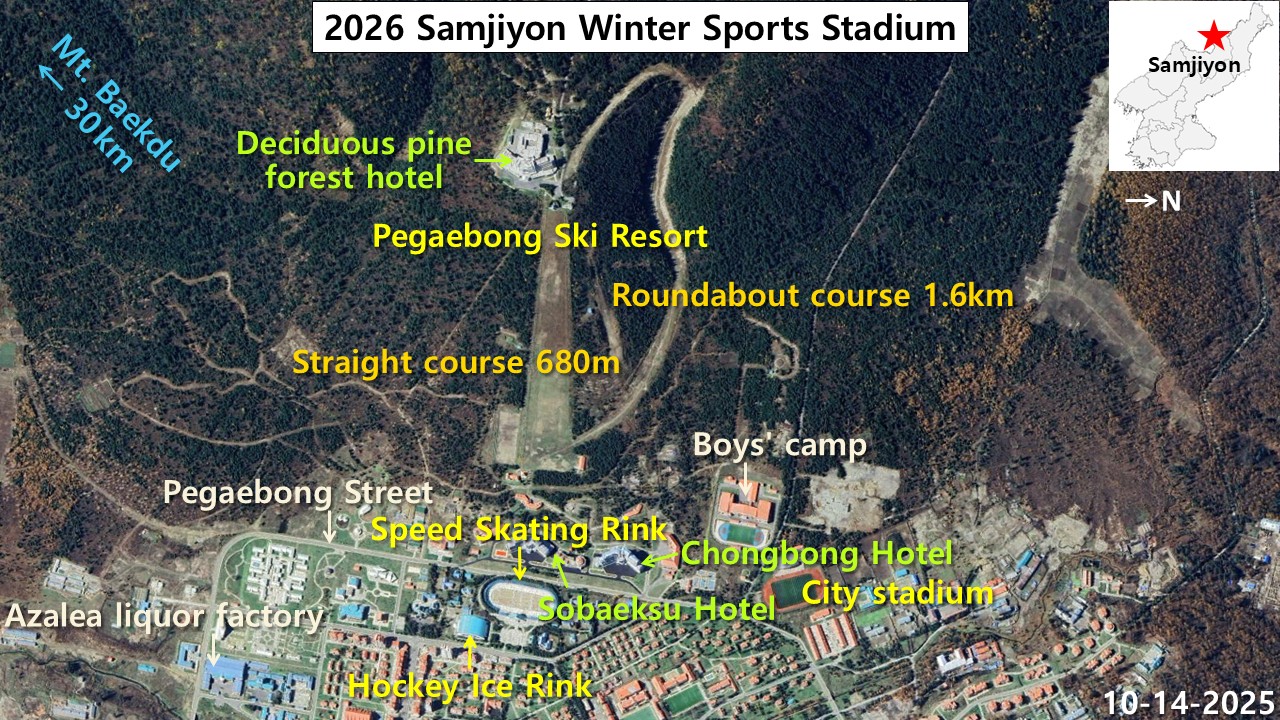
Satellite photos show Samjiyon’s hockey rink, where the opening ceremony was presumably held. The facility — a sky-blue, bunker-like structure roughly 230 feet (70 meters) long and 148 feet (45 meters) wide — is believed to be an indoor ice rink. Its design suggests it is more than a simple sports venue; it is a multifunctional facility that incorporates military bunker-style architectural elements. The photos also reveal that the Mount Pegae ski resort features a 2,231-foot (680-meter) straight downhill run and a winding slope of about 1 mile (1.6 kilometers). At the base of the resort sits a 1,312-foot (400-meter) speed skating track — consistent with North Korea’s characteristic “concentrated event space” approach, in which a compact, all-in-one winter sports complex is built within a small footprint.
At the summit of Mount Pegae stands the Milyong Hotel, a symbolic structure that transformed the “revolutionary holy site” of the Mount Paekdu Secret Camp (Milyong) — an outdoor camp used by Kim Il Sung’s anti-Japanese guerrillas — into a modern tourist hotel. Kim Jong Un personally inspected it upon its completion in 2025. Blending revolutionary sites with modern tourism infrastructure has been a hallmark of North Korea’s propaganda space-building under Kim Jong Un.
The area also includes accommodations and additional facilities such as the Chongbong Hotel, Sobaeksu Resort and Samjiyon’s Korean Children’s Union camping ground. The camping ground, in particular, is not simply a resort — it serves as an ideological base where children are indoctrinated with the myths of Kim Il Sung’s anti-Japanese struggle and revolutionary history, making it a central pillar of the regime’s educational infrastructure. Mount Pegae takes its name from the topography of the 5,315-foot (1,620-meter) peak, whose round, gentle summit is said to resemble a pillow — pegae in Korean.

The area around Samjiyon’s sports village — concentrated along Pegaebong Street — burns bright in the middle of winter nights. VIIRS nighttime illumination data from the Suomi NPP, a U.S. polar-orbiting satellite, shows intense artificial lighting in the cluster of ski resort, ice rink and hotel facilities, in sharp contrast to the surrounding mountain darkness. This is likely the result of heavy nighttime lighting installed for the preparation and operation of the National Winter Games. VIIRS sensors are multi-band environmental sensors that allow satellites to detect artificial surface lighting day and night, and are widely used to track urban activity, events and energy use patterns.
The spike in nighttime light serves as indirect confirmation that the National Winter Games actually took place. Because Samjiyon is ordinarily a sparsely populated alpine area with limited economic activity, intense lighting at specific periods points to a large-scale, state-directed event. The concentration of light around the ski resort, ice rink and accommodation facilities in particular suggests increased energy consumption tied to athlete and staff housing, competition operations and propaganda activities.
This appears to be part of a deliberate strategy to maximize the propaganda impact of hosting North Korea’s own winter sports event at the same time as an Olympics it could not attend. The surge in nighttime lighting across the Samjiyon area goes beyond a routine sporting event — it can be read as the regime staging a visible, symbolic performance for both domestic and international audiences.

Satellite thermal infrared (TIR) data of the National Winter Games venue confirmed that the area around the event sites and sports village was gripped by the severe winter conditions typical of North Korea’s northern region. TIR data from the U.S. Landsat 8 satellite measures surface temperatures by detecting thermal radiation and is widely used to map surface temperature distributions and thermal environments. The data shows that the average temperature in Samjiyon on Feb. 8 was minus 18 degrees Fahrenheit (28 degrees Celsius below freezing), with a low of minus 24 degrees Fahrenheit (31 below zero Celsius) — among the coldest readings recorded across North Korea’s major cities. The crater lake atop Mount Paekdu was colder still, dropping to around minus 29 degrees Fahrenheit (34 below zero Celsius) that day. In February of the previous year, the summit of Mount Paekdu fell to minus 36 degrees Fahrenheit (38 below zero Celsius), confirming that the region experiences temperatures on par with polar environments. While such extreme cold is physically well-suited to preserving natural snow and hosting ice and ski events, it is a serious deterrent to tourism and extended stays.
Samjiyon, in short, has the natural conditions for winter sports but faces severe structural barriers to attracting and retaining tourists — which undercuts North Korea’s stated ambition to develop the city as a winter sports and tourism hub, and points to fundamental limits in its economic viability.
Significance of Samjiyon’s National Winter Games and development as a tourism destination
Samjiyon’s location in an alpine area near Mount Paekdu means long winters with heavy snowfall, and a glance at its natural environment makes it easy to see why the area would seem suited to winter sports and tourism. It does have the facilities to host a National Winter Games — a ski resort, ice rink, athletes’ village and hotels — and the bitter cold actually benefits winter sports competition. These natural and geographical advantages have long led North Korea to position Samjiyon as a potential winter sports hub and tourist city.
Yet the city faces serious structural obstacles on both fronts. Tucked away in a remote mountain region far from Pyongyang, Samjiyon suffers from poor accessibility — limited road and rail links, and traffic that is regularly disrupted by blizzards and extreme cold. Poor connectivity, thin service infrastructure, safety concerns and weak international networks all make it hard to draw large numbers of tourists or a consistent flow of international sports teams. The city is also vulnerable to external shocks, given how heavily North Korea’s tourism market depends on Chinese visitors.
Despite all this, North Korea’s massive investment in developing Samjiyon appears to be driven by political symbolism rather than economic calculation. The Samjiyon and Mount Paekdu areas hold central importance as “revolutionary holy sites,” and Samjiyon has been positioned as a showcase model city demonstrating the achievements of Kim Jong Un’s modernization drive. The National Winter Games and the broader development of Samjiyon as a tourist destination are best understood, then, not as market-driven tourism projects but as exercises in building political space — combining regime propaganda, leadership achievement displays and regional development showcases.
Disclaimer : This story is auto aggregated by a computer programme and has not been created or edited by DOWNTHENEWS. Publisher: dailynk.com