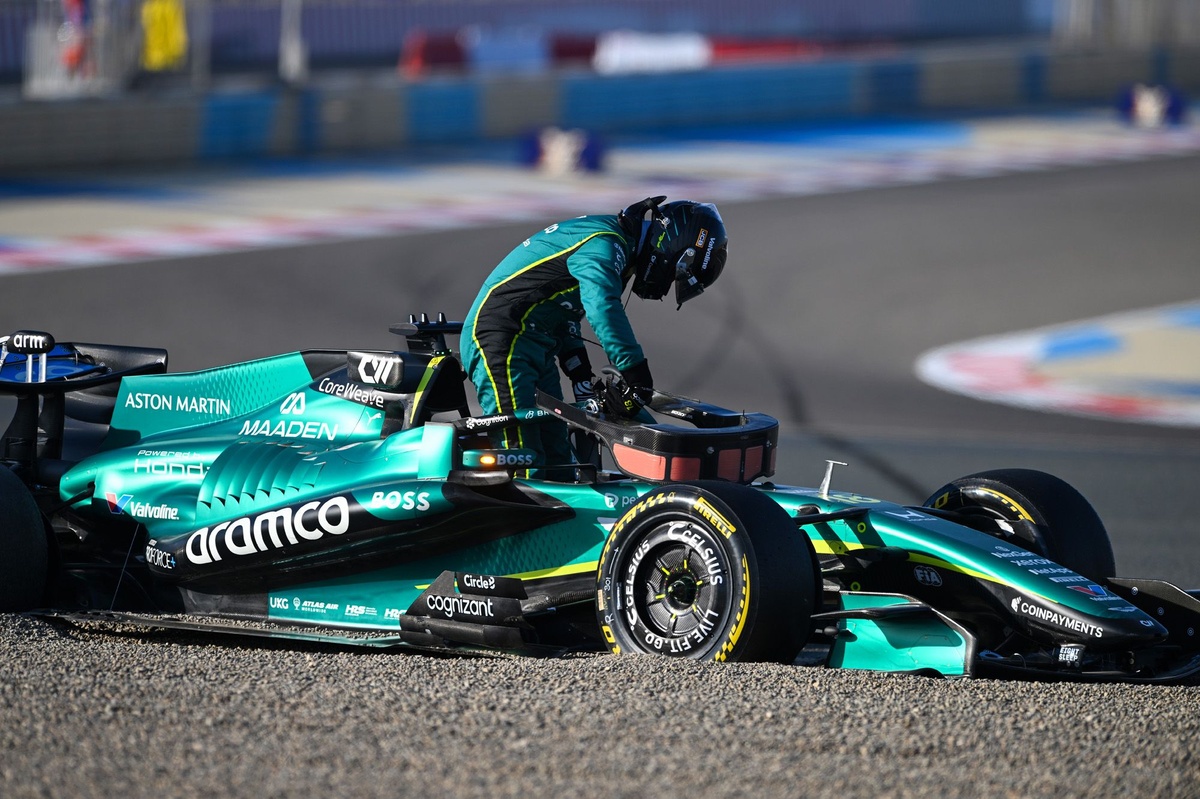
The Honda engine vibrations that Aston Martin is suffering are so severe that they limit the number of laps drivers are able to complete without risking damage to their hands, team boss Adrian Newey has revealed.
The new partnership between Aston Martin and Honda got off to a disastrous start in pre-season testing when a variety of reliability issues limited the AMR26’s running. The headline item was excessive vibrations coming from the power unit, which kept breaking the engine’s battery unit until the team ran out of spares.
As revealed by Motorsport.com, Aston Martin has come to Australia fully expecting to just turn a limited number of race laps before being forced to retire both cars. Speaking on Thursday morning, the squad’s team principal Adrian Newey revealed the real extent of its vibration woes, admitting drivers Fernando Alonso and Lance Stroll are only comfortable turning a limited number of laps before risking nerve damage to their hands.
“What we have achieved for this weekend [is a solution] that tested on the dyno over the course of the weekend that has successfully, significantly reduced the vibration going into the battery,” Newey explained.
“But what is important to remember is the power unit is the source of the vibration, it’s the amplifier. The chassis is, in that scenario, the receiver. A carbon chassis is a naturally stiff structure with very little damping, so the transmission of that vibration into the chassis, we haven’t made any progress on.
“That vibration is causing a few reliability problems, mirrors falling off, all that sort of thing, which we are having to address. But the much more significant problem is that the vibration is transmitted ultimately into the driver’s fingers. So, Fernando is of the feeling that he can’t do more than 25 laps consecutively before he will risk permanent nerve damage to his hands. Lance is of the opinion that he can’t do more than 15 laps before that threshold.
“We are going to have to be very heavily restricted on how many laps we do in the race until we get on top of the source of the vibration and improve the vibration at source.”
The team says it is upbeat about the innate performance potential of its car, but because it hasn’t yet gotten to the root cause of Honda’s power unit vibrations, there is no clear timeline on when it can eliminate or reduce them.
“From Honda’s point of view, unfortunately we have not yet been able to run the power unit at the maximum RPM,” said HRC president Koji Watanabe. “It’s quite too early to say what the performance is yet, so let’s understand the situation.
Newey said: “Given a bit of time, I see no inherent reason within the architecture of the car why we can’t become, on the chassis side, close to, if not fully competitive. “On the PU side, if we simply talk about pure raw power, then there’s no point in speculating. We’ll find out, particularly on Saturday, when everybody has their engines at full beans.
“One of the problems with these regulations is that the shorter you are on ICE power, the more you have to make up for using electrical energy to cover for that lack of ICE power, which means that by the time you really want that electrical energy on the straights, your battery’s gone flat. So it becomes a self-fulfilling downward spiral.”
We want your opinion!
What would you like to see on Motorsport.com?
– The Motorsport.com Team
Disclaimer : This story is auto aggregated by a computer programme and has not been created or edited by DOWNTHENEWS. Publisher: motorsport.com