
The Queensland government has been told to make high-powered motorbikes legal – rather than ban them – in response to safety fears and widespread fury over teens flagrantly ignoring laws and riding the devices dangerously in public.
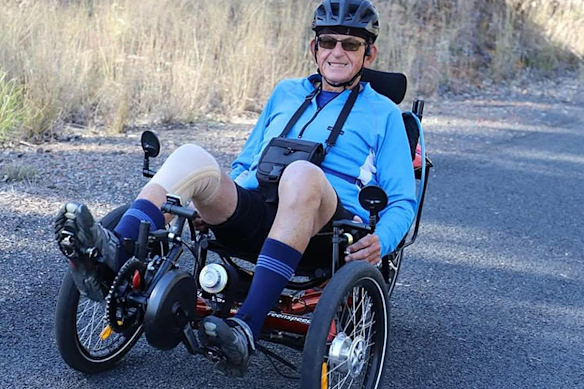
But the proposed crackdown, recommended by a parliamentary committee, will instead target people like Clive Bassett, who uses an electrically assisted recumbent trike.
Among those who welcomed the report is the RACQ, which said the proposed laws struck the right balance.
Bassett, 81, handed over his driver’s licence and bought an e-trike, which helped him shed 30 kilograms, and he enjoys travelling the paths around Jindalee.
Dannon Day, 28, has a vision impairment, and could have got a driver’s licence, but decided he felt more comfortable riding an e-bike, which he has used for the past eight years as his main form of transport.
“Brisbane is quite spread out, and it can be difficult to get around just by public transport,” he said.
“I don’t really want to feel like I have to rely on everyone all the time if I want to go somewhere that’s not easily accessible by public transport.”
Day said when he wanted to play tennis after work, it was about a 30km round trip.
“On a regular bike, I don’t think I’d be able to play tennis,” he said.
“I just can’t see how it’s going to stop the issue they’re trying to solve anyway because if you suddenly require a licence, it’s not like all the kids riding illegal bikes are going to stop because they have to have a licence.
“It seems like they’re not actually looking at the issue.”
No other Australian state or territory, or major country worldwide, requires riders of low-powered e-bikes or e-scooters to hold a driver’s licence.
People riding a bicycle would not require a licence, including children.
The requirement would mean e-bike riders who get a learner’s licence only to ride their bike would brush up on the road rules far more regularly than car drivers.
A learner licence is only valid for three years, whereas holders of an open licence do not require re-testing.
The committee said they “grappled” with the idea of banning under-16s.
But they decided a clear age requirement would provide a “strong and simple framework for improving safety”.
Victoria and Western Australia require e-bike riders to be 16 years or older.
The committee recommended any device that did not meet the EN15194 standard for a legal e-bike with assistance cutting out at 25km/h should be defined as a motorbike, and riders would need a motorbike licence, registration, a VIN, CTP insurance, and only ride on roads, not paths.
That would legalise the riding of high-powered electric motorbikes, which are currently illegal to ride on public roads and paths.
Recommendation 19 says e-mobility devices for on-road use should align with the EN15194 standard – with a 25km/h limit and maximum 250-watt motor – and devices sold for private property only should be permanently marked.
That could apply to high-powered bikes without a VIN.
The report says 6300 people presented to emergency departments with injuries and 12 people died from e-mobility last year in Queensland – this was not broken down by e-scooters, legal e-bikes or illegal electric motorbikes.
WorkCover reported the significant increase in claim costs, to $4.4 million in 2025, was primarily driven by e-scooter injuries.
During hearings in June 2025, Geoff Magoffin, from Transport and Main Roads explained e-scooters were subject to stricter rules, under current laws, because e-bikes were more stable due to their larger wheels, while e-scooters had a high centre of gravity and were more prone to tipping.
The committee also wants the speed limit on footpaths for e-bikes and e-scooters, but not bicycles, to be 10km/h – slower than jogging.
And it wants the government to support Queensland councils to set even slower speeds for high pedestrian areas and pathways.
Many riders take to footpaths or shared paths, including with children riding to school, to avoid the dangers of riding on the road in the absence of separated paths.
Queensland Transport and Main Roads’ guideline for speed on shared paths says: “a bicycle can become unstable at speeds below 11km/h”.
It states cyclists can travel at speeds between 15-25km/h on well-designed paths with “minimum risk or decrease in amenity to people walking”.
In 2023, complaints about cyclists getting fined $464 for exceeding the 10km/h speed limit on the shared walking and cycling Kurilpa Bridge led the government to raise it to 20km/h.
Dr Michael Kane, from the RACQ, said the proposed changes struck the right balance between improving safety and recognising the important role of e-mobility devices.
Transport Minister Brent Mickelberg said the government would consider the report and deliver “nation leading reforms that Queenslanders are calling for”.
Start the day with a summary of the day’s most important and interesting stories, analysis and insights. Sign up for our Morning Edition newsletter.
From our partners
Disclaimer : This story is auto aggregated by a computer programme and has not been created or edited by DOWNTHENEWS. Publisher: www.smh.com.au