
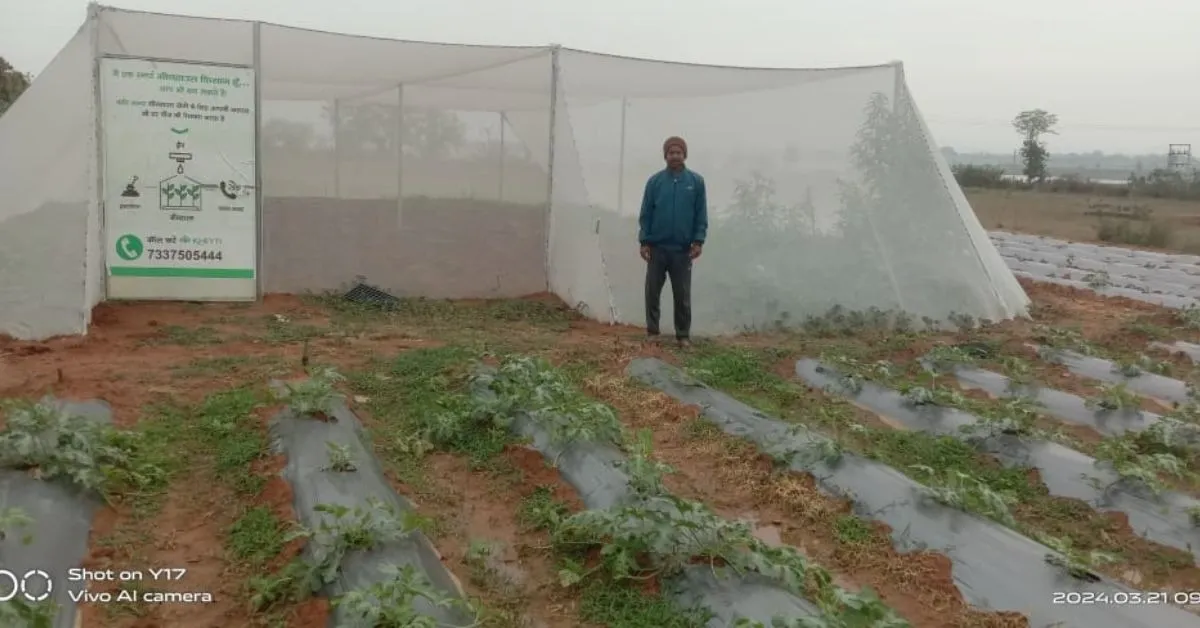
Last year, Basanti Devi (33) moved into a ‘pakka makan’ (a solid, durable home) in Hesapora Tola, Shishatand-Gola village, in the Ramgarh district of Jharkhand. The family had previously been living in a mud home. Last year was transformative in more ways than one; Basanti’s son (the eldest of her three children) began pursuing his bachelor of arts degree.
All these developments are symptoms of the successful farming model that allows Basanti to grow crops, particularly coriander, even in the off-season.
Reasoning that coriander grows well in the winter months of October and November, Basanti says she would often experiment with growing it in the monsoon season as well.
But these attempts were unsuccessful. “The heavy rains would damage the crop and wash it away, and all the money we spent on seeds would go to waste,” she explains. But last year, the net house technology by Kheyti, a company that designs farmer-friendly, climate-smart ecosystems, gave Basanti the confidence to dream beyond what she was comfortable with on home turf.
She shares, “I used three kilograms of high-quality coriander seeds worth Rs 900 and prepared the field.” On 16 October 2025, she got her first off-season harvest, and over the course of the season, she harvested the crop eight times, collecting a total of 85 kilograms of fresh coriander, which she sold for Rs 150 per kg.
The net house technology was installed on Basanti’s farm in 2023 with the support of TRI (Transform Rural India), an NGO that works to improve rural livelihoods by supporting farmers, promoting sustainable agriculture, and strengthening community institutions, and with technical guidance from the Kheyti team. “The more I started seeing the results of growing these crops, the more I wanted to learn about the technology,” she shares, adding that in time she also adopted a battery-operated sprayer to replace manual spraying; this reduced her labour and time while improving the accuracy of pesticide application.
When tech combats climate change
On any given day, if you were to stop by Basanti’s 1.2-acre field, you’d find her surrounded by women farmers eager to learn and understand how she’s reaping success with her farming techniques. They bond over the same woes.
Basanti echoes these concerns: “Either the availability of water used to be a problem for us, or the crops would get affected by insects. But even when the factors were in our favour, we were unable to earn throughout the year.”
/filters:format(webp)/english-betterindia/media/media_files/2026/03/05/net-house-2-2026-03-05-16-55-35.jpg)
While Basanti says the peas, beans, tomatoes, and potatoes she cultivated would bring in income, she admits she was always worried about the capricious climate dynamic and the toll it would take on the crops. But the net house technology has shifted the odds in her favour.
Elaborating on this technology, Bapi Gorai, Senior Practitioner at TRI, shares, “The Kheyti Rakshak Net House is a part of our Greenhouse-in-a-Box ecosystem. It helps farmers grow over 20 vegetables, herbs, fruits, and flowers profitably. The technology protects crops from harsh sunlight and reduces the temperature within the net house by three to five degrees Celsius. It protects crops from high-speed winds of up to 100 kmph, unpredictable rains, and reduces pest infestations by up to 90 percent.”
He asks farmers to think of the net house as a portable technology that helps farmers grow vegetables throughout the year and produce three to four crops annually, instead of the usual one or two.
A farmer’s first line of defence
Calling it a farmer’s first line of defence, Bapi says one of the most unique features of the net house is that it comes with a complimentary year-long agri advisory support service.
He shares, “To ensure a smooth transition from an open-field farming system to the greenhouse system, we offer one year of free agronomy support to each farmer. Our on-field representatives and online advisory team work together with farmers and guide them on their way to climate-resilient farming.”
/filters:format(webp)/english-betterindia/media/media_files/2026/03/05/net-house-1-2026-03-05-16-53-18.jpg)
Bapi explains that between March and June — months characterised by high temperatures — the net house’s 30 percent shade-net provision reduces heat and creates conducive conditions for growing tomato, cucumber, chilli, okra, and bottle gourd.
“From July to September, heavy rain and pest attacks are common. During this period, the net house protects crops and provides conducive conditions for growing tomato, beans, coriander, and spinach. In the winter months between October and January, the net house provides temperature and humidity control and allows crops like capsicum, cabbage, cauliflower, and strawberries to thrive.”
Being able to grow crops off-season translates into better income for farmers like Basanti, who shares that she now earns around Rs 70,000 a year. The microbiome she has cultivated stands as proof of her perseverance and of how technology can transform harvests and livelihoods.
All pictures courtesy TRI
Disclaimer : This story is auto aggregated by a computer programme and has not been created or edited by DOWNTHENEWS. Publisher: thebetterindia.com







