Ahead of the 2026 Australian Grand Prix and the debut of another new set of rules, we’ve decided to pick out the most dramatic Formula 1 season openers since the world championship began in 1950.
These aren’t necessarily the greatest grands prix, but they all had their elements of drama, action and, in some cases, a surprise result.
10. 1990 United States GP
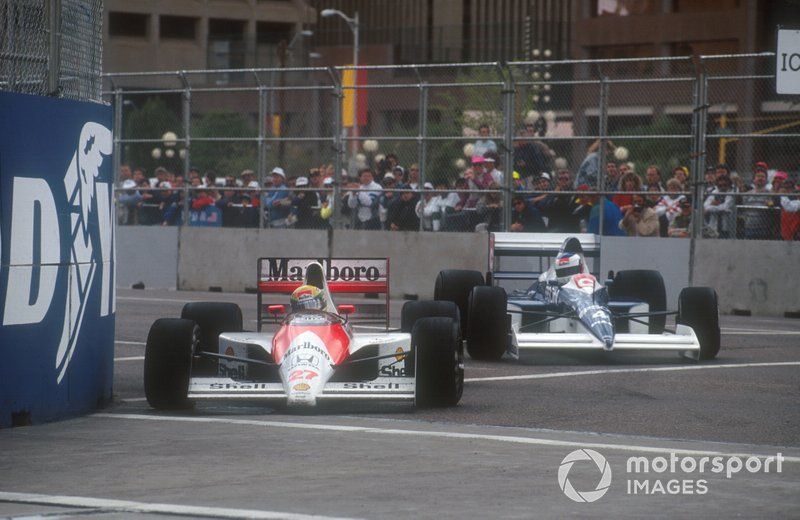
Ayrton Senna, Mclaren MP4/5B Honda leads Jean Alesi, Tyrrell 018 Ford
Photo by: Motorsport Images
Phoenix, 11 March
Winner: Ayrton Senna (McLaren MP4/5B)
Lap leaders: 2
This race is remembered for Jean Alesi’s spirited battle with Ayrton Senna. In just his ninth world championship race start, fast-starting Alesi grabbed the lead from poleman Gerhard Berger at the first corner and led nearly half of the 72 laps.
Strong Pirelli qualifying rubber had helped create an unusual-looking grid, with Pierluigi Martini’s Minardi on the front row, Andrea de Cesaris third in a BMS Scuderia Dallara and Alesi next.
Hampered by a misfire in qualifying, Senna quickly rose from fifth to third in the race and moved into second when team-mate Berger crashed. At that stage Senna trailed Alesi by more than eight seconds.
The gap didn’t come down for a while, but eventually the Goodyear-shod McLaren started closing on the acrobatic Tyrrell. Ken Tyrrell’a team hadn’t won a race for more than six years and Senna’s progress to the front seemed inevitable, but Alesi was in combative mood.
On lap 34 Senna got a run down the start/finish straight and duly took the lead into the first right-hander. But as he moved over to the right to take his line for the subsequent left, Alesi stuffed the Tyrrell down the inside to retake the lead. It was a cheeky move that won Alesi a lot of fans.
Next time around, Senna tried again and this time held the McLaren to the left to prevent a repeat. That put him off line and Alesi almost squeezed ahead into the left-hander at Turn 3.
Thereafter Alesi fell away, but he still took a famous second, well clear of Thierry Boutsen’s Williams. “Alesi was driving very well, aggressive and precise – it was exciting,” said Senna.
9. 1958 Argentinian GP
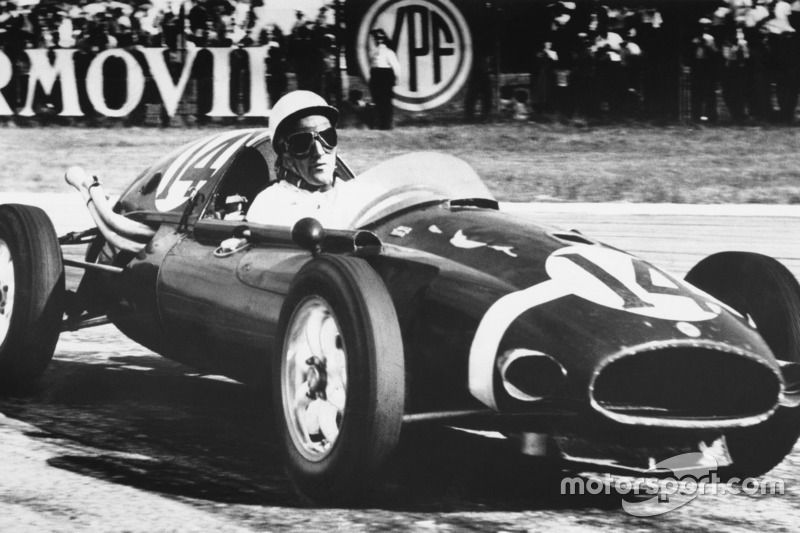
Stirling Moss, Cooper-Climax
Photo by: Motorsport Images
Buenos Aires, 19 January
Winner: Stirling Moss (Cooper T43)
Lap leaders: 4
A race that falls into the surprise and tense category rather than pure entertainment. Most British teams weren’t ready for the 1958 opener, following F1’s move to commercially available fuel, and only 10 cars lined up.
Reigning world champion Juan Manuel Fangio’s Maserati took pole, ahead of Ferrari drivers Mike Hawthorn and Peter Collins. No surprises there, but the expected Maserati-Ferrari fight was overshadowed by the car starting seventh: the Cooper of Stirling Moss, 2s off pole.
Moss harassed the bigger, front-engined cars from the start, completing lap one in the lead pack. They couldn’t shake off the tiny Cooper in the early jostling and, on lap 21 of 80, Moss moved into second. When Fangio came in for his pitstop, the Rob Walker-run Cooper took the lead.
The Italian teams now waited for the leader to stop. And they waited. And waited, particularly as the Walker team busied themselves as if preparing for a pitstop. Fangio hit engine trouble and too late Ferrari realised that the Cooper was running non-stop, Luigi Musso and Hawthorn charging to close on the leader.
Even driving through oil patches to protect the tyres, Moss could see things getting worse and worse as the rubber went down to the carcass. But everything held together and Moss took a remarkable victory by 2.7s, the maiden world championship success for Cooper and the first for a rear-engined machine.
8. 2022 Bahrain GP
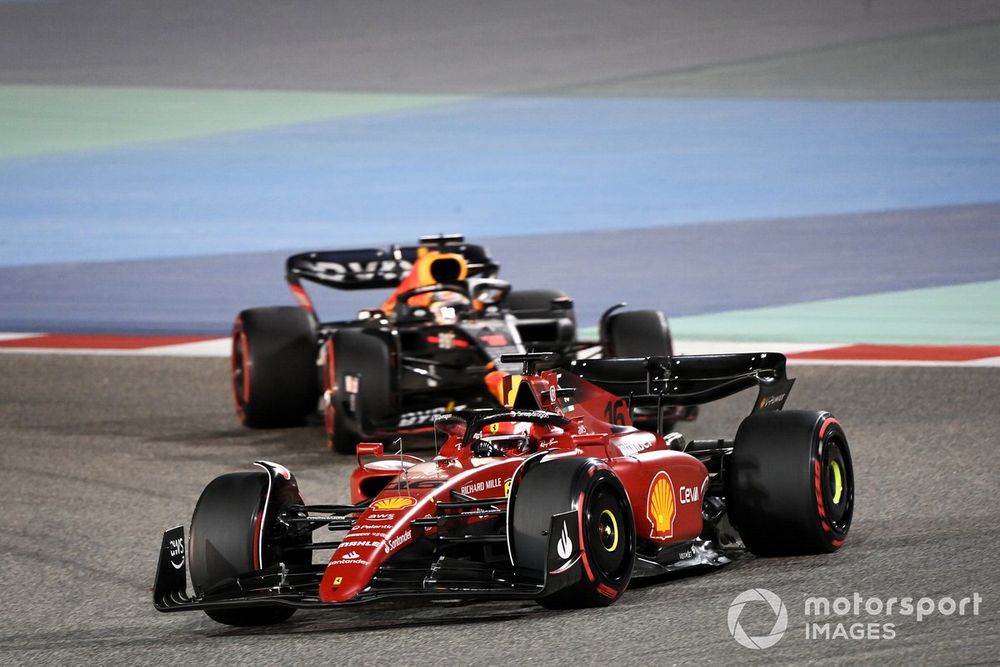
Charles Leclerc, Ferrari F1-75, Max Verstappen, Red Bull Racing RB18
Photo by: Mark Sutton / Motorsport Images
Bahrain, 20 March
Winner: Charles Leclerc (Ferrari F1-75)
Lap leaders: 2
This was all about reigning world champion Max Verstappen versus Ferrari’s Charles Leclerc – and the battle indicated that perhaps F1’s new ground-effect era would feature some great racing.
Leclerc took pole but just over a tenth covered the Monegasque, Verstappen and the second Ferrari of Carlos Sainz. The top two soon pulled clear, with Leclerc initially edging away from the Red Bull before the first pitstops.
Verstappen pitted first and was much closer once both had been serviced, launching a series of attacks on the Ferrari down the start/finish straight and into the first corner. On the first two occasions he got by before the DRS detection line (Leclerc deliberately making sure of that on the second try), so Leclerc got DRS on the next straight and squeezed back by into Turn 4, once on the outside, then on the inside.
On the third try, Verstappen, already dealing with overheating brakes, left it later and dived by the Ferrari after the DRS line into Turn 1. But he locked up, ran wide and the Ferrari again slipped by. Leclerc then managed to inch away once more.
Leclerc again pitted a lap later than Verstappen at the second stops, but this time had a slightly better cushion. Verstappen then started suffering with a steering issue thanks to a bent trackrod.
Pierre Gasly’s AlphaTauri caught fire and caused a virtual safety car, which became a full safety car. Despite a poor restart, Verstappen narrowly held off Sainz until problems with his fuel system, which forced him to retire with three laps to go.
To add to Red Bull’s woes, Sergio Perez started having engine trouble, causing him to spin on the final lap. That allowed Lewis Hamilton’s Mercedes to snatch the final podium spot behind a Ferrari 1-2.
7. 1967 South African GP
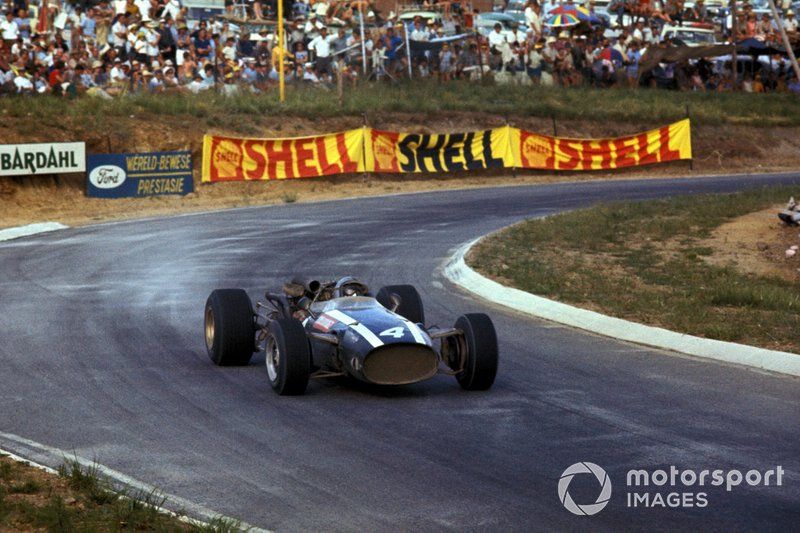
Pedro Rodriguez, Cooper Maserati T81
Photo by: Sutton Images
Kyalami, 2 January
Winner: Pedro Rodriguez (Cooper T81)
Lap leaders: 3
This was almost one of the biggest upsets in motorsport history thanks to privateer John Love, driving an underpowered 2.7-litre Cooper-Climax T79.
“One of the most exciting GPs for many years,” said Autosport magazine’s report of the race that kicked off the second season of the three-litre F1 formula. It was so early that practice began when it was still 1966!
In front of what was reported as the largest crowd to attend a sporting event in Africa, reigning world champion Jack Brabham started from pole. Love, in the middle of a run of six consecutive South African F1 entries, had qualified a fine fifth, 1.2s adrift.
Love fell back early on as the Brabham of Denny Hulme took command. Love battled Dan Gurney and Jo Siffert, gradually moving forward as the 80-lap race progressed.
He was helped by misfortunes for some as the heat took its toll – Jim Clark’s Lotus-BRM had fuel system trouble, Pedro Rodriguez’s Cooper had a couple of offs, the Cooper of Jochen Rindt retired with engine issues – but he was also running competitively.
By half-distance, Love was up to third and that became second when Brabham hit engine trouble. The dominant Hulme was almost a minute ahead and looked set to win until the dramatic final stages.
Hulme suddenly dived into the pits to have fluid added to his braking system, and crushed ice was put in his header tank. As the New Zealander sat in the pits, Rhodesian Love swept into the lead, with Rodriguez 22.8s behind.
Despite his engine sounding rough, Love had enough pace, but his little Cooper didn’t have enough fuel. With seven laps to go, he dived into the pits and, by the time he got back out, Rodriguez was long gone.
And so, Rodriguez scored his first world championship victory, the first by a Mexican, and Cooper’s 16th – and last. Love was a gallant and popular runner-up.
6. 1982 South African GP
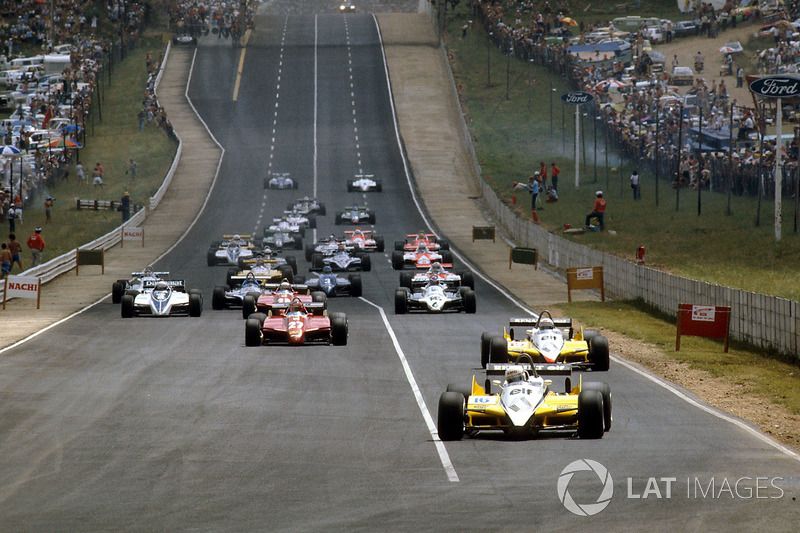
Start: René Arnoux, Renault RE30B and teammate Alain Prost, Renault RE30B lead the rest of the field
Photo by: Motorsport Images
Kyalami, 23 January
Winner: Alain Prost (Renault RE30B)
Lap leaders: 2
What could be more dramatic than a drivers’ strike? How about someone coming from a lap down to win? The 1982 South African GP was certainly unusual.
Once the Niki Lauda-led strike over new superlicence terms had been ‘resolved’ sufficiently for cars to hit the track, the turbo cars dominated at high-altitude Kyalami. Rene Arnoux’s Renault took pole from Nelson Piquet’s Brabham-BMW and Gilles Villeneuve’s Ferrari. The top Cosworth DFV runner – Keke Rosberg in his first Williams drive – was 2.5s slower.
Arnoux held the advantage at the start, while a poor getaway from Piquet helped Alain Prost shoot through from fifth on the grid to form a Renault 1-2. Arnoux and Prost pulled away and the other turbocharged frontrunners soon fell by the wayside. Piquet went off, Villeneuve’s turbo failed and Riccardo Patrese’s BMW engine lost oil pressure.
When Arnoux was delayed in traffic, Prost took the lead on lap 14 of 77. Prost then opened a small cushion and appeared in control of a race that looked like it might fizzle out.
But then the leading Renault suffered a frightening moment at the high-speed Jukskei as a puncture struck on lap 41. Prost caught it and cruised back to the pits, falling to eighth and a lap down before getting back on track.
He immediately started setting fastest laps – his best would end up being 1.5s faster than anyone else’s – as he scythed through the field. With Arnoux suffering tyre problems of his own, Prost took more than a minute out of his team-mate. Incredibly, Prost retook the lead on lap 68.
A struggling Arnoux lost out to Carlos Reutemann’s Williams in the closing laps, while Lauda – returning after two years away from F1 – took fourth for McLaren from 13th on the grid.
The strange weekend finished with the stewards announcing that all but Jochen Mass, Teo Fabi and Brian Henton would have their licences suspended for the strike action. The season had plenty more controversy to come…
5. 2025 Australian GP
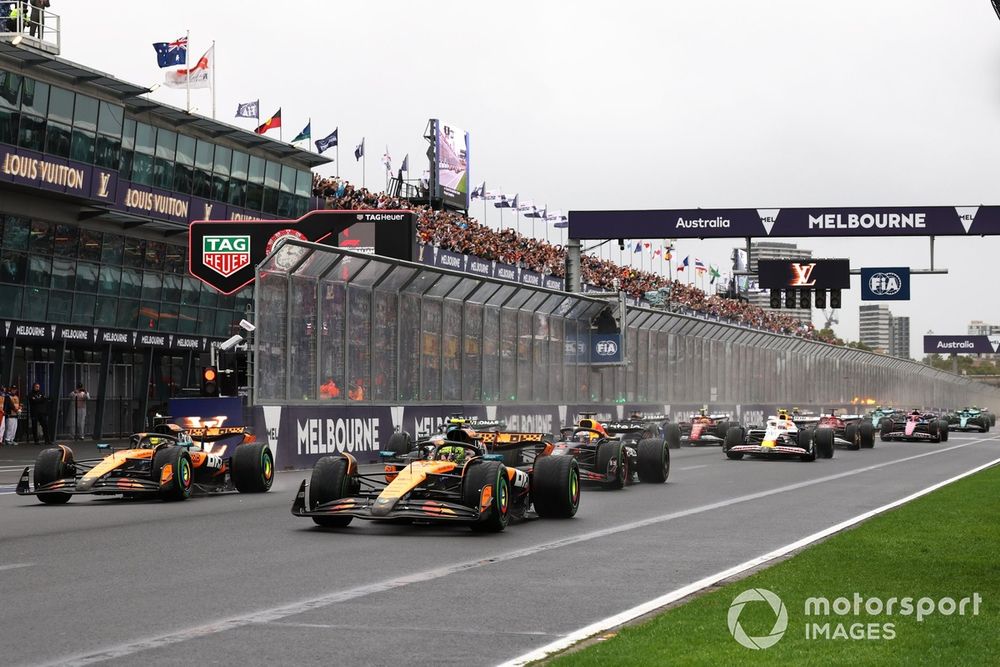
Lando Norris, McLaren
Photo by: Steven Tee / Motorsport Images
Melbourne, 16 March
Winner: Lando Norris (McLaren MCL39)
Lap leaders: 3
McLaren seemed to have carried over its advantage from the end of the previous season to the 2025 opener after qualifying 1-2. But rain on race day made things tougher than expected.
Rookie Isack Hadjar underlined how tricky things were by crashing on the formation lap and the conditions would claim five other cars before the day was done.
Up at the front, Verstappen moved his Red Bull ahead of Oscar Piastri to chase poleman Lando Norris before Jack Doohan crashed and brought out the safety car, under which Sainz dropped his Williams.
After the restart, Verstappen started to struggle on his hard-worked intermediates as the track dried and he ran wide, allowing Piastri into second.
The momentum ebbed and flowed between Norris and Piastri until, now on slicks, the leaders found rain at Turn 14. Both McLarens went off but, whereas Norris gathered it together quickly before pitting for intermediate tyres, Piastri spun out of contention.
Despite a late safety car, Norris held on to defeat Verstappen by 0.9s, with George Russell completing the podium and his rookie Mercedes team-mate Kimi Antonelli fourth after starting 16th.
Piastri recovered to ninth, brilliantly going around the outside of Hamilton’s Ferrari on the final lap.
4. 1977 Argentinian GP

Jody Scheckter, Wolf WR1 Ford
Photo by: Motorsport Images
Buenos Aires, 9 January
Winner: Jody Scheckter (Wolf WR1)
Lap leaders: 4
This one falls more into the shock category than being a great race, given the level of unreliability and unpredictable result. Despite starting 11th, Jody Scheckter came through to win for Wolf – in the team’s first F1 race.
John Watson was the star of the weekend in the improved Brabham-Alfa Romeo. He grabbed the lead from poleman James Hunt’s McLaren at the start and initially pulled away. But his tyres soon started to go off in the sweltering Buenos Aires heat and Hunt closed back in.
On lap 11 of 53 the reigning champion moved ahead. He looked comfortable until a suspension breakage pitched him off shortly after half-distance.
That put Watson back in front, but he now had team-mate Carlos Pace right behind. As the gearbox and rear suspension on his Brabham started to come apart, Watson struggled and Pace moved to the front.
But the Brazilian was soon suffering from heat exhaustion in the blistering conditions and he struggled to keep going. With Watson out, Scheckter – whose best lap was more than a second off the fastest – was now second and catching the Brabham.
The Wolf grabbed the lead with just over five laps to go and Scheckter crossed the line 43.2s ahead of Pace, who collapsed after the finish. Carlos Reutemann’s Ferrari almost caught the Brabham and might have done had he not previously suffered a spin and started to run out of fuel on the final tour.
3. 1989 Brazilian GP

Nigel Mansell, Ferrari 640
Photo by: Sutton Images
Rio, 26 March
Winner: Nigel Mansell (Ferrari 640)
Lap leaders: 3
McLaren had won 15 from 16 races in 1988 and the Ferrari 640, complete with pioneering semi-automatic gearbox, could barely hold together for a handful of laps in testing. A surprise in Rio looked unlikely, particularly as Senna’s McLaren took pole, 0.9s ahead of Patrese’s Williams.
But the race had drama from the off. Senna did not make one of his better starts and immediately had Patrese alongside. That was fine, but then the fast-starting Ferrari of Berger made it three wide into the first corner. Nobody backed off; the Ferrari and McLaren made contact, putting both out of contention.
Patrese therefore led at the end of the opening lap, chased by team-mate Boutsen and the Ferrari of Nigel Mansell, up from sixth on the grid. The Ferrari soon overtook Boutsen and closed the gap to Patrese, sweeping past the Williams with a touch of the grass on lap 16 of 61.
After the first round of tyre stops Mansell ran second to Prost’s McLaren, which had stopped early after starting fifth. But the Frenchman couldn’t outpace Mansell, who closed in and took the lead again on lap 28 – his gearbox surprisingly still working!
In typical Mansell style, there was still time for drama. He shot into the pits again – to have five wheels changed, his steering wheel having worked loose.
That put Prost back into the lead, but clutch problems meant he was now trying to get to the end without another tyre change. Just over two laps after stopping, Mansell repassed the McLaren to take the lead for the third and final time.
Against expectation, Mansell reeled off the closing laps to take a famous victory on his Ferrari debut, 7.8s clear of Prost. “It’s the most laps the car has done, ever!” said Mansell.
2. 2002 Australian GP
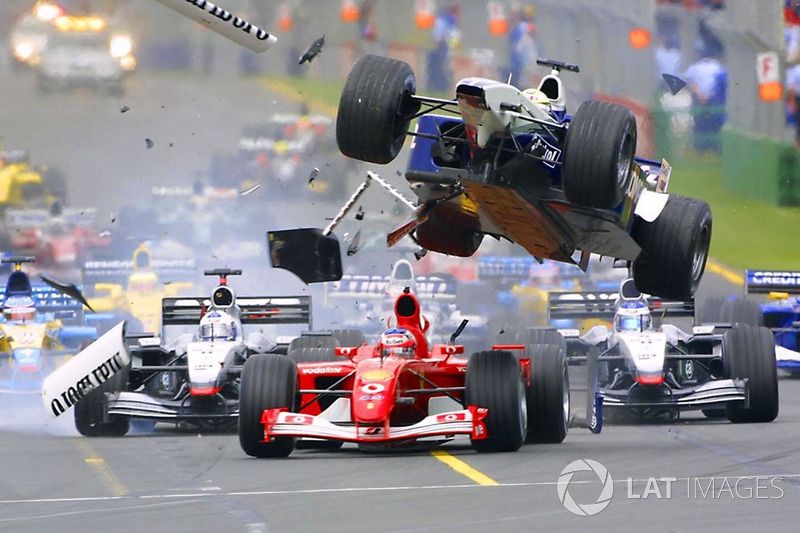
First corner accident: Ralf Schumacher, Williams flying over Rubens Barrichello, Ferrari
Photo by: Motorsport Images
Melbourne, 3 March
Winner: Michael Schumacher (Ferrari F2001)
Lap leaders: 3
If we’re talking drama, the 2002 Australian GP delivered from the start. Poleman Rubens Barrichello’s move across to the left as the pack arrived at the braking zone caught out Ralf Schumacher, who launched his Williams over the back of the Ferrari, triggering a multi-car accident that put eight out.
Surprisingly given the carnage, there was no red flag and the survivors, led by David Coulthard’s McLaren, followed the safety car until lap six of 58. At the restart, a small error from Juan Pablo Montoya allowed Michael Schumacher’s Ferrari into third and the Ferrari gained another place when Jarno Trulli crashed his Renault.
That brought out the safety car again, eroding the 6.7s lead Coulthard had already built. The Scot then went off before the restart thanks to a gearbox glitch and Montoya jumped Schumacher on the run down the start/finish straight – the third leader in two corners.
But the Bridgestone-shod Ferrari soon looked quicker and pressured the Williams (on Michelins), outfumbling the Colombian at the right-left at the start of lap 17.
Schumacher pulled away as he headed to victory and the race settled down, but there was still action to come.
Coulthard’s gearbox problem got worse before failing and Jacques Villeneuve’s BAR crashed when the rear wing broke, while Kimi Raikkonen took third in his first race for McLaren despite having to pit to get debris removed and a couple of offs. Eddie Irvine finished fourth in a Jaguar that had lined up on row 10, but the feel-good storyline involved a rookie.
Home hero Mark Webber kept his head to overcome a slow refuelling stop and a late challenge from Toyota’s Mika Salo to take a popular fifth for Minardi, the team’s first points finish for more than two years. It was that sort of race.
1. 2003 Australian GP

Michael Schumacher, Ferrari F2002, runs wide as he battles with Kimi Raikkonen, Team McLaren Mercedes MP4/17D
Photo by: Steve Etherington / Motorsport Images
Melbourne, 9 March
Winner: David Coulthard (McLaren MP4-17D)
Lap leaders: 4
Poleman Michael Schumacher led Ferrari team-mate Barrichello from the off, in damp-but-drying conditions. Some started on wet tyres but there were a few gamblers, including Williams driver Montoya, who dropped from fourth to third on lap one.
Once his rubber was up to temperature, Montoya moved forward, driving past Nick Heidfeld’s Sauber for third on the start/finish line at the end of lap two. At that same moment, Coulthard dived into the pits to switch to dry tyres. The McLaren rejoined in 20th and last…
Montoya started taking huge chunks of time out of the leading Ferraris before Barrichello crashed. Schumacher finally dived into the pits for dry tyres just before Ralph Firman crashed and brought out the safety car. It was a slow stop and meant Schuey was sixth come the restart, just ahead of the recovering Coulthard.
Montoya led Trulli’s Renault as racing resumed. When the leaders made their fuel stops, Raikkonen – who’d started from the pitlane after a late switch to dry tyres but got most of the time back thanks to the safety car – moved ahead and the McLaren led the train during another safety car period caused by Webber’s Jaguar coming to a halt with suspension failure. The safety car had minimised Montoya’s time loss, and he started a charge while Schumacher pressured Raikkonen, with Coulthard now third.
Schumacher couldn’t make it by, and Ferrari called him in on lap 29 of 58. Raikkonen came in four laps later, handing Montoya the lead but maintaining track position over Schumacher.
The Ferrari again attacked, Raikkonen showing him the grass at the first corner before having to come in for a stop/go penalty for speeding in the pitlane thanks to a software problem. Schumacher thus took the lead when Montoya pitted for the final time on lap 42 – though only for fuel, not fresh tyres.
But the Ferrari still had another stop to make and started shedding bits after Schumacher had a small off. When Schuey came in, Montoya retook the lead with just 12 laps to go. Crucially, Coulthard was also close enough to take second.
That meant it was the McLaren that benefited most when Montoya spun away his 2.7s lead at the start of lap 48.
And so, having been last at the end of lap three, Coulthard took the flag first an hour and a half later to take his 13th and final F1 victory, with Montoya second. Raikkonen held off Schumacher for third despite his penalty and a subsequent excursion.
For more top 10s, subscribe here.
We want your opinion!
What would you like to see on Motorsport.com?
– The Motorsport.com Team
Disclaimer : This story is auto aggregated by a computer programme and has not been created or edited by DOWNTHENEWS. Publisher: motorsport.com