

Indian law does not allow for dual citizenship, so Indians are forced to renounce their citizenship if they choose to naturalise abroad. Dr Mihir Nayak told The Local about his experience of becoming German, and how he still feels close to his home.
When Dr Mihir Nayak renounced his Indian citizenship at the Indian Embassy in Frankfurt in 2022, the newly naturalised German citizen asked to keep a souvenir: his Indian passport.
“Normally they take your Indian passport and then they dispose of it,” he tells The Local. Following Mihir’s request to keep it, the official punched holes in his passport to signal that it was no longer valid.
“To have it and to have these two holes there is a constant reminder…your identity has been punctured a little bit,” he says. “Some people say it’s only it’s only a piece of paper but it’s definitely part of your identity.”
It had taken Mihir 19 years in Europe to reach that moment. It wasn’t an easy decision but he was ready for the next step. He went on to not only vote in the 2025 German election, but stand in it too.
‘Go back to where you came from’
The 40-year-old, who was born and brought up in Bangalore and with family from Goa, first arrived in Europe in the early 2000s. He studied at the tourism school in Salzburg, graduating with top marks.
But when he applied for a work permit, he faced an unfriendly encounter at the immigration office.
“I don’t know how it is today, but in those days, it was completely dependent on the person you got. So I got bad luck.
“She looked at my grades… she said, ‘you are from India.’ I said, ‘yes’. And she said, ‘what are you doing here? Go back to where you came from’… and that was the end of the interview,” recalls Mihir.
Mihir now sees it as a policy failure. Years of study, much of it subsidised by the Austrian state, appeared to count for nothing.
“In that moment, she sort of just threw away €50,000 or €75,000 of taxpayer money that had gone to educate me,” he says.
Undeterred, Mihir studied in the UK before moving back to Austria for further education and then came to Germany in 2014.
“I went across the border to Germany, where thanks to Mutti (former Chancellor Angela Merkel), they were very welcoming,” he says. “They said, ‘of course, yes, you have a job, no problem.'”
He began teaching tourism – later moving into sustainability – and eventually became a professor in Cologne where he stayed for around eight years before moving to Vienna around a year ago.
Photo courtesy of Mihir Nayak
’19 years and 5.2 kilograms’
When Mihir talks about his German citizenship journey, he often introduces it with two numbers: “One is the 19 years that I took to get citizenship and the other is 5.2 kilograms, which is how much paper I had to send in.”
Mihir applied during the pandemic, when documents had to be submitted by post. The stack of paperwork weighed in at over five kilos.
“It was 5.2 kilograms of paper that I had to send in,” he says. “That’s always a number that makes people smile and then sort of cry a bit.”
At the time of his naturalisation, Germany didn’t yet allow everyone to hold multiple nationalities – that came during the reform in 2024. However, for Mihir – and other Indian nationals – the rule change doesn’t make a difference. Indians have to part with their home citizenship if they naturalise abroad.
“I had decided that I was going to do this but there is definitely this sadness of having to choose or having to relinquish one part of yourself; sort of cutting out this is one part of yourself,” he says.
READ ALSO: Why Indians in Germany face hurdles to citizenship
An unusual first time voting
Becoming a German national gave Mihir the chance to vote and stand in elections. He was a listed candidate for the pan-European party Volt in the 2024 European elections, and he stood in Cologne in the German federal elections the following year.
Although he didn’t succeed, a moment he says he will never forget is standing at a kebab stand in the constituency during the campaign trail chatting to voters of all ages.
He also had an interesting first voting experience.
“I became a citizen in ’22 so the ’25 election was the first time I was able to vote and I was also able to vote for myself,” he says. “Seeing my name and putting the mark next to it was very cool.”
Inspired in part by his personal experience, Mihir advocated for easier legal migration pathways, streamlined citizenship and easier access for foreigners to work visas.
German and Indian, despite everything
Mihir feels German. He supports the German women’s football team. He stands up and sings the German national anthem when he hears it. But he still feels Indian even though he had to officially give this up.
“You’re never really neutral,” he says. “If India is playing Australia… you’re going to be cheering for the Indian team.
“There are definitely those strings that can never be cut.”
He’s happy that India and Germany do not play against each other much in sport so he can stay faithful to the countries that have a place in his heart.
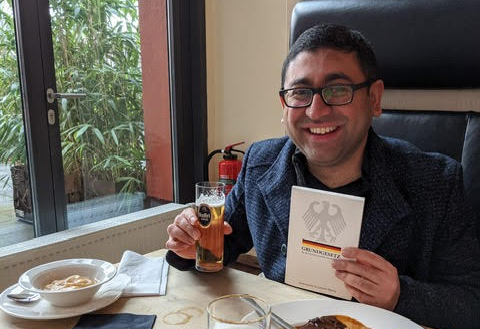
Mihir Nayak holds the Grundgesetz document and a beer after becoming German. Photo courtesy of Mihir Nayak.
When he visits India, he uses the OCI card, which allows former citizens to travel and live in India after they have renounced their citizenship, although it does not offer the same rights held by citizens.
He faced a reality check when visiting India for the first time with his German passport. “You don’t get sort of waved through back into your own country,” he says.
At a hotel, staff were confused by his German passport and paperwork. “[The man working there] looked at me and he’s like, ‘when I saw you, I thought you were Indian’. But then he suddenly saw the passport and he’s like freaking out,” says Mihir.
READ ALSO: ‘Germany needs you’ – Labour Minister’s plea to skilled workers from India
Feeling at home in Germany and Europe
Even though naturalising as German – and giving up Indian citizenship – was “very, very difficult”, Mihir says it was worth it.
For instance, it’s easier for him to travel in Europe, and he has the chance “to have a say here” through voting rights.
But it’s also about belonging and becoming part of another country.
He reiterates that a passport may be “like a piece of paper, sometimes with two holes in it, sometimes without”.
Ultimately Mihir says it makes a difference: “Identity is a complicated thing. It’s a sentimental thing.”
He says having a German passport “reminds you that you are a citizen here and that sort of makes you feel more at home here”.
Mihir, who is currently based in Vienna doing grassroots work with communities as well as teaching around Europe, hopes in future the rules will change to allow Indians to hold multiple nationalities.
But he says becoming German is “definitely worth it” for anyone who is planning to stay in Germany or Europe long term, “to be part of this society”.
Disclaimer : This story is auto aggregated by a computer programme and has not been created or edited by DOWNTHENEWS. Publisher: thelocal.de



