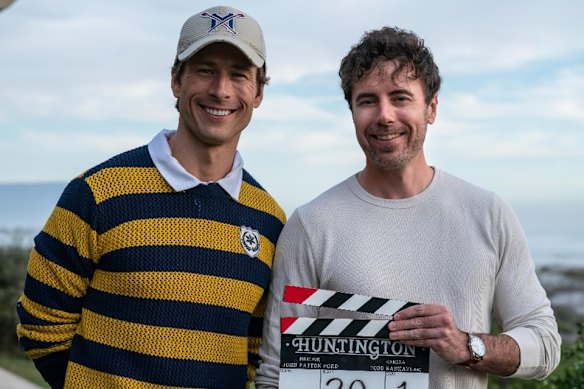

John Patton Ford sometimes feels like he was raised in a cult – but one of material rather than spiritual or intellectual ambition. Born in the 1980s, the US filmmaker was told time and again to “earn more” and “achieve more” to create space for himself in the world. In this “cult”, bigger always meant better.
So, he became fixated on achieving his ultimate professional goal: to direct successful movies. His life, he says, became all about the pursuit.
That meant starting small, from making deliveries for catering companies to selling knives door-to-door. It was during the latter job that one speech about “turning his conscience off” changed his trajectory.
“Someone sat us down and said your conscience is an enemy,” recalls Ford. “It’s going to tell you this fairytale about what’s right and wrong, and who are you to say what’s right and wrong? You need to just turn that off, and then suddenly you’ll be capable of all kinds of things, and you’ll achieve success.
“He wasn’t trying to be dark, he wasn’t trying to be funny, he wasn’t trying to be polarising. He just said it in this banal way, like he was saying any fact … So, I just got up and left.”
That moment eventually inspired his second feature film, How to Make a Killing. Loosely based on the 1949 British black comedy Kind Hearts and Coronets, Ford’s film follows a disowned son named Becket (Glen Powell) who decides to kill off every member of his wealthy bloodline to reclaim his inheritance.
There’s a lot of himself in Becket, Ford says. There was also a lot of himself in the flawed protagonist of his critically lauded debut film, Emily the Criminal, in which Aubrey Plaza’s character commits credit card fraud to pay back her crippling student debt.
“The idea of someone just doggedly pursuing something to the point where they’re just throwing all ethics out the window to achieve it – I feel like that’s my story,” he says. “Not that I killed people, committed credit card fraud, or did any of the things my characters have done. But I did do everything else to get a movie career going, and now I’m like 40, looking back like, ‘Whoa, what was that about? What got planted in me so early that made me so bloodthirsty?’”
While he didn’t intend for How to Make a Killing to be an “eat the rich” story, he says many viewers have considered it so, probably because such films are common. For example, Parasite, Triangle of Sadness, Ready or Not – all of which explore the absurdity of extreme wealth divides. But Ford says he was less interested in class-based revenge and more in the attitudes of successful people.
Powell’s Becket was the ideal vessel through which to explore this. Beginning as a retail worker, he becomes obsessed with reclaiming the wealth he believes was “stolen” from him when his mother was ostracised by the Redfellow empire. As his success and net worth slowly climb throughout the film, he becomes increasingly cutthroat, his conscience weakening with each scene.
“Very often, at least in the US, there are many sociopathic things that successful people do that have been normalised and that are easy to criticise, yet those things have led to great wealth and success,” Ford says. “So, it becomes complex. You can’t fault them for it – it worked for them. Yet, wow, it’s dark.”
Powell couldn’t have been more perfect for this role, Ford notes. His “irrepressible goodness” in real life combined with his character’s descent into criminality created a delicious irony that also spoke to how “normal” successful, sociopathic people often appear.
In contrast to Becket and the film’s other sociopathic characters is Ruth (Jessica Henwick), a teacher who believes in the value of humility and modest dreams. She challenges Becket to dream a little smaller.
Was she the proverbial Greek chorus, warning of the dangers of dreaming too big? Was she one of the lucky ones to escape the “cult” of ambition in which those like Ford were raised? Perhaps, Ford says, but then again, he wouldn’t have just made a film with Glen Powell if he had dreamt smaller.
“There’s so much of me in every one of these characters,” he says. “There’s a Ruth in me that’s like, ‘I could have had a simpler life and been just as content.’ And then there’s someone else in me that’s like, ‘That’s for cowards.’ There’s a yin and a yang, and I think my life will always be trying to reconcile those two.”
Must-see movies, interviews and all the latest from the world of film delivered to your inbox. Sign up for our Screening Room newsletter.
 Nell Geraets is a Culture and Lifestyle reporter at The Age and The Sydney Morning Herald.Connect via X or email.
From our partners
Disclaimer : This story is auto aggregated by a computer programme and has not been created or edited by DOWNTHENEWS. Publisher: www.smh.com.au