There are few things both a 60-year-old and six-year-old can relate to these days. As technology advances and culture shifts, an ever-widening gulf seems to separate the generations. But sing the Play School theme song, and it’s almost certain they’ll both be smiling from ear-to-ear.
“There’s a bear in there, and a chair as well. There are people with games, and stories to tell,” the familiar tune goes. It’s a jingle that hasn’t changed since 1966, when the ABC first aired the beloved children’s television show. Since then, it has become the defining soundtrack of an Australian childhood for generations.
Now six decades on, Play School is the country’s longest-running children’s series, and the second-longest-running children’s show in the world (it’s just behind the UK’s Blue Peter, which first aired in 1958). Its premise has remained the same throughout its tenure: to encourage curiosity and imagination through gentle, interactive storytelling and play.
“It’s always been child-centred,” says Leah Vandenberg, who joined Play School as a presenter in 2000. “As our wise producer has said, it’s ‘play’ first and ‘school’ second. Those tenants haven’t changed in 60 years. It’s always been about seeing the world through the child’s eyes.”
Since the beginning, bright colours have welcomed children into a creative space filled with iconic toys like Big Ted and Little Ted, Jemima and Humpty. Different shaped windows have transported little ones to the real world, and everything on-set continues to feel slightly homemade.
But while little has changed on the show, the world around it has changed immensely. Streaming and social media have fragmented viewing habits, and our collective attention span continues to shrink. So, how has this simple, low-fi show managed to remain so popular for 60 years and counting?
An exhibition at the Australian Centre for the Moving Image (ACMI) seeks to answers this, though with a slight twist. In collaboration with the ABC, Play School: Come and Play! shines a light on the nuts and bolts of a Play School episode.
“We’ve taken the core pillars of play-based learning that have existed within the series since its inception and injected them into the gallery in a fresh, modern way,” says the exhibition’s curator Chelsey O’Brien. “We thought about who’s watching Play School now, and where screen literacy begins.”
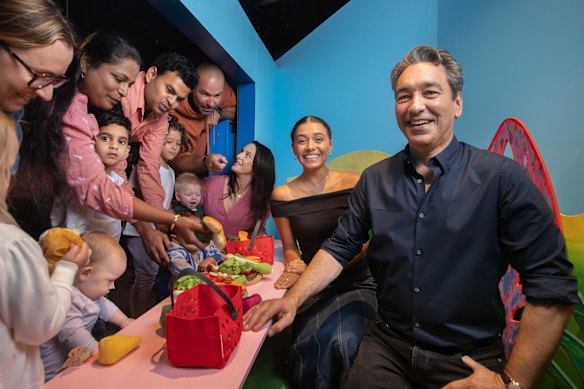
Young visitors will journey through different parts of the production process, interacting with the set as a presenter, camera-operator or director. Meanwhile, parents and older visitors will receive a healthy dose of nostalgia through familiar faces like Big Ted, and a musical loop created by Play School’s very own musical director.
“If you told my four-year-old self that I was going to work with Play School and make a playful exhibition, I think my little brain would have exploded,” O’Brien says. “It was a show that was so close to my heart.”
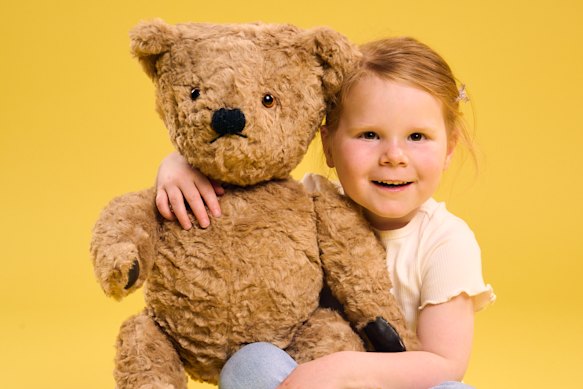
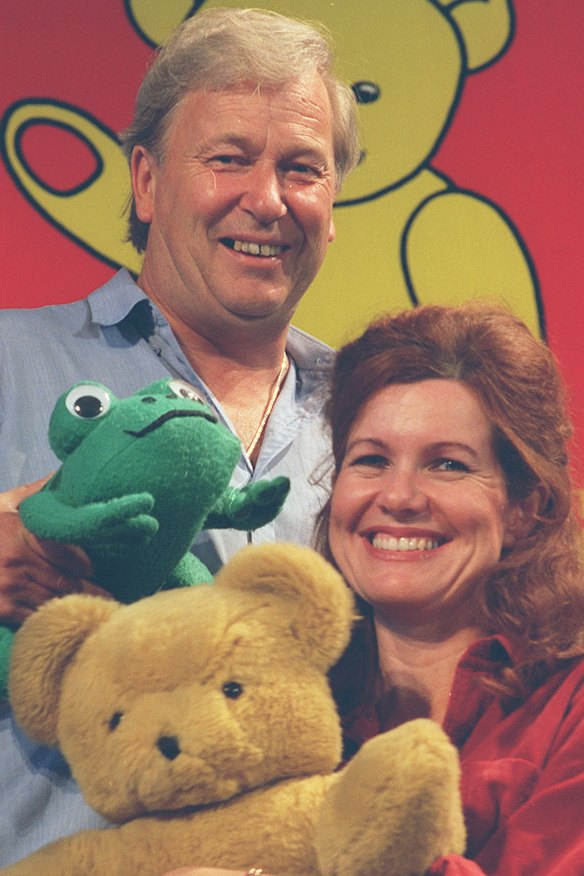
O’Brien is far from alone. One of the reasons why Play School has resonated so deeply across generations is because of how it speaks with, not to, children. Ever since Diane Dorgan and Alister Smart landed on set in 1966, followed by other iconic names like Don Spencer, Patsy King, “Naughty John” Hamblin, and Benita Collings, Play School’s warm, welcoming presenters have been a signature element.
“Play School doesn’t ever patronise or come across like a teacher-child relationship. We’re communicating with the child at that child’s level,” Vandenberg says. “When you think about other children’s programs 60 years ago, you could say there’s a tone of voice that was particularly parental or ‘teacherly’. But Play School has always been, ‘let’s get down in the mud and play together.’ It’s a conversation.”
A simple, yet effective, example of this is the show’s common opening line: “Hello”. It’s short and sweet, yet it makes it immediately clear that the presenters aren’t speaking to an indeterminate group of kids, rather they’re speaking directly with one child.
Most episodes would begin this way before following a similar pattern – checking the clock, looking through the windows, creating something and story time. There’s a comfort in this predictability, O’Brien says, particularly for children who generally crave structure.
It’s within this comfortable familiarity that children have been able to discover their own identities, says Play School presenter Alex Papps, who has worked with the show for two decades.
“More than ever, the message of Play School is: Don’t look outside of yourself, but look within and around you for simple ways of using your imagination, having fun, discovering your own creativity,” he says. “It represents a short period in a small person’s life when nothing is expected of you other than to be totally who you are … I think that’s more important now than ever.”
In fact, Papps believes Play School is one of the last bastions of longer conversation involving children. As useful as technology is within education, he says it has largely primed us to constantly seek out the “next shiny thing”.
“Nowadays, there are so many streaming platforms, and they all want us to keep watching,” Papps says. “It panders to the worst aspects of humanity, frankly. But before our young audience is exposed to technology on a wider scale, Play School exposes them to a slower, more gentle, longer conversation between the presenter and the child.”
The topic of these conversations run the gamut – from balloon experiments to “painting sounds”. But many episodes have also been sprinkled with larger life lessons, those which may otherwise be relatively difficult to broach with small children between daily tasks. Papps notes a particular episode in which he drew on his own experience of losing his grandmother to explain “beginnings and endings”, aka life and death, in an age-appropriate, reassuring way.
Overall, Play School is about sitting quietly with yourself, creating things with your hands or exploring new ideas. It has always focused on something children will forever need and want: creativity. Because of this, and the fact that parents, or even grandparents, watched Play School themselves as children, there’s trust in it as a cultural heirloom – it can be passed down to newer generations with confidence it will send the same, dependable message.
That’s not to say the show hasn’t changed at all over time. Vandenberg says it has evolved alongside the shifting experiences of Australian children. For example, about 5.7 million Australians now speak a language other than English at home. So, Play School has reflected this by expanding the number of languages spoken and sung on-air. While it was mainly just English, French and Italian when Vandenberg started about 26 years ago, she says they’re now singing in Hindi, Punjabi and so on. Similarly, Auslan interpreters have also been incorporated into some of the content.
And while it began with a largely Anglo-hetero cast, it has since featured Indigenous, Asian, LGBT and differently abled presenters. Vandenberg herself was born in New Zealand to an Irish-Australian mother and a Fijian-Sri Lankan father. Papps, meanwhile, is Greek Australian.
“My intention is around reflecting the cultural diversity of children in Australia, and making kids feel seen and heard,” Vandenberg says, noting an episode in which she brought Punjabi musicians onto the set to perform on the Dhol (a traditional Indian drum), and the introduction of Kiya, the First Nations toy.
“It’s really just fostering that sense of familiarity. And then when children who aren’t Punjabi go into the community, they go, ‘oh yeah, I know this, I feel more connected. I feel less of a difference.’ As long as we keep evolving with the child’s diverse realities, Play School will continue to be relevant.”
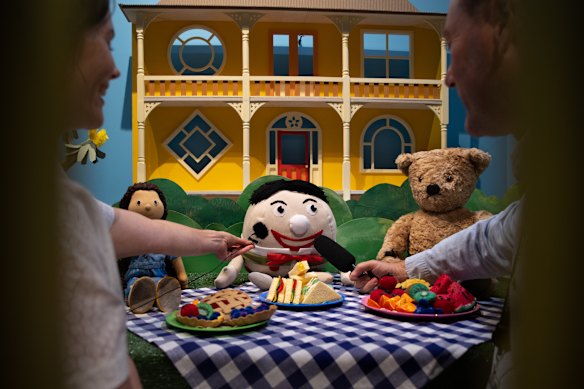
Play School has evolved with the times, Papps says, but it will forever remain the same at its heart. He ultimately likens it to a “stunning table” that has been passed down the generations of a family.
“Lots of different people sit at it, but it still retains its integrity as it’s passed down,” Papps says. “You respect the heirloom – you sit at that table and enjoy your time. You don’t get a hammer and nails, and cover it in gaudy tiles. You maintain it.”
Australian children have so far been sitting at this table for 60 years. If the ACMI exhibition is any indication, they will continue sitting there for many more to come.
Play School: Come and Play! will run at ACMI until July 12 before touring nationally.
Find out the next TV, streaming series and movies to add to your must-sees. Get The Watchlist delivered every Thursday.
Disclaimer : This story is auto aggregated by a computer programme and has not been created or edited by DOWNTHENEWS. Publisher: www.smh.com.au