From voter groups trying to disrupt party politics in Bavaria’s municipal elections to students against military conscription to people placing bets on when DB trains will arrive, here’s what we’re talking about at The Local this week.
Inside Germany is our weekly look at some of the news, talking points and gossip in Germany that you might’ve missed. It’s published each Saturday and members can receive it directly to their inbox by going to their newsletter preferences or adding their email to the sign-up box in this article.
‘Keine partei wählen’ (No party voting).
‘Ohne freie kultur keine demokratie’ (Without free culture, there is no Democracy).
Orange posters with these and other, somewhat cryptic, slogans written in simple back letters have popped up on the streets of Nuremberg in recent weeks, ahead of city elections set to take place on Sunday.
Voters will go to the polls across the south of Germany on March 8th. The neighbouring state of Baden-Württemberg will elect a new state parliament and, crucially, also a new minister-president.
READ ALSO: What’s at stake in Baden-Württemberg’s state election?
Meanwhile in Nuremberg, and other cities across Bavaria, mayors, city councils and district councils are up for election.
Of course these elections wont get nearly as much attention in the national press. But for local residents, the city and district leaders elected may actually have more tangible impacts on their lives than say Chancellor Friedrich Merz, or Bavaria’s Minister-President Markus Söder, despite all the noise those two make.
That’s why it’s interesting to see that, in central parts of Nuremberg, posters belonging to the main party politicians are outnumbered by those with the above slogans, urging voters to look beyond party politics.
And it’s not just Nuremberg. In cities all across Germany’s southern ‘Free State’, non-affiliated voter groups are increasingly taking seats in city councils and directing attention toward issues that directly affect local residents.
Voter groups like these have a long tradition in regional politics in Germany, especially in villages and rural communities. What’s new is their rise in German cities.
On Sunday, a group called “The onion” (Die Zwiebel), with a focus on organic gardening among other issues, is running in Bamberg.
In Regensburg, a group called the Christian Social Citizens (CSB) has split off from the CSU party and has a candidate running for the mayoral seat. Virtually everywhere you look, from Munich to Bayreuth to Passau, there are independent voter groups to be found.
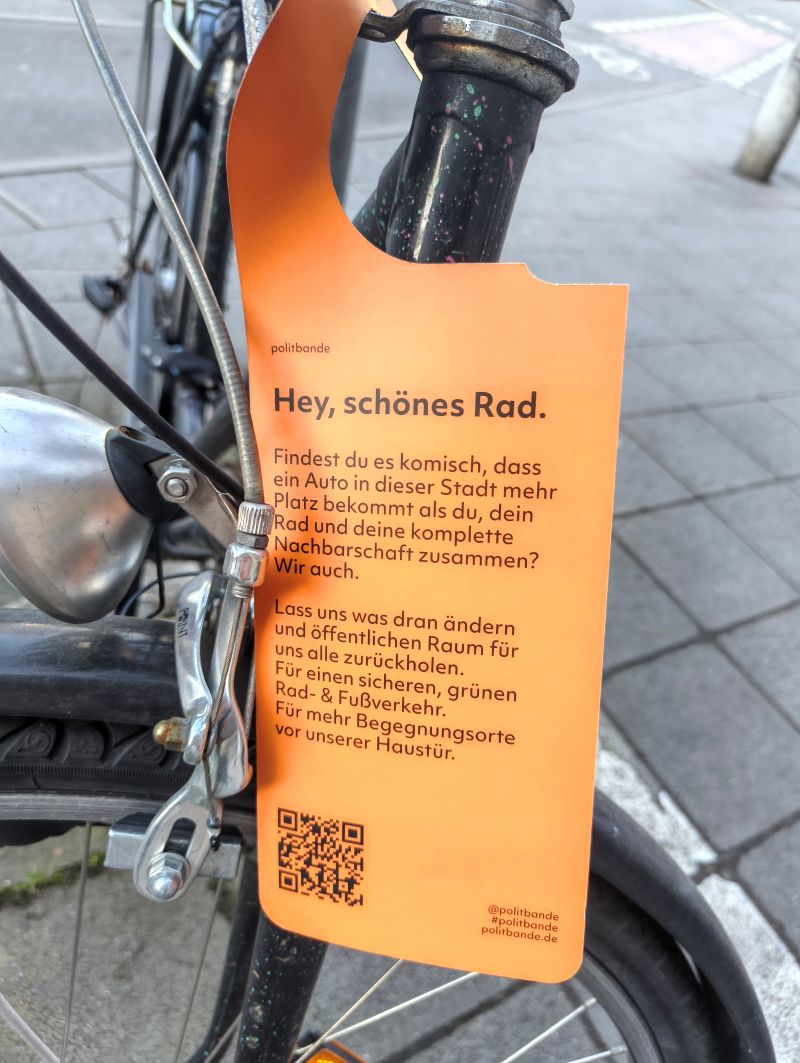
In Nuremberg the group Politbande is responsible for the aforementioned orange posters. According to its mission statement, the group “explicitly sees itself as activist” and identifies as feminist, anti-fascist and anti-racist.
A Politbande flyer says, ‘Hey, nice bike. Do you find it strange that cars get more space in the city than you, your bike and your entire neighbourhood…’ Photo by Paul Krantz.
It’s easy to see the appeal of voting party-free: Too often Germany’s coalition politics seem to amount to voters being told they must accept a bit of what they didn’t vote for, and almost none of what they did. In this sense, the success of more independent candidates could be seen as a step toward a more direct democracy.
On the other hand, if the response results in further splintering of the political landscape into a hundred single-issue groups, that wouldn’t prove to be very effective either.
For now, one point that seems apparent is that Germany’s traditional parties are losing their grip on growing numbers of voters, especially at the local level.
READ ALSO: Who can vote in the upcoming elections in Baden-Württemberg and Bavaria?
What is this?
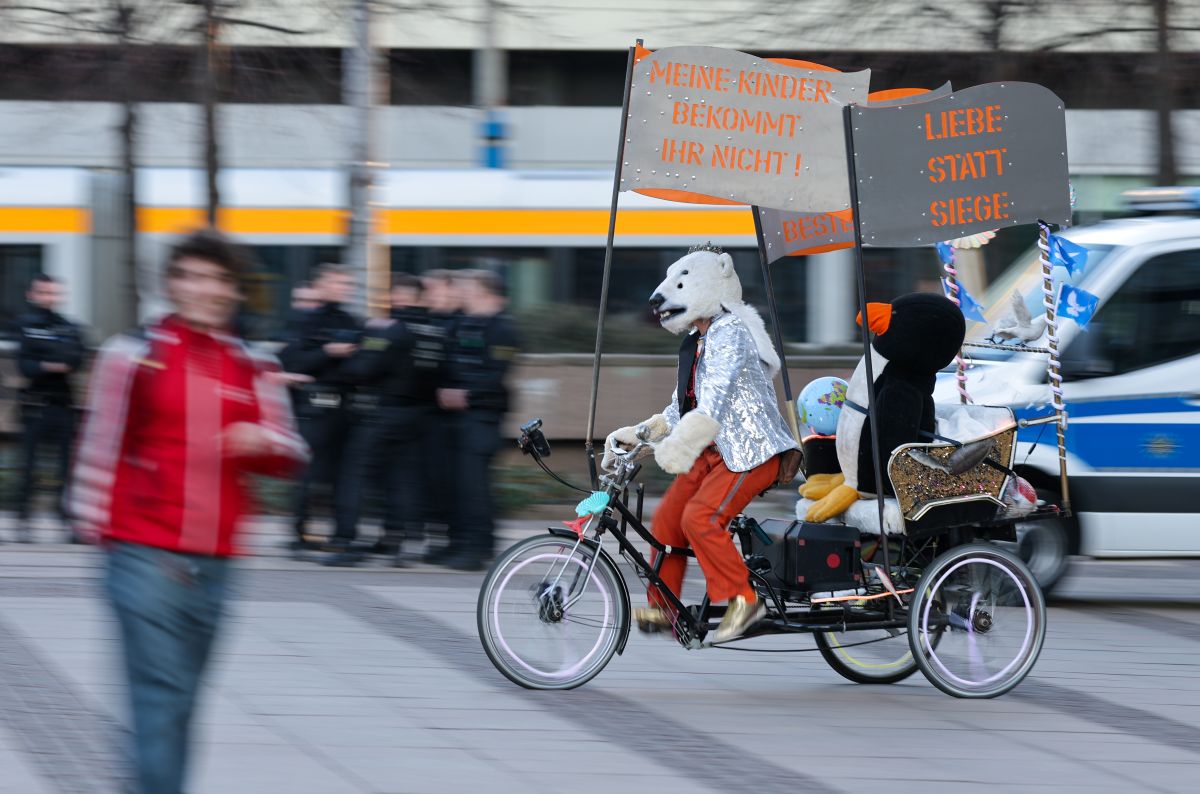
Photo: picture alliance/dpa | Jan Woitas
As the Germans have been known to say, “Leben ist kein Ponyhof” (Life is no pony farm).
In other words, life is not so easy.
Among life’s great trials and tribulations at the top of mind at the moment are escalating conflicts around the world. And for young people in Germany this comes with the growing threat of military conscription.
The person pictured above has found an eye-catching way to protest what feels like an inevitable slow-march toward the return of a military draft in Germany.
The signs attached to the tricycle read: “You wont get my kids!” and “love instead of victory”.
You can really bet on anything now
In case you’ve missed it, the world of online gambling is getting weird – like really weird.
READ ALSO: What are the rules around online sports betting in Germany?
One silly example is Bahn Bet, a betting portal for placing wagers on Deutsche Bahn (DB) train delays.
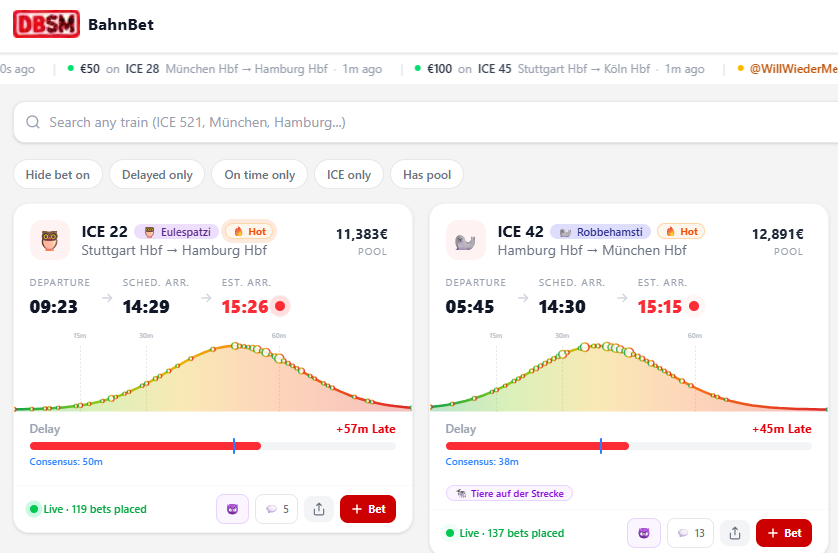
Screenshot of the BahnBet website.
Let’s say an ICE train from Munich to Berlin, originally scheduled to arrive at 14:05, is running 72 minutes behind schedule. In the portal at Bahn Bet you can see that the current estimated time of arrival is 15:17. When do you think it will arrive?
Users can place bets on trains’ specific times of arrival, as well as the type of disruption trains will face, including; strikes, police activity, animals on the track or even aliens.
The live train data seen on the site is real, but unlike other betting portals, the money is not. The site was created by a Viennese artist who said he was inspired by his own painful experiences with DB.
Disclaimer : This story is auto aggregated by a computer programme and has not been created or edited by DOWNTHENEWS. Publisher: thelocal.de