
When it comes to creating an investment strategy that’s right for you, there is no one-size-fits-all approach.
Deciding where you want to put your money, what you want it to achieve, and how much time you’ve got are all essential factors to consider. Another, and one that people too often don’t give enough consideration to in my opinion, is your appetite for risk and how risk factors into the investing you choose.
For some people, the housing market or superannuation are the preferred option if you have a lot of time and want to essentially set and forget. For others with less to spend and an understanding of more niche markets, it’s vintage Swiss watches or designer handbags.
Recently, gold has been booming. Last year, it outperformed almost every other major asset class and increased its value by roughly 65 per cent. For many people though, still the most common and accessible investing option is the sharemarket.
And while it’s always been well known for its ups and downs, the sharemarket’s volatility of late has plenty of first-time investors or people with a limited understanding of the market wondering if this is where they should be investing. And this is especially true when it comes to technology stocks.
On the one hand, these stocks are predicted to do extremely well for the foreseeable future. According to estimates for the 2025-26 financial year released in November, Nvidia – which manufactures graphics processing units and surpassed a market capitalisation of $7.7 trillion in November – is set to deliver returns on equity of 90 per cent. Apple is tipped to do even better at 175 per cent, while Meta, Alphabet (Google’s parent company) and Microsoft will all probably average about 20 per cent.
When the sharemarket is already volatile, knowing how much you want to risk and how long you’re willing to risk it should play a big part.
But those high highs can also come with unpredictable lows. Cast your mind back to June 2025, when Tesla’s share price declined by 14 per cent, and $US150 billion was wiped off the automotive giant’s market value.
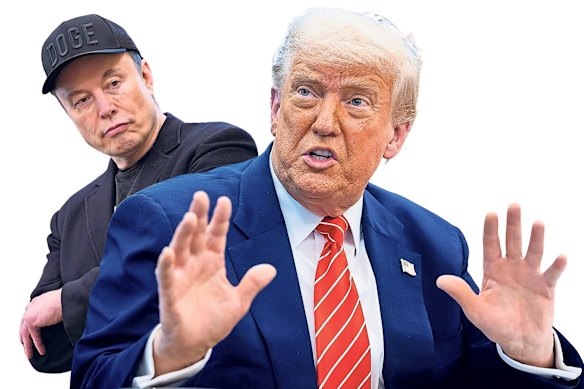
The reason for this dip mostly came down to the very public falling out Tesla’s chief executive Elon Musk was having with his one-time BFF, US President Donald Trump.
Leading up to that moment, Trump praised Musk, had Teslas parked outside the White House and let him contribute to major government policies and reforms. But all it took was a few spicy posts exchanged on social media for the 14 per cent drop.
For shareholders, it was a moment of uncertainty. Would Trump the president rip up the lucrative contracts that were in the works with Musk’s other companies, or would they hug it out and move on? While the share price has since well and truly bounced back, and we know things ultimately did stabilise, that wasn’t a given at the time.
Last week, a similar kind of cautionary tale involving AI investing and the White House made headlines around the world when the US government had another massive and public bust-up with one of the world’s leading technology companies.
The short version of the story is that, after weeks of negotiations, a $US200 million ($285 million) deal between the government and a tech company called Anthropic broke down after it wanted formal assurances from the White House that its AI systems would not be used in autonomous lethal weapons or mass surveillance – demands the administration didn’t respond well to.
As is the norm these days, Trump responded to the deal falling apart by slamming Anthropic on social media and calling it a “radical Left AI company run by people who have no idea what the real World is all about”.
Secretary of Defence Pete Hegseth then effectively blacklisted the company by designating it a supply chain risk to national security. By the end of that same day, OpenAI – which owns ChatGPT and is Anthropic’s competitor – announced it had swooped in and scooped up the lucrative $US200 million contract.
Now, if you happen to own shares in OpenAI, news that it secured a major contract with one of the most powerful governments in the world is probably very welcome. And given Anthropic is still a privately held company that you cannot buy shares in, you might be wondering if all this really matters.
To my mind, it’s significant for a number of reasons. Of course, there are numerous factors at play when it comes to the sharemarket and how it performs, and the social media posts of one world leader is hardly responsible for every drop or rise.
But when it comes to these shares specifically, what is significant is that the vast majority of publicly listed tech companies are based in the US. The second is that, right now, governments around the world are working very closely, and spending a lot of money, with tech companies, and the US is largely leading the way.
The third is that when this work goes well and the relationships are positive, it can be great for shareholders (see Apple’s share price and the company’s chief executive Tim Cook’s friendly relationship with Trump). But when things go badly, they can go south quickly (Hello, Musk and Tesla in June).
Or imagine in another way. If it was Anthropic winning the contract at the last minute and not OpenAI, shareholders would probably be pretty spooked and reliving an alternative version of Tesla shareholders’ reality from June 2025.
Another important consideration is that J.P. Morgan Global Research has estimated that there is a 35 per cent probability of a US and global recession hitting in 2026. Even though this is a big reduction from last year’s estimation of 60 per cent, it’s still a one in three chance that things could get very uncomfortable for plenty of people.
That, combined with inflation and sustained cost-of-living pressures, should be at the front of your mind when you’re thinking about investing and your appetite for risk.
As I said earlier, there is no one-size-fits-all. But we do know that some investments carry more risk than others. When the sharemarket is already volatile, knowing how much you want to risk and how long you’re willing to risk it should play a big part in guiding you – even when it is on a winning streak.
Victoria Devine is an award-winning retired financial adviser, a bestselling author and host of Australia’s No.1 finance podcast, She’s on the Money. She is also founder and director of Zella Money.
- Advice given in this article is general in nature and is not intended to influence readers’ decisions about investing or financial products. They should always seek their own professional advice that takes into account their personal circumstances before making any financial decisions.
Expert tips on how to save, invest and make the most of your money delivered to your inbox every Sunday. Sign up for our Real Money newsletter.
 Victoria Devine is an award-winning retired financial adviser, best-selling author, and host of Australia’s number one finance podcast, She’s on the Money. Victoria is also the founder and managing director of Zella Money.
From our partners
Disclaimer : This story is auto aggregated by a computer programme and has not been created or edited by DOWNTHENEWS. Publisher: www.smh.com.au


