
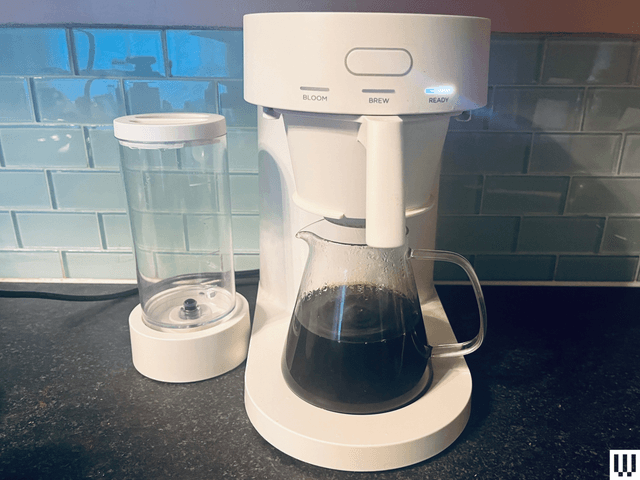
Coffee is the original office biohack and the nation’s most popular productivity tool. As we lose sleep to the changeover to daylight saving time, the caffeine-addicted WIRED Reviews team is writing about our favorite coffee brewing routines and devices that’ll keep us alert and maybe even happy in the morning. Today, reviewer Matthew Korfhage expounds on his lasting love for drip coffee—and why the Ratio Four never leaves his counter. In the days after, we’ll add other Java.Base stories about other WIRED writers’ favorite brewing methods.
As with any vice worth having, a morning coffee routine can take on the character of religion. And like a lot of religion, it’s often born as much accident as moral conviction. My denomination is good, old-fashioned drip coffee. That’s what I drink first thing, before I even think about crafting a shot of espresso.
I’m WIRED’s lead coffee writer and I’ve developed a deep fondness for coffee’s many variations, from espresso to Aeropress to cold brew. But “coffee” to me, in my deepest soul, still means a steaming mug of unadulterated drip. Luckily, that’s also the coffee arena that has been transformed the most by technology in recent years. The drip coffee from the Ratio Four coffee maker (now quietly on its second generation) feels to me like coffee’s purest form, the liquid distillation of what my coffee beans smell like fresh off the grinder.


My love of filter coffee began as a teenager traveling and studying in India—perhaps my first glimpse of adult freedom. This is where I drank the first full cup of coffee I remember finishing. In Jaipur, filter coffee was an intense, jet-black gravity brew typically mixed with milk and sugar. I decided that if I was going to drink coffee, I would take it straight and learn to like it on its own terms. A newfound friend, tipping jaggery into his own brew, laughed at my insistence I didn’t want sweetened milk. I then downed a cup so thick and strong and caffeinated it made my hairs stand at perpendicular. If I’d made a mistake, I refused to admit it.
I carried this preference back to Oregon, drinking unadulteratedly black, terrible drip coffee at all-night diners and foul office breakrooms. Black coffee had become a morality clause, though it was hardly a matter of taste.
It wasn’t until years later that I discovered that drip coffee could actually be an indulgence every bit as refined as pinkies-up espresso.
Upping the Drip
In part, this was a problem of technology. Aside from a classic Moccamaster, it’s only very recently that home drip coffee makers have been able to produce a truly excellent cup. For years, I didn’t keep one at my home.
What woke me up to drip’s possibilities was a new wave of cafes in Portland, first third-wave coffee pioneer Stumptown Coffee and then especially Heart Coffee Roasters in Portland. Heart’s Norwegian owner-roaster, Wille Yli-Luoma, expounded to me at length about the aromatic purity of light-roast immersion coffee—the fruity aromatics of a first-crack Ethiopian that could smack of peach or nectarine or blueberry. Scandinavians had long prized this, he told me, and had evolved light-roast coffee into pure craft. America was finally catching up.
Still, I could never quite get that same flavor or clarity on a home brewer. Not until recently. To get the best version, I still had to walk up the street to Heart and get my coffee from the guy who roasted it. Or I had to spend way too long drizzling water over coffee in a conical filter. I rarely wanted to do this while still bleary from sleep, already late for work.
What it took was a whole new generation of drip coffee makers modeled on cafe pour-over, complete with agitating showerheads, tight temperature control, and a “bloom” phase that wets down the coffee grounds and lets the coffee off-gas its carbon dioxide and extract more fully. A new generation of machines from makers like Bonavita and Oxo set off a revolution in home drip coffee that’s now in full swing.
The Machine I Use to Test Coffee

My most-used machine lately is the Four small-batch brewer from Portland company Ratio. I spend a lot of time testing coffee and espresso machines. And so the machine on my counter rotates often, depending on whatever new machine has rolled up my way. The coffee also rotates quite often.
But it’s the Four that rarely leaves my counter after trying almost every high-end drip coffee maker on the market. There are machines, like the Fellow Aiden and the xBloom Studio, that have far more versatility and customizability to get the perfect cup for each person. What I love about the Four is that it’s made for my natural routine. I brew just a mug or two at a time, and the Four is optimized for eight or 16-ounce batches. It also brews for rich extraction without requiring me to futz around with each new bean I’m trying out.
The Four brews long, a bit over five minutes for a full 20-ounce batch, with a bloom cycle that’s also pretty patient. It’s a gentle, even, and full-bodied extraction—maybe the fullest-tasting drip coffee maker I know of when brewing a single 10-ounce mug. A classic Technivorm Moccamaster KBGV (see here on Amazon) can offer a somewhat crystalline precision. It tastes clean. But the Four seems to reveal a coffee’s deeper secrets, and unpacks flavors you didn’t know would be there. It’s also reliable, and repeatable, just like a Moccamaster is. Two batches brewed in a row, with the same coffee and the same grinder on the same setting, usually have the same character.
On the white machine especially, I’ll grant it’s hard to keep coffee stains out of the ribbed brew chamber, which signals coffee oil buildup. This necessitates a monthly soak in water with Urnex Cafiza coffee cleaner powder to avoid off flavors. The lack of a drip stop means I also have to wipe the base after removing the carafe, because of inevitable stray dribbles.
The Four is also a coffee maker that wants you to drink immediately. It comes out at drinking temperature, and there’s no thermal carafe. If one of the main things you want from your first sip is diabolical heat, I’ll send you back to the Aiden or the Moccamaster. But I actually prefer the Four’s serving temperature, which mimics pour-over. I’d rather not let my coffee cool down and oxidize before it’s at my preferred temp of 150 degrees Fahrenheit, when coffee aromatics and perceived sweetness reach their optimal balance.
All this adds up to make Ratio Four what I use most often when tasting beans from a new coffee subscription service I’m trying out. When paired with a precise flat burr grinder—these days, it’s the Mazzer Philos—I can taste heartening clarity from the aromatics locked in each bean. The chocolate notes taste like chocolate grown in a specific place. The strawberries taste like strawberries. The snozzberries taste like snozzberries.
It’s a far cry from my first, angrily strong cup in Jaipur. But maybe it is finally what I wanted back then, when I decided as a teenager that loving coffee meant loving it only in its purest form.
Disclaimer : This story is auto aggregated by a computer programme and has not been created or edited by DOWNTHENEWS. Publisher: wired.com



