
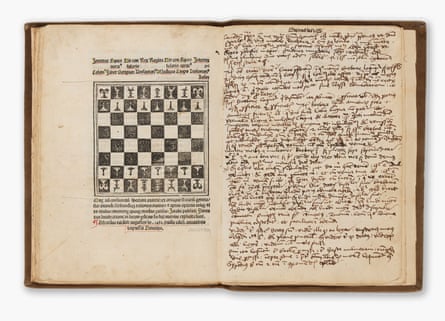
A vast collection of chess memorabilia, including souvenirs from the 1972 “Match of the Century” and considered to be the largest and most important of its kind in private hands, is to be auctioned at Sotheby’s in London next month.
The collection belonged to the German grandmaster Lothar Schmid, whose passion for the sport extended way beyond the board.
Considered one of the foremost German chess players, Schmid is best known for being chief arbiter of the legendary 1972 World Chess Championship match in Reykjavik between Boris Spassky of the Soviet Union and the American Bobby Fischer.
His score notes from the encounter, labelled the “Match of the Century”, along with those of Spassky and Fischer, as well as other souvenirs from the cold war showdown, are among the items up for auction from the collection, which contains more than 50,000 artefacts spanning several centuries.
Schmid’s three children are selling the collection, which until recently was stored at the grandmaster’s sprawling house in Bamberg, southern Germany, where he died in 2013.
His son Bernhard Schmid recalled his father’s passion for the things he gathered, saying: “He was crazy for the game and everything to do with it. He travelled to five continents to buy up artefacts he had fallen in love with, once to South America for a book he told us children was as expensive as a house.”
That book, one of the highlights of the auction, is Repetition of Loves and the Art of Chess. Written by Luis Ramírez de Lucena, a leading Spanish chess player around 1497, it is the first to describe the rules and strategy of chess, and the oldest existing book on the sport, written at a time when the modern game was emerging in Spain. Sotheby’s predicts it will sell for at least £70,000.
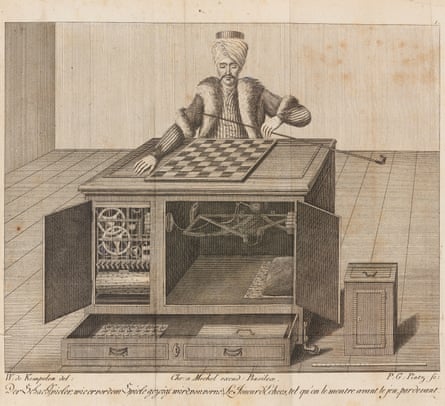
Also up for auction is a set of rare works documenting the Mechanical Turk – a famed chess-playing automaton that was unveiled to the Habsburg empress Maria Theresa in 1769 and which toured through Europe and the US for more than eight decades before its secret was revealed. While it appeared to run on clockwork, it in fact contained a real, skilled chess player inside, who operated its arms with a system of magnets and levers.
Sotheby’s Gabriel Heaton, a specialist on English literary and historical manuscripts, said collections of this kind rarely came to the market. He said the collection brought home the enduring longevity of the sport, which along with the boom it has experienced in recent years – helped by the pandemic and cultural touchstones such as the Netflix hit series The Queen’s Gambit – ensured the auction would attract a wide range of buyers and onlookers.
“To have something that has engrossed humanity for centuries is particularly compelling in our world. It’s based not on luck but pure strategy, and is also nicely predictable because everyone knows what the rules are. That’s quite anchoring.”
Other star lots include the only existing Italian edition of Givocho’s Chess Book by Jacobus de Cessolis, a medieval morality poem that uses chess as a metaphor for feudal society, and which contains intricate woodcut illustrations of a chess game.
Schmid’s love of books and his means to build up his treasure trove of such prized objects stemmed from his family’s ownership of Karl-May-Verlag, publishers of the hugely popular adventure novels of the late 19th- and early 20th-century German writer Karl May, which the chess champion later ran.
Schmid, who remained an amateur his whole career, was, unusually, a grandmaster in both over-the-board chess and correspondence chess, and represented West Germany at 11 Olympiads between 1950 and 1974.
The 1972 world championship in Reykjavik was held against the backdrop of the cold war, and the final generated more global interest in a chess match than any before or since.
“He [Lothar Schmid] was a very charming person, very urbane,” Bernhard Schmid said. “When they were looking for a referee it had to be someone who was measured, and politically neutral. He knew and respected both men well and was well liked himself, so he was considered to fit the bill, and he accepted.”
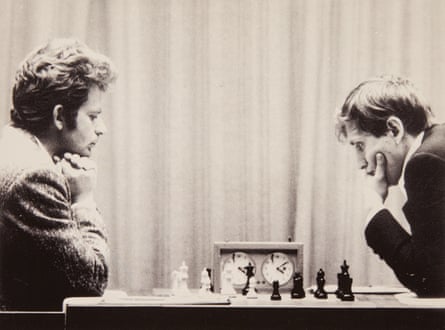
As a 10-year-old at the time, Bernhard Schmid had been considered too young to accompany his father on the trip to Iceland, and had to satisfy himself with watching TV news bulletins of the match, which went on for several weeks.
He recalled his father later being visited separately at his home by Fischer and Spassky, who remained friends with him, and how he enjoyed showing items from his collection to them.
Heaton described the score sheets, which are expected to fetch thousands of pounds, as “the handwritten record-taking of the times, and the scores, each player’s sheet signed off by the other to signal they were in agreement, which gets you as close as you can to the greatest chess match of the 20th century.”
Bernhard Schmid said his mother, Ingrid, had “patiently endured” her husband’s collecting habit. “Like everyone who knew him, she saw it as his little addiction, but in a positive sense. Some people buy property, my father bought chess books and artefacts.”
Disclaimer : This story is auto aggregated by a computer programme and has not been created or edited by DOWNTHENEWS. Publisher: theguardian.com



