The only surprising thing about Sam Docherty’s potty-mouthed tirade about the f—ing Blues was that he didn’t f—ing swear more. F— it.
The least surprising bit was that his mate, former Blue and podcaster Dan Gorringe, thought: “this is gold, I’m going to run it.” It should be surprising that Gorringe put the tirade to air. But it isn’t.
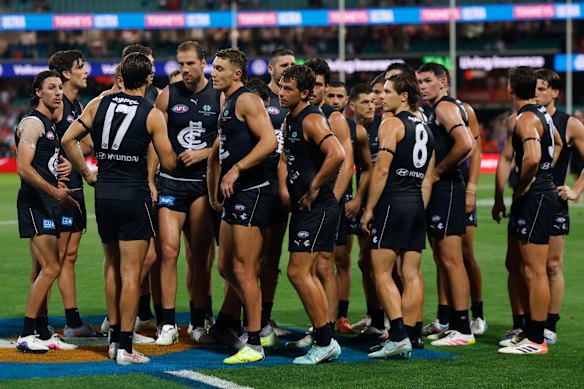
Same old Blues, after their Opening Round loss to the Swans.Credit: AFL Photos via Getty Images
Put aside the fruity adjectives. The illuminating but not surprising point of Docherty’s exasperated rant that found its way onto Gorringe’s podcast was that he opened the locker room door on the conversations Carlton players have been having among themselves for years.
Their cussed – most definitely cussed – post-mortems in the locker room and in leadership meetings mirror the ones their fans and footy followers have been having about them for years. Why do we keep doing this? Why does it always happen the same way?
What was left hanging was the more pertinent question: Why haven’t we fixed it?
It’s the Pavlovian aspect to Carlton’s lapses that is the source of the deepest frustration. Even those playing for the Blues, we now know, have been as angry as their fans at their inability to change and their ability to continue to fall into the same holes. F— it.
“Exactly what happened again last night is the same shit that happens in every other game,” Docherty told Gorringe.
“When the game’s hot and contested and pressurised, Carlton is good in that environment, but as soon as some team can do somewhat good in the contest, the rest of the game just f—in’ falls to pieces.”
That is the most succinct summary of Thursday night’s game, the fallout of which had about it the same sort of season-deflating effect as their first round loss to Richmond last year. It’s probably opportune to mention they play the f—ing Tigers this Thursday night. F— it.
Yes, this is the first game of the year and there is a danger of over-reacting, but as Docherty pointed out in frustration, it’s a new year, but these are not new maladies at Carlton.
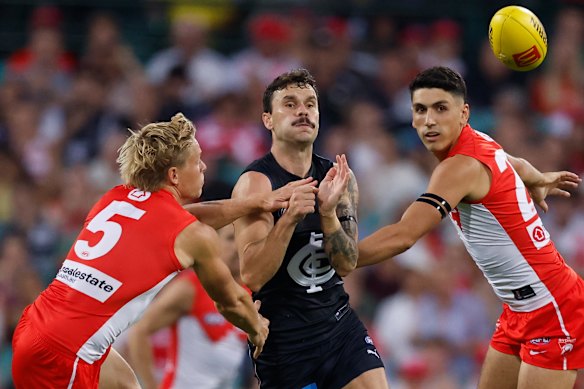
Zac Williams handballs between two Swans. Credit: AFL Photos via Getty Images
The frustration is heightened by the fact that Carlton between times can, and do, play some good footy. Like the first half on Thursday night, when they brought superior pressure, speed and intensity to Sydney and the Swans were wilting.
That first half should not be lost in the teeth-gnashing angst of what happened afterwards. Carlton lacked forwards to convert their field position, but they had the better of the game. That says they had bought into what the coaches were telling them. They are connected and fully on board with what they are doing. The question, then, is what are they doing when the game goes against them?
When the game slowed in the second half, as it had to given the pace at which the first half was played, space opened up and Sydney filled it. When the Swans came at them, Carlton were bereft.
They were slow to defend, or didn’t intuitively know where to be to defend. When Isaac Heaney and Chad Warner came out the front of packs at a centre bounce, no defender was coming at them to close down space. Even when the Blues had an extra player in defence no one was free to press up in the face of the Swans ball carrier. Too often they had numbers filling space behind the ball without an understanding of where to be.
Similarly, when the Carlton midfielders were free they moved into space but didn’t pivot to chase or provide cover. When the best teams break down they still have defenders pressing and getting up on the opposition to help delay them, to get numbers back in meaningful support. Carlton didn’t.
As much as it felt familiar, Carlton have defended better than this before, but in this third quarter they looked lost. There could be an element of first game blues about them and as Jacob Weitering admitted afterwards, they were suckered by the emotion of the night with Charlie Curnow playing in another jumper and the forced exits his arrival created for Will Hayward and Ollie Florent. But as excuses these feel thin.
The Blues were unable to wrestle the game back onto their contested terms by creating stoppages and allowing their mids to win the ball back for them. Their half-forwards had pulled up so high to help their under-siege backline in the third quarter that when, or if, they won the ball back in their defence they had nowhere the go to transition the ball. The defence was cluttered so they could not use short, 45-degree angle kicks as Brisbane do so artfully to open space in their defence to counter-attack.

Patrick Cripps after the defeat. Credit: Getty Images
When the Blues tried to get out of defence through long high balls to tall forwards, who had pushed up to the midfield, they were unable to win it in the air, or at ground level once the contest was halved. The kicks were not wide enough to force the ball over for a boundary throw-in so they could try to return the game to a stoppage and their clearance and contested-ball strengths.
It was the devastation of that third quarter that framed this loss, not the fact they lost. Few people considered Carlton a top six team before the game, while many fancied Sydney flag contenders. The loss was not the surprise, the way it happened in that third quarter was.
As Sam Docherty said, it felt like déjà vu. Why does it keep happening? F—!
How the Hawks missed a target
Christian Petracca was brilliant for Gold Coast, playing the sort of game some felt was no longer in the Norm Smith Medallist after his life-threatening King’s Birthday injury. Then he messaged Clayton Oliver on Saturday morning to say: “your turn now”. Oliver took his turn against Hawthorn. Both played to exorcise Demons, as it were.
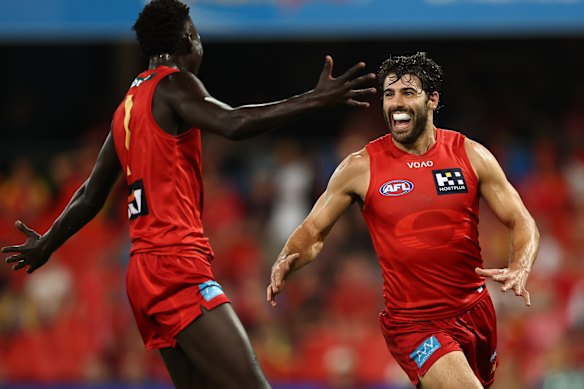
Christian Petracca celebrates a goal with Mac Andrew.Credit: AFL Photos
Watching Petracca on Friday night, then watching Hawthorn lose to Oliver’s Giants army on Saturday, the irresistible thought was that Hawthorn should have chased the gettable Petracca rather than the unlikely Zach Merrett.
Admittedly, this is easy to say now that the Hawks missed out on one and the other played a blinder, but Petracca was always leaving the Demons, and Merrett was always a long shot to be prised out of Essendon. The Bombers said at the start of the trade period they wouldn’t let him go, and they didn’t budge.
The Hawks could never accommodate both players. Gold Coast had a better hand of early draft picks to get a Petracca deal done, so the contracted player would have to have nominated Hawthorn as the only club he was prepared to be traded to.
Petracca might well have said no to them, no matter how hard they pushed.
Opening Round reinforced that Petracca is still a great player. It’s a one-match sample, but he also showed he is precisely the type of player the Hawks need.
These are new Dogs
These are different-looking Bulldogs. In Tim English’s case, he is thinner and fitter. English kicked the critical goal against Brisbane on Saturday night, taking the mark in the goal square having out-run his opponent when he took off from centre-half-back.
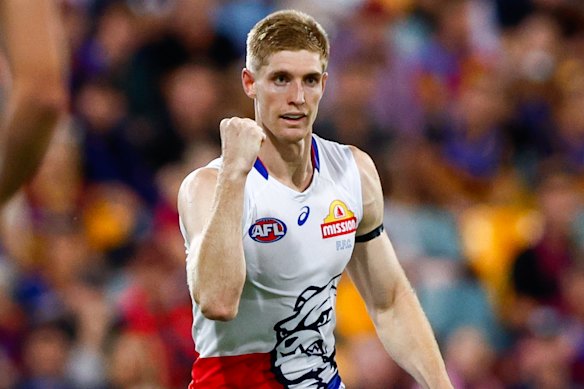
Tim English is leaner for the demands of footy in 2026.Credit: AFL Photos via Getty Images
He couldn’t have done that last year. It is not that he was unfit then and is fit now; it is that he looks to have altered his body shape for a game that has changed its demands, with the new ruck rules and five man bench. He knows he has to approach the game in a different, more athletic way.
The other difference was that when the game had to be won in the last term, Marcus Bontempelli was playing forward. In evolving his team, coach Luke Beveridge trusted others in the midfield to get the job done. When as a forward the Bont ended up with Harris Andrews, the star Dogs drew him away. Then when the lead needed to be preserved, Bont moved to defence as a spare in the last minutes.
Previously, winning or losing seemed to ride on Bontempelli’s boot in the midfield.
Higher scores, speed thrills
The AFL’s rule tweaks have had an immediate effect. It’s a small sample size, but scoring was way up – which also meant that games went for longer because of the amount of time taken between goals. Is that a good thing? Seeing goals kicked normally is.
The combination of last touch out of bounds and the stricter stand rule means the ball is in play more often and making the games faster, which also means more exhausted players; hence the scoring opens up later in quarters.
Surprisingly, given the “last touch” rule change means a free kick is awarded when the ball goes out between the arcs, the first four games still produced more throw ins than the 2025 average (40.3 this year compared to and 34.1 across last season).
Keep up to date with the best AFL coverage in the country. Sign up for the Real Footy newsletter.
Most Viewed in Sport
Disclaimer : This story is auto aggregated by a computer programme and has not been created or edited by DOWNTHENEWS. Publisher: www.smh.com.au