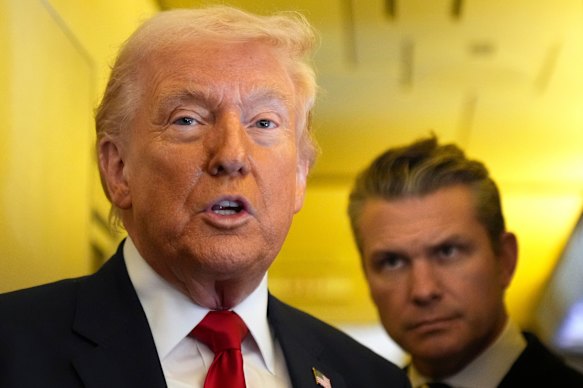
Donald Trump says the war in Iran is “very complete, pretty much.” His Secretary of War Pete Hegseth says the devastating air strikes on the country are “just the beginning.”
Who should we believe?
While the answer to that question matters most to the people of Iran and others in the region caught up in the conflict, it also has major implications for the global economy, financial markets and investors.
This has been evident in the wild swings in global sharemarkets, which dived last week, sending the ASX careening on Monday, before the US market recovered some ground overnight and the local market rebounded this morning.
Oil prices – which had soared to almost $US120 a barrel on Sunday, when the appointment of a new hardline “Supreme Leader” made it clear that Iran isn’t simply going to fold under the weight of the attacks, as Hegseth has implicitly acknowledged – fell back below $US90 a barrel in response to Trump’s stated confidence that the end of the war is nigh.
Up to the US president’s latest comments, the Iran war, and the effective closure of the Strait of Hormuz, appeared likely to drag on to markets, choking global oil supplies because about a fifth of the world’s crude and refined oil passes through that narrow waterway. Then Trump indicated the war might end soon, describing it as just “a little excursion.”
‘This was just an excursion into something that had to be done. We’re getting very close to finishing that.’
Donald Trump
“This was just an excursion into something that had to be done. We’re getting very close to finishing that,” he said. The oil price fell back below $US100 a barrel.
However, Sunday’s oil price spike, which reflected the dawning realisation that the war wouldn’t be as shortlived as Trump and Hegseth had previously promised, seems a better reflection of the state of affairs than Trump’s optimistic assessment and the “relief rally” in markets that it produced.
Despite the decimation of Iran’s former leadership, and the destruction of much of its military infrastructure, the country shows no signs of the regime change and surrender Trump has foreshadowed.
The strait remains effectively closed – only a handful of tankers have braved it since the US and Israel launched their assault – and the key justification for the military assault, Iran’s stockpile of weapons grade uranium, appears to be intact.
Without regime change and the seizure of Iran’s nuclear stockpile, the US-Israeli mission remains incomplete and the prospect of the conflict being prolonged (Iran has said it can sustain it for six months) remains very much alive.
That makes the Hegseth’s analysis more convincing than Trump’s, although it is open to the US president to simply declare a victory, cease the missile and drone attacks and hope that no-one notices that his stated objectives haven’t been achieved.
If the conflict is truly just at its beginning, then the optimism that caused financial markets to rebound overnight and this morning is misplaced, and oil prices at or above $US100 a barrel are likely to be sustained until the war reaches some form of conclusion.
That’s clearly not goods news for the global economy, although the extent to which individual economies are impacted hinges on how dependent they are on imported oil.
Of the oil-dependent regions, Asia is probably the most affected. Japan, South Korea, India and the south-east Asian economies are all reliant on imported energy.
China is the world’s largest oil importer, but with a strategic reserve estimated at about 1.5 billion barrels and the world’s most electrified economy, it isn’t as vulnerable as it would have been in the past.
The Europeans, having largely shut down their access to Russian gas and reduced their purchases of Russian oil, are also vulnerable to price hikes that could, like the Asian economies, generate a 0.5 percentage point increase in inflation rates.
And it’s not just oil prices that are a threat to economies, but the availability of oil at any price.
Increased volumes of oil transported through Saudi Arabian and United Arab Emirates pipelines to Red Sea terminals might blunt the price rally, as might the release of the G-7 economies’ strategic reserves of about 1.2 billion barrels, including an American reserve of about 415,000 barrels.
At face value, net energy exporters like the US and Australia should be less affected by a lengthy period of sustained higher oil and gas prices (although Australia’s petrol stocks are limited, making us dependent on continued offshore supplies).
Oil and gas are, however, priced by global markets. While the higher prices might deliver windfall gains to domestic oil and gas producers, they also lead to higher petrol/gasoline and diesel prices.
Moreover, about 20 per cent of the world’s fertilisers are also transported from the Middle East via the strait, adding another inflationary aftershock from the conflict.
The first-order effect of the surge in oil prices from their sub-$US70-a-barrel levels before the war erupted will be on fuel prices. Those will, however, feed into transport costs and subsequently into economy-wide prices. Increased fertiliser prices will eventually flow into increased grocery prices. The longer the war lasts, the more lasting the inflationary shock will be.
For economies like the US and Australia, where inflation rates are already well above the levels targeted by their central banks, that means higher interest rates are likely.
That’s a particular problem for Trump, who has vowed to lower US interest rates and has been manoeuvring to try to gain control of, or at least have strong influence over the US Federal Reserve Board’s interest rate decisions.
With his tariffs continuing to feed into US goods pricing, and now average standard gasoline prices jumping from just below $US3 a gallon to around $US3.50 a gallon – and diesel from below $US3.80 a gallon to more than $US4.60 a gallon – an inflation rate that was relatively steady, albeit above the Fed’s 2 per cent target, is likely to kick up quite sharply.
America has been experiencing shrinking employment growth. In February, 92,000 positions were lost, and the unemployment rate ticked up to 4.4 per cent. Towards the end of last year, US economic growth slowed sharply.
A rising inflation rate coinciding with increased unemployment and slowing growth equals stagflation, a condition that Trump’s tariffs had threatened, but haven’t yet delivered.
The longer the war continues, the more likely it is that the US – and other economies – find themselves throttled by the relatively high interest rates required to combat inflation while experiencing declining growth and rising unemployment.
The Trump administration misjudged Iran and its regime, and its willingness to fight. While its missile and air attacks have been extraordinarily effective in destroying Iranian military infrastructure, Trump has yet to recognise the limitations of an air-only assault on a country as large as Iran and a regime that is fighting for its existence.
The complacency that characterised financial markets in the first week of the conflict was shattered at the weekend but, thanks to Trump’s comments, has re-emerged overnight.
Unless he’s willing to suffer the embarrassment of walking away without achieving any of the objectives he identified at the outset of the Iran attacks, this optimism might turned out to be misplaced and shortlived.
The Market Recap newsletter is a wrap of the day’s trading. Get it each weekday afternoon.
 Stephen Bartholomeusz is one of Australia’s most respected business journalists. He was most recently co-founder and associate editor of the Business Spectator website and an associate editor and senior columnist at The Australian.Connect via email.
From our partners
Disclaimer : This story is auto aggregated by a computer programme and has not been created or edited by DOWNTHENEWS. Publisher: www.smh.com.au