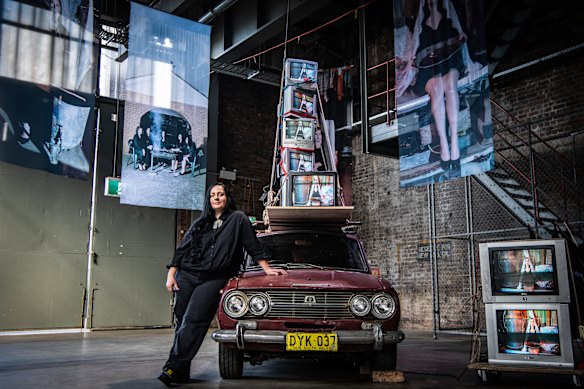

A dilapidated 1964 Isuzu that once carted around a family of eight crowns Australia’s largest visual arts festival, Biennale of Sydney, a showcase of 66 contemporary works by 83 artists from 37 countries.
Artist Marian Abboud retrieved the unregistered car with “very dodgy brakes and a battery that has a mind of its own” from her late father’s garage in Merrylands, towing it to the White Bay Power station, headquarters of the 25th edition of the festival, which opens Saturday.
Several televisions are perched on its roof. Above that are pictures of her sisters posed either inside or in front of the garage, in a gesture of sisterhood.
“My dad was the only one who knew how to fix the car, it was the car that took us everywhere, until we became embarrassed and wanted to have a flashy car; he would call it the Rolls-Royce,” Abboud says.
Abboud’s Sister +++++ Familial Formations III is one of several commissions for the festival that bridge personal testimony with grand scale.
But the curator responsible for the biennale’s vision was missing from the media preview, insisting that the voices of the global artists take centre stage.
In a highly unusual turn of events, artistic director Hoor Al Qasimi absented herself from Tuesday’s media preview at White Bay Power Station. It was a deliberate curatorial choice, a spokeswoman said, to platform the artists whose works are installed across five primary exhibition venues.
“Hoor felt strongly that the media preview must be about the individual artists who make up this edition,” the spokeswoman said. “She has chosen to let their work, their histories, and their voices take centre stage.”
Al Qasimi is a leading international curator and the first Arab appointed to the role in the festival’s 53 years. She is also a member of UAE royalty and the daughter of the ruler of Sharjah. Her appointment had drawn intense scrutiny from some Jewish advocates, including high-profile publisher Morry Schwartz, who says her pro-Palestinian views should disqualify her from the Biennale. He has called on her to step down.
The Biennale said Al Qasimi’s decision not to attend was driven entirely by this artist-first philosophy, rather than a reaction to any external events or commentary.
“Hoor remains deeply engaged in her role as artistic director and will continue to participate in the Biennale program in ways that best serve the exhibition and foster an inclusive and welcoming environment for our audiences.”
Al Qasimi’s theme for the year, Rememory, draws from Toni Morrison’s novel Beloved, with works inspired by stories of displacement, migration and survival that shape future generations.
Biennale chief executive Barbara Moore said Al Qasimi’s vision was expansive and deeply human, bringing overshadowed voices into cultural conversations. The biennale was an invitation to pause and reflect on issues that shaped lives, at a time of great uncertainty, and appealed to the media to make space for complexity and discussion.
“Remembering reminds us that the past is not simply behind us, it’s something we carry forward,” she says.
Several Palestinian artists and collectives feature, including at the Chau Chak Wing Museum, where artist Khalil Rabah, who lives and works in Ramallah, has stitched together a traditional dress coat inspired by an ancient Byzantine church mosaic discovered by Australian soldiers in Gaza during World War I.
The mosaic was controversially installed at the Australian War Memorial, where a portion remains on display. The artist has characterised the work as an “act of resistance” to counter “forces of erasure that began with colonial politics in 1917 and continue today”.
Inside White Bay Power Station, not far from the clapped out Abboud family car, stands a towering African baobab tree. Two storeys tall and made of 20 metres of draped cotton gauze, it brings together 10 years of inquiry, five years of deep research and is infused with the memories of elders recorded in American archives who were born into slavery and recall the landscape of the slave trade.
Alongside the baobab tree is a replica of a 1860s slave cabin. “Everything is touchable, intractable in the cabin, but falling apart,” says American artist Nikesha Breeze.
“It’s disintegrating before your eyes. The roof, the walls are disappearing, which is what’s happening currently in the United States,” Breeze says.
Living Histories is Breeze’s largest work to date: “It was such an intimate history. I wanted to create a work that was massive, that needed a huge space but would call people into intimate conversation.”
Biennale exhibitions will also be held at the Art Gallery of NSW, Penrith Regional Gallery and Campbelltown Arts Centre, with programs of food, markets and night activations spread between 13 venues.
At the AGNSW, audiences can view the landmark 80-square-metre Ngurrara Canvas II. Created by more than 40 artists to support a 1996 native title claim, this is the painting’s final public outing before it returns permanently to the artists’ Country.
Biennale of Sydney runs from March 14 to June 14.
Start the day with a summary of the day’s most important and interesting stories, analysis and insights. Sign up for our Morning Edition newsletter.
From our partners
Disclaimer : This story is auto aggregated by a computer programme and has not been created or edited by DOWNTHENEWS. Publisher: www.smh.com.au