
Footballers from the Middle East, finding themselves in peril, first sought and gained asylum in Australia more than 85 years before members of the Iranian women’s soccer team did the same thing this week.
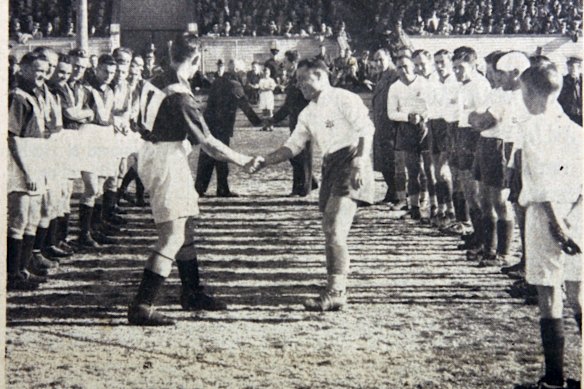
In 1939, almost on the eve of World War II, a soccer team from the British Mandate of Palestine toured Australia.
Though the tour was billed as Palestine versus Australia, all the players were Jewish, from the Maccabi Tel Aviv team: Israel did not exist for another nine years.
World War II was only two months away, and extreme repression and violence against Jews was at its height in Nazi Germany. Jews throughout Europe and the Middle East feared what would come next.
And so, when the tour of Australia wound up in July 1939, six members of the team from Mandatory Palestine sought to stay in Australia, according to historians Roy Hay and Bill Murray, quoted in 100 years of the Socceroos: A team indivisible from Australian society, published in 2022 by Professional Footballers Australia.
They were granted their wish.
Three of them joined the Australian Army. Two – Abraham Beth-Halevy and Menachem Mirmevitch – died fighting the Japanese.
War, as the Iranian women have had impressed upon them, brings desperately fraught times far from home for all manner of performers.
Shortly after the team from Mandatory Palestine chose to stay in Australia, 14 members of the Vienna Mozart Boys Choir found themselves stranded in Melbourne when war broke out and their ship was requisitioned.
The Austrian boys, thus, were officially “enemy aliens”. But Catholic Archbishop Daniel Mannix arranged for local families to take them in and paid for their education. The young choristers continued performing throughout the war.
Numerous men and women from strife-torn nations have since won asylum in Australia while on major sporting tours.
The most spectacular mass defection was during the Cold War by almost half the Hungarian team at the 1956 Olympic Games in Melbourne.
As the 111 Hungarian athletes arrived in Australia, they learned that Soviet troops had invaded their capital, Budapest, starting a bloody crackdown.
Many of them decided they would not return home.
When the Games were done – and the sporting world had been rocked by the infamous “blood in the water” match – 48 members of the national team refused to return home.
Some remained in Australia, and others eventually moved to the US. Footballers who stayed helped establish the Melbourne Hungaria Soccer Club, which played in the Victorian Soccer League for 30 years.
Athletes from troubled African nations make up the majority of those who have sought asylum in Australia during big sporting events.
Almost 30 sports people and officials from Cameroon, Ghana, Sierra Leone, Nigeria and Bangladesh applied for asylum after the Melbourne Commonwealth Games in 2006.
In 2008, at least 15 participants from the 400 taking part from 52 nations in football’s Homeless World Cup in Melbourne embraced the name of the competition literally. Hailing from Rwanda, Zimbabwe and Afghanistan, they filed for asylum.
Asylum-seeking among sport participants reached a crescendo in 2018 when the Commonwealth Games were held on the Gold Coast and the Invictus Games occurred in Sydney. It was also a high-watermark for refusals of protective visas.
More than 200 people decided not to go home to Rwanda, Cameroon, Uganda, Sierra Leone and Afghanistan. The following year, 2019, documents revealed the Department of Home Affairs had rejected 217 of about 230 applications for protective visas.
The Afghan women’s football team, in the end, had greater fortune.
Formed by the Afghanistan Olympic Committee in 2007, the team members found themselves on the dangerous side of history when the Taliban came to power and consigned women to the status of the invisible.
The women buried their uniforms and trophies, fearing for their lives.
But after a campaign by leading Australian soccer and human rights figures, the Australian government in 2021 provided emergency visas for about 50 female athletes, officials and their families and evacuated them from Kabul airport.
The Afghan women’s football team was sponsored by A-League Club Melbourne Victory and Victoria University.
Now, with the Middle East in chaos again, Iran under attack and threats of retribution made to the Iranian women’s football team for refusing to sing their national anthem in Australia, an old story is being replayed.
Cut through the noise of federal politics with news, views and expert analysis. Subscribers can sign up to our weekly Inside Politics newsletter.
 Tony Wright is an associate editor and special writer for The Age and The Sydney Morning Herald.Connect via email.
From our partners
Disclaimer : This story is auto aggregated by a computer programme and has not been created or edited by DOWNTHENEWS. Publisher: www.smh.com.au