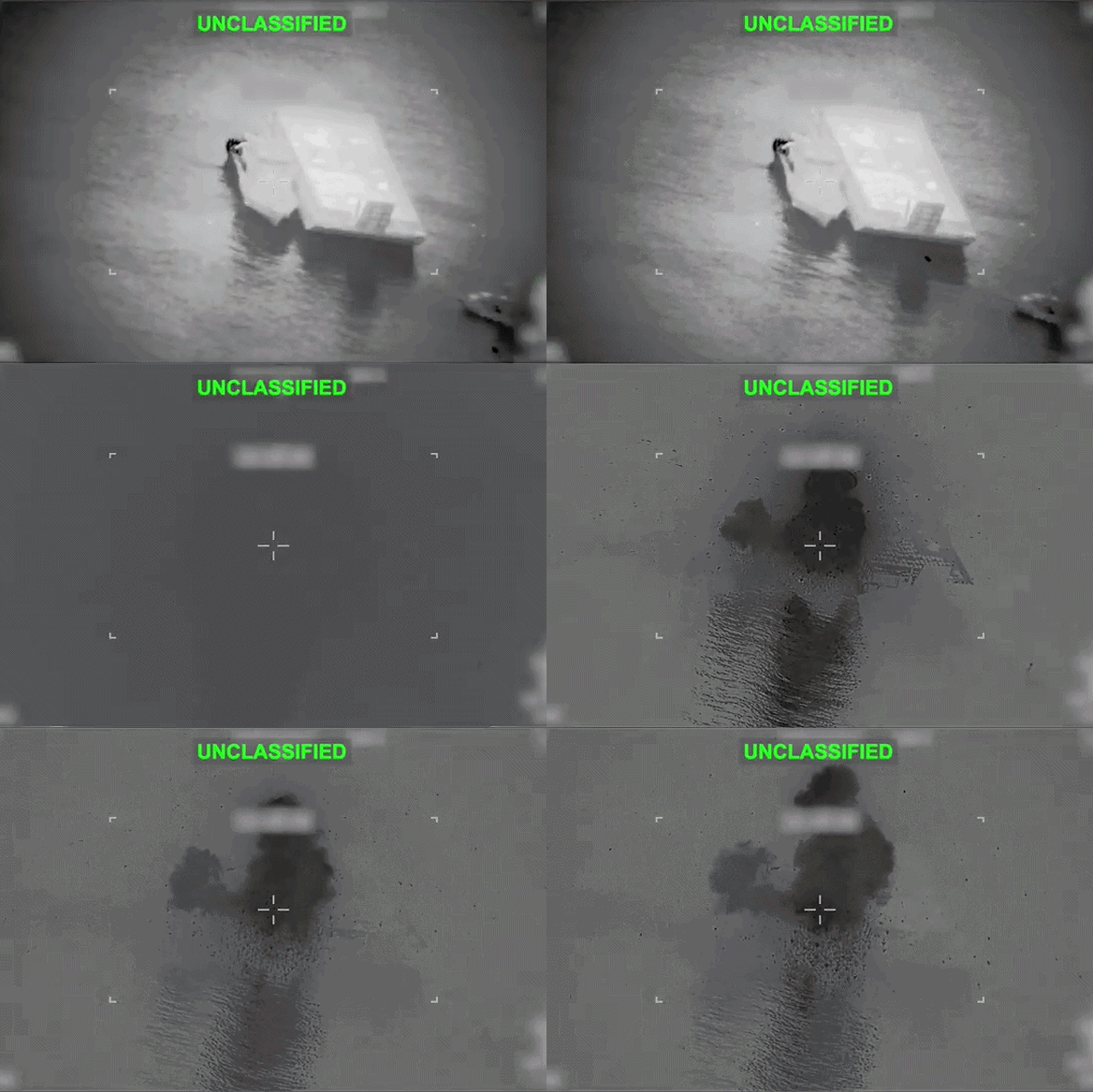

Washington: The US military says it has blown up more than a dozen “mine laying” Iranian boats near the Strait of Hormuz amid conflicting claims about attempts to disrupt oil supplies shipped through the crucial channel.
US Central Command said it eliminated 16 “minelayers” near the Strait, and uploaded footage showing strikes against several large and small vessels, similar to previous videos depicting strikes against suspected drug boats near Venezuela.
The military offensive came as President Donald Trump vowed to bomb Iran “at a level never seen before” if it placed mines in the passage, amid US media reports that the Iranian regime had begun deploying the devices.
CNN reported that a few dozen mines had been laid, citing sources familiar with US intelligence on the issue – though Trump said the government was not directly aware of it happening.
“If Iran has put out any mines in the Hormuz Strait, and we have no reports of them doing so, we want them removed, IMMEDIATELY!” he posted on social media.
“If for any reason mines were placed, and they are not removed forthwith, the Military consequences to Iran will be at a level never seen before. If, on the other hand, they remove what may have been placed, it will be a giant step in the right direction!”
Meanwhile, one of Trump’s cabinet members, Energy Secretary Chris Wright, deleted a social media post saying the US Navy had successfully escorted a tanker through the strait to keep global oil supplies flowing.
White House press secretary Karoline Leavitt confirmed the Navy had not escorted any vessel through the strait, though it was an option the president could use in the future. The post was deleted “quickly”, she said.
The oil price surged to $US116 a barrel at the start of the week, but Trump calmed markets by asserting the war would be over “soon”, and the price has generally hovered between $US80 and $US90 since.
Still, the regime in Tehran – which has been severely weakened by US and Israeli bombing over the past 10 days – is seeking to use the war’s impact on petrol prices to foment opposition to the US-Israeli operation. Iranian Foreign Minister Abbas Araghchi accused Wright of “posting fake news to manipulate markets”.
“It won’t protect them from inflationary tsunami they’ve imposed on Americans,” he said on X. “Markets are facing biggest shortfall in HISTORY: bigger than Arab Oil Embargo, Iran’s Islamic Revolution and the Kuwait invasion COMBINED.”
Ali Larijani, secretary of Iran’s Supreme National Security Council, wrote: “The Strait of Hormuz will either be a path of peace and prosperity for all, or a path of failure and suffering for warmongers.”
About a fifth of the world’s oil supply ordinarily passes through the Strait of Hormuz, but traffic has dried up since the outbreak of war on February 28.
General Dan “Razin” Caine, the chairman of the joint chiefs of staff, who is the president’s top military adviser, said the Pentagon was looking at a range of options to escort ships through the strait and would report to the president on the risks and resources required.
Some experts downplayed the threat posed by Iranian mines. Gregory Brew, an expert on Iran and oil at the Eurasia Group, said the mines were “a bit of a red herring”.
“Yes, Iran can lay them and yes, they make navigating the strait extremely hazardous,” he said. “But unlike drones, the mines don’t move. And the US Navy has craft that can detect and clear them.”
Tim Callen, a visiting fellow at the Arab Gulf States Institute, said the Strait of Hormuz was “pretty well closed anyway” and none of the recent developments changed the short-term scenario.
“I’m not aware of any mines having been dropped in the strait, although there have clearly been threats from Iran to do so,” he said.
“Potentially, if it becomes harder for Iran to threaten with drones or missiles, using mines against shipping is another option.”
Trump has sought to play down the war’s impact on oil prices as temporary, and said oil may be cheaper in the long-run if the Iranian threat is eliminated.
But he continues to face questions about the war’s duration, and what level of success he – and Israeli Prime Minister Benjamin Netanyahu – would be willing to accept.
While Trump has previously demanded Iran’s “unconditional surrender”, Leavitt said on Tuesday (Washington time) that that did not mean waiting for Tehran to literally surrender.
“He’s not claiming the Iranian regime is going to come out and say that themselves,” she told reporters. Rather, the president would decide that Iran’s missile stocks and fighting capability were so degraded that it constituted surrender.
“President Trump will determine when Iran is in a place of unconditional surrender when they no longer pose a credible and direct threat to the United States of America and our allies.”
Meanwhile, Democrats emerged from a classified briefing on the war with concerns that the operation was going to drag on longer than anticipated.
Richard Blumenthal, a Democratic senator from Connecticut, said: “We seem to be on a path toward deploying American troops on the ground in Iran to accomplish any of the potential objectives here.”
He was also concerned about Russia potentially assisting Iran by sharing intelligence about US military targets. Trump’s special envoy Steve Witkoff told CNBC television the Russians had denied doing so when Trump spoke with Putin on Monday.
“So, you know, we can take them at their word,” Witkoff said. “Let’s hope that they’re not sharing.”
 Michael Koziol is the North America correspondent for The Age and Sydney Morning Herald. He is a former Sydney editor, Sun-Herald deputy editor and a federal political reporter in Canberra.Connect via X or email.
From our partners
Disclaimer : This story is auto aggregated by a computer programme and has not been created or edited by DOWNTHENEWS. Publisher: www.smh.com.au