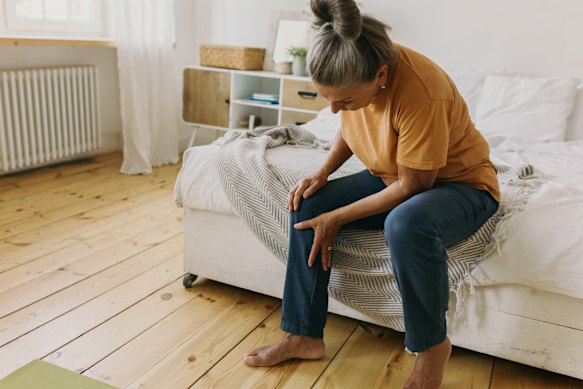

From “muscles falling off a cliff” to changing sexual function, menopause can bring a host of physical and psychological changes. But there’s one body part that tends to be forgotten when it comes to midlife: feet.
“Generally, there are two phases where your foot changes: during pregnancy, where a lot of the pre-pregnancy hormones are causing ligaments to loosen, and during menopause,” says Rachael Ferguson, a sports podiatrist and founder of SynxBody.
So, what’s the link between menopause, ageing and foot health? What can be done to support hard-working feet in the long term? And what should you do if you’re in pain?
The link between menopause and foot health
Our feet are delicate structures, comprised of 26 bones, 33 joints and more than 100 muscles, tendons and ligaments.
Caroline Robinson, associate professor of podiatry at Charles Sturt University, explains these weight-bearing extremities, while often forgotten about, endure an enormous amount of stress during our lifespan.
A reduction in collagen and elastin during menopause causes foot structure and strength to deteriorate, she says.
These changes, in turn, can lead to a wider foot or flattened arch, and increase the risk for conditions like plantar fasciitis or heel pain.
Ageing can leave feet more prone to tears, “and then women get less active perhaps because their feet are sore … there’s potentially quite a vicious cycle,” she says.
More than 70 per cent of those going through menopause experience musculoskeletal pain, which includes feet.
Robinson says smokers and those with diabetes – who tend to have poorer circulation, which impairs healing – can be at greater risk of foot injury or degradation.
Ferguson adds that “feet can be the first indication that you’re experiencing some hormonal changes in your skin”, with declining collagen causing dryness or fissures.
Hot flushes can also manifest in the feet with a “burning sensation”, particularly at night, she says.
How to take care of feet as you age
We know that declining estrogen and progesterone during menopause leads to a reduction in muscle mass and bone density, which of course affects feet too.
Ferguson says this means women should focus on evidence-based preventative measures, like strength training.
“Every female over the age of 35 needs to think about planning, including for your feet. Squatting with weights [for example], helps build bone density, so it’s not an issue later,” she says.
Robinson agrees that a whole body approach to supporting feet through ageing is key.
“It’s very hard to lose weight as you get older, and a lot of women do put on a fair bit of weight in midlife. The heavier you are, the load on your feet is huge, and that becomes a real issue.”
The other thing to consider is posture and core strength, and making sure feet are square with hips and not rolling inwards when standing still.
“The position of your legs and feet is dictated very much by your core muscles, so, your gluteal muscles around your bum, your hips and your abdominal muscles,” says Robinson.
She also suggests simple exercises that improve foot mobility, like the “towel scrunch”.
How to ease foot pain during menopause
So, what can be done if you’re experiencing foot pain or discomfort?
“No matter what the condition is, looking at shoes is No.1. So making sure you’ve got really good supportive, cushioned shoes, because if you’re not wearing the right footwear, then all these problems are going to be exacerbated,” says Ferguson.
Those experiencing foot pain can also consider more targeted options, she adds, like extra cushioning for areas most affected, such as the heel or ball of the foot.
Massage or taking magnesium can also help with aches, suggests Ferguson, while choosing a non-greasy foot cream with ingredients like urea and hyaluronic acid can help with dryness.
Robinson suggests some simple home remedies like rolling a sore foot on a frozen water bottle or wrapping a towel around the ball of your foot and gently pulling it towards you, to ease pain in the short term.
For some women, Ferguson says, treating the hormone decrease through medication like HRT or testosterone therapy can help address the root cause of pain.
But Ferguson’s main message is not to suffer in silence – particularly if pain persists.
“By changing your shoes and putting, say, a plantar fasciitis cushion or insole in your shoe, you should be able to get some immediate relief. If you’re finding the pain is persisting, it’s definitely better to see a podiatrist,” she says.
Make the most of your health, relationships, fitness and nutrition with our Live Well newsletter. Get it in your inbox every Monday.
From our partners
Disclaimer : This story is auto aggregated by a computer programme and has not been created or edited by DOWNTHENEWS. Publisher: www.smh.com.au