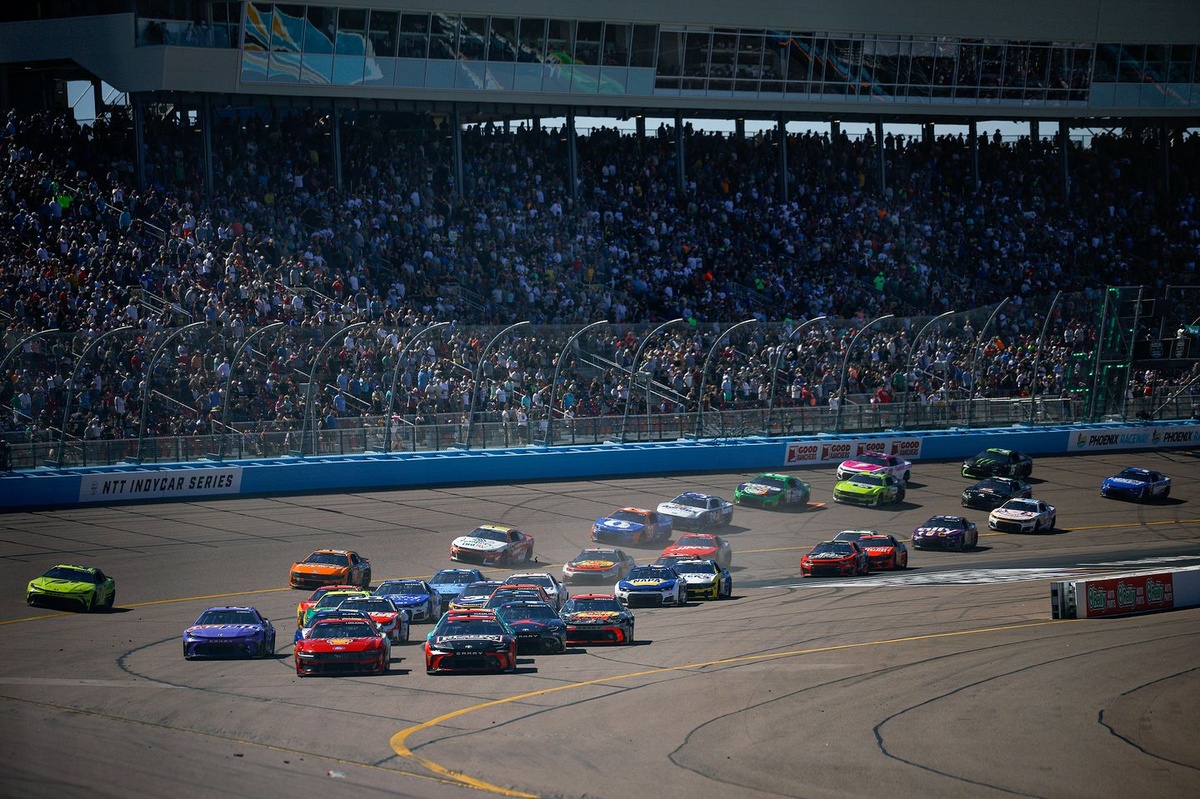
It was really easy on Sunday to see flat tires or tires come apart during the Cup Series race at Phoenix Raceway and say ‘tire failure’ but everyone with a reputable resume know that teams with problems were largely responsible for their fate.
As best described by Joe Gibbs Racing No. 20 crew chief Adam Stevens, there is a risk-versus-reward balance
“It’s so tough,” Stevens said with a laugh on Tuesday during an appearance on SiriusXM NASCAR Radio. “It’s just a quirk of our sport that the fans don’t understand. We just don’t know the load, air pressure and camber (combination) with certainty where we’re going to have a problem.
“What we do know is generally the tires make the most grip at higher camber settings and they last the longest at lower air pressure settings so, those two material facts are polar opposites of working together so the only way to really know where the edge is unfortunately is to cross it. You can think you know but you don’t know until you cross it or somebody else crosses it and you know exactly what they have going on.”
Stevens said, as a competitor, he has to ‘sneak up’ on the line and hope that crossing over it happens early enough in the race that his team can recover from it.
“It’s a quirky part of the sport and I don’t know how to get around it,” Stevens said. “In practice, we all get to break our down tires down and then Goodyear can cut them and see if there are any internal failures going on.
“But the tires are blowing because they are overloaded for a sustained amount of time. That load decreases as the lap times slow down and as the air pressures come up. So, there’s a lot of variables and the tires are laid up by hand. They’re made by humans, not machines, so there is a variability there and we could maybe all of practice at the same setup, air pressure and camber, and not have any problems and then get in the race and have a problem.”
Also speaking on SiriusXM NASCAR Radio, crew chief for William Byron and the Hendrick Motorsports No. 24 team Rudy Fugle echoed those competitive sentiments.
“The reason we want to go lower is — for most of the time, especially with this really short sidewall — as the driver leans the car into the corner, that sidewall has a ton of flex, and gives the driver a ton of feel before he goes from spinning out to tight.
“He can feel all of that … and make a decision on, ‘hey, I’m too loose, or I’m too tight, I’m going to pick up the gas and add steering wheel,’ and with this NextGen, with its shorter sidewall, this tire has way less so the driver is on edge.”
This is why, he says, there were way more snappy-spins in the first year of the NextGen in 2022 as drivers adapted to that sidewall.
“So the lower air pressure gives that sidewall way more flex, way more feel,” Fugle said. “When you have a tire that digs, the low air pressure generally means it survives way longer, so you make it a 60-lap run and it just survives a lot longer.
“So we want to push down to those limits and we have gotten to where we kind of have a calculation of trying to know, like air pressure, load (and) camber; what we can do.”
Remember, air pressure builds over the course of a run, no matter where you start it, but also, lower air pressure increases contact patch and overall mechanical grip.
Hosting his own show on SiriusXM, longtime crew chief turned broadcast analyst Todd Gordon also says drivers have a degree of responsibility to take care of whatever setup they are given too.
“At old Auto Club, the fast way around was you turned down across the apron in 3 and 4, and transition back up,” Gordon said. “I had a conversation with Joey (Logano) and told him that I could go lower (on air pressure) if you commit to me that you’re not going to pass anyone on the backstretch for four laps … and where drivers choose to race can impact tire life as well.”
Remember, at Phoenix, drivers can use the short cut by cutting across the apron on the restart, and that can shock the tires into an eventual degradation process too.
“So yes, camber is one, air pressure becomes one, how you install where you choose to be aggressive, how much load you’ve got into the setup, how much it shocks the load” Gordon added. “And then, how aggressive your driver is.
“Phoenix is tough on them because everybody wants to bail off and, and shorten the dog leg on cold tires first lap at speed. You’re driving across … and I mean, we see sparks and everything else coming out of these cars … It’s a brutal transition both down and back onto the race surface.”
This is also why, for years, Goodyear built much harder and way more durable tires, which negatively hurt the racing. To move towards the direction the industry has gone over the past three years, teams had to accept responsibility for all the things they’re admitting to this week, and not assign blame to the tire manufacturer.
The racing product has improved and crew chiefs and drivers have also earned the ability to take high risks for higher rewards over the course of any given race weekend.
We want your opinion!
What would you like to see on Motorsport.com?
– The Motorsport.com Team
Disclaimer : This story is auto aggregated by a computer programme and has not been created or edited by DOWNTHENEWS. Publisher: motorsport.com