Updated ,first published
THEATRE
Year of the Rooster ★★★★
fortyfivedownstairs, until March 22
Indie artist collective Spinning Plates Co made a splash with what has become known as The Beast Trilogy. The company kicked off with a biting adaptation of Dostoevsky’s bureaucratic satire, The Crocodile (2023), and continued through a bouffon-style take on the absurdist theatre classic, Rhinoceros (2024). Now the final instalment, Olivia Dufault’s The Year of the Rooster, takes the stage in a cockfight of epic proportions.
You read that right. It’s a play about cockfighting. The hero, Gil (Jessica Stanley), is an unlovely drudge at an Oklahoma McDonald’s. He still lives with his disabled Mother (Natasha Herbert), and gets regularly emasculated by a girlboss manager (AYA) with a Disney cosplay obsession. So far, so incel.
But Gil has an outlandish plan to go from omega to alpha male. He’s raising a monster rooster named Odysseus Rex (Zachary Pidd) that he’s pumped full of ’roids, fed on chicken nuggets, and turned into a beefcake through daily training.
Odysseus is a killing machine. Will it be enough to defeat the reigning champion – a blind assassin of a rooster, raised by despicable cockfighting impresario, Dickie Thimble (James Cerché)? And will Gil finally be respected if he owns the biggest cock in town?
Well, the play might technically nod to Homeric epic, but it’s the ridiculous, rather than the sublime, that dominates in this supersized satire of masculinity and McMisery in contemporary America.
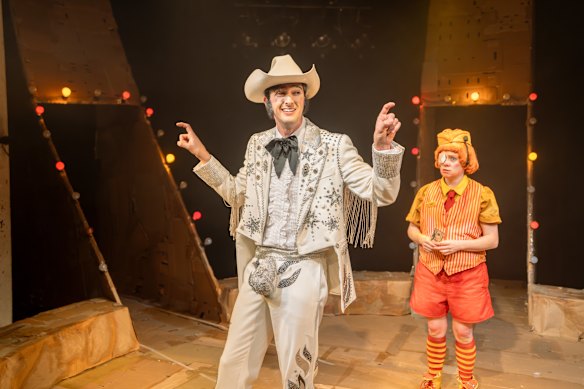
Director Alexandra Aldrich pumps the action to bursting with grotesque gender caricature, and together with Dann Barber’s outrageous costuming, the show struts and swaggers with vicious glee into a camp takedown of the delusive manospherics underpinning Trump 2.0.
It’s closer to the subversive comedy of disgust in Taylor Mac’s Hir, or even the Russian futurist opera Victory Over The Sun, than it is to anything in Homer. The only thing mythic here is the level of comedy the cast achieves.
The performances reveal with painful hilarity the dehumanising power of patriarchy: Pidd plays a tormented killer chicken in a hyper-jacked muscle suit, armed with Rambo knives, as if it were the role of a lifetime.
Stanley is winning as the hapless, mock-heroic loser at the centre of the play, and Cerché is brilliant in an awful way as the slimy misogynist nemesis – complete with gold tooth, black cowboy hat, and an enormous rhinestone-studded codpiece. And both AYA and Natasha Herbert revel in lampooning toxic views of femininity.
One chicken sex scene – featuring AYA as a hormone-riddled, hyper-femme specimen raised at a McDonald’s farm – is so absurd a gender parody that it proved impossible for anyone in the room to keep a straight face.
It’s unforgettable theatre and a savage, hideously stylish conclusion to a justly acclaimed project. I can’t wait to find out what this company does next.
Reviewed by Cameron Woodhead
DANCE
Mekar yang Diam ★★★★
Dancehouse, Carlton, until March 14
The achievement of Mekar yang Diam, a fine new cross-cultural duet by Yuiko Masukawa and Mekratingrum Hapsari, is its air of quiet ceremony: patient, unhurried movement shaped with real care.
This wonderfully solemn and spacious production is the result of a two-year exchange pairing a Melbourne-based choreographer with a Surakarta-based counterpart, with studio time split across both cities.
The work is itself a reflection on collaboration – perhaps because the partnership is partly given rather than chosen. It’s a study in how to share space and time while letting separateness remain felt.
What’s striking is how coherent it all feels. This isn’t a patchwork of influences or ideas. They’ve found a shared sensibility and, as performers, they look very well matched when dancing together.
Hapsari brings a background in hip-hop and traditional Javanese dance. She measures her own unfolding, taking pleasure in the transitions between poses, as if discovering her mobility in the moment. Masukawa’s base is classical ballet and yet her real asset is versatility. She’s presented a lot of work recently – and in very different contexts – and yet she always suggests the same high level of craft and intelligence.
The gaze of the dancers is striking. After beginning in slow unison, they both look off into the distance, past the audience: tracking the same vectors, holding the same focus, combining their attention.
The lighting is dim but tasteful. The excellent kimono-like costumes – grey with a structured rear silhouette – open suggestively at the seams. And red fingertips give the scene a small, decisive pop.
Streamers are eventually attached to the fingers, signalling entanglement and a developing intimacy, while also filling the stage with more colour, more air being worked, more drama in the picture.
It’s really a sensual model of neighbourliness: a proposition that strangers, shaped by different traditions and habits, might communicate by making careful, shared rituals of attentiveness.
So much of the duet is built around stillness and slowness. It hints at an awareness of the constraints that are involved when working across cultural difference – and a willingness to work patiently within them.
Following the duet downstairs, Dancehouse is also offering a triple bill of short concert works called new new by contemporary street dance artists – including Joshua Faleatua and Tyler Carney-Faleatua, Jorje and CONJAH.
These works are more earnest and a lot rougher at the edges than Mekar yang Diam, but that’s part of the wager: less self-interrogation, more pop reference, more interest in stage effects. The commitment to reinvigorating contemporary dance, at least, feels genuine.
Reviewed by Andrew Fuhrmann
THEATRE
Some Secrets Should Be Kept Secret ★★★
La Mama, Until March 29
Oz gothic is now a global phenom in the same way Scandi noir was in the 2000s. Some Secrets Should Be Kept Secret dives into classic gothic tropes, yet it derives a sense of deep and abiding horror from the cruelties inflicted on members of the Stolen Generations.
The play is the final part of a more expansive theatrical vision, the Indigenous Trilogy, from playwright Glenn Shea. It was in development at last showing and has been tweaked into a standalone of some brutality.
In its full context, the trilogy follows one character’s story of reconnection with Indigenous culture and spirituality, language and art; his transformation into a social worker in adulthood; and a reckoning with untold trauma that shaped him as a kid.
Here, we get the reckoning.
Three adult siblings – the brooding focus of the trilogy, Peter (Corey Saylor-Brunskill), sex worker Camille (Maggie Church-Kopp), gay activist Matthew (Brodie Murray) – are reunited at a crumbling rural homestead after the death of their adoptive mother.
A wild storm is brewing. A sudden power outage plunges everything into darkness. A sinister housekeeper (Nicole Nabout) and a ghost from Camille’s past (Syd Brisbane) await, as do unopened letters from their mother and damaging secrets that have stalked them all, unacknowledged, through adult life.
Directed by Shea, who also haunts the action as The Storyteller, the show is memorably split between open-air and indoor performance. It begins in the courtyard, as the siblings travel across the country, and features Aboriginal language and the use of ochre to build tension – and contrast to the appalling truths they will confront at their childhood home.
Even the weather seemed poised for dramatic effect, with a perfectly timed spot of light rain just before the audience moved inside La Mama’s historic black box theatre.
To some extent, the performances provoke discomfort by leaning into the gothic genre. It’s a deliberate tactic, I think. The artists know that no trope or template can capture the vastness of the suffering endured. No ghost story with bumps in the night, no blood-soaked reveal, no theatrical device can do justice to the enormity of the betrayal faced by the Stolen Generations.
Despite all that, silence is worse. The stigma surrounding institutional child sexual abuse is part of what allows it to flourish.
Some Secrets Should Be Kept Secret is a salient reminder of the importance of truth telling, and an unnerving excursion into gothic that remains acutely aware of both the power and limitations of theatre in representing and addressing historical injustice.
Reviewed by Cameron Woodhead
MUSIC
Sergej Krylov x Konstantin Shamray ★★★★
Live at Yours, Toorak Synagogue, March 10
Melbourne sports some splendid domes, not least the Exhibition Building and the State Library,
but being under the expansive dome of Toorak Synagogue proved a sympathetic acoustic space
in which to experience Russian-Italian violinist Sergej Krylov and Australia-based Russian
pianist Konstantin Shamray in a program of French favourites.
After a short Bach prelude, the duo got down to business with the Introduction and Rondo
Capriccioso by Saint-Saëns. After presenting his well-honed technical credentials in the
introduction, Krylov underlined the capricious nature of the main theme with deft lightness of
touch, making it sound like a passage cut from Bizet’s Carmen. This is not so fanciful, as Bizet
actually arranged Saint-Saëns’ original orchestral accompaniment for piano.
A modernist sensibility prevailed in two Ravel works from the 1920s. Violin Sonata No. 2 was
completed in 1927 at the height of the jazz age. Under Krylov’s hands, its central blues
movement presented a slightly risqué proposition; the idiomatic bending of pitch summoning up
smoky speakeasies. In the outer movements, Krylov and Shamray developed a persuasive
synergy; their exchanges dovetailing well in the sparse textures of the opening, while the
perpetual motion finale became a musical dynamo.
Tzigane from 1924, with its imaginary gypsy flavour was another ideal vehicle for Krylov,
allowing his glittering technical fireworks to illuminate the music.
In César Franck’s well-loved but perhaps over-played Violin Sonata in A major, Shamray took
the lead in the first movement, impressively using the gargantuan piano part to build powerful
and convincing climaxes. In the second movement, Krylov’s solo interventions allowed the
silvery tone of his 1710 Stradivari to soar. Over-excitement got the better of him in the finale
where the pushed tempo meant some important dramatic moments were passed by. Even so,
this enjoyable night under the dome ended on an ebullient note.
Reviewed by Tony Way
OPERA
Mary Motorhead/Trade ★★★★
Malthouse theatre, until March 13
On the morning of the Australian premiere of Mary Motorhead/Trade, opera singers across the globe woke to an unexpected diss from one of Hollywood’s biggest names.
Timothée Chalamet, in conversation with fellow actor Matthew McConaughey, said he didn’t want to be working in, “ballet or opera where it’s like, ‘Hey, keep this thing alive, even though no one cares about this anymore’.” Cue the horned helmets – opera singers and companies came out swinging, thousands of posts and videos filled social media showing packed houses with protestations decrying Chalamet’s comments.
This Irish double bill by composer Emma O’Halloran is about as far from the powdered wigs and screeching sopranos of Chalamet’s imagination, as it could possibly get.
Motorhead is a 30-minute, one-woman show, set in a place Dubliners sardonically call, “The Joy”, Mountjoy Prison, where we hear a young woman’s sorry tale of how she ended up stabbing her boyfriend in the head. Trade focuses on a transactional relationship between Older Man and Younger Man, who meet for sex in a seedy hotel room. Both operas were originally plays by the composer’s uncle, Mark O’Halloran.
Between the subject matter, the close proximity of the performers and the amplified chamber ensemble (including electronica) the intensity never lets up. There are no attempts at levity, each character traverses a deeply unsettling past, arriving at an apex of explosive rage or acute pain.
The Australian Contemporary Opera Company has assembled an all-Australian trio of singers for each of these tremendously difficult, Irish-accented roles. It’s a fickle one to nail, with its distinctive broad and slender vowels, and was inconsistent across the board.
Emily Edmonds is commanding as the unhinged Mary. The climactic moment where she exclaims she “split him open” is felt viscerally. Despite Mary’s relentless fury, Edmonds’ beautifully even and coloured mezzo still shone through, though in wild outbursts.
Tenor Callum McGing as Younger Man has a lot of one-word lines, though he makes the most of a brilliant countertenor-like quality he possesses when afforded the opportunity. His insecurity and brokenness were thoroughly believable.
Seasoned baritone Christopher Hillier gives the performance of his career as Older Man. This is a singer with supreme command of his voice; sometimes cold and dark, then evoking a burnished melancholy or desperate fragility at others. The scene unfolds in a profoundly unnerving manner; Hillier was visibly exhausted when it was finally over. It was exhausting just watching it.
Irish conductor Elaine Kelly has now premiered these works across three continents, and her expert hand seamlessly weaves techno with chamber ensemble, including saxophone and electric guitar. O’Halloran’s scores are a coup for contemporary opera.
Mozart might not be for our aforementioned motormouth actor, perhaps someone could convince him to try Mary Motorhead instead.
Reviewed by Bridget Davies
The Booklist is a weekly newsletter for book lovers from Jason Steger. Get it delivered every Friday.
From our partners
Disclaimer : This story is auto aggregated by a computer programme and has not been created or edited by DOWNTHENEWS. Publisher: www.smh.com.au