Often, just before Cillian Murphy, as Tommy Shelby, is about to snuff the life from someone, he stands very close and stares at his victim for a moment.
There are worse final sights than Murphy’s startling blue eyes.
Shelby, the boss of Peaky Blinders, a criminal enterprise, is a rather intimate murderer. He’s also savvy, complex and ruthless.
The beloved Peaky Blinders series ended with season six, almost four years ago. But the true finale is Netflix’s two-hour film, Peaky Blinders: The Immortal Man.
It’s a fitting and bloody cap to the drama that gave us history lessons on post-World War I Birmingham, Irish “travellers” and a street gang crazy enough to take on the Mafia.
Incidentally, Murphy has no idea how many bodies Tommy left in his wake.
“I’m sure there’s someone online who has done that,” he begins with a nod to the series’ massive popularity. “But to do that would be to forget what happened in the first world war, which we never see in the TV show. And I suppose we meet him as a product, sort of a waste product, of that war. He managed to get home from it alive, but completely dead inside. And so, I think that was such a fantastic starting point for a character because he was so emotionally crippled.”
He was also unaware that, when the situation allows, Tommy moves so close to the soon-to-be corpses.
“Maybe that’s a sort of a soldier thing,” Murphy says. “Maybe that’s a sort of an honour thing. To shoot a man in the back, or to shoot a man without looking at him, would be an act of cowardice. I don’t quite know, but that’s interesting. The whole thing with Tommy is that he’ll stare any man down because he’s seen things that nobody should ever witness, so I think he probably has that death stare.”
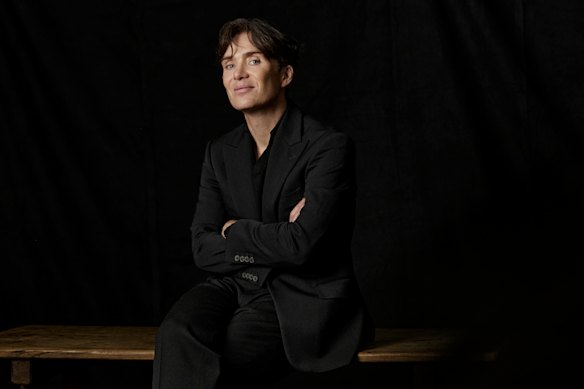
In a black turtleneck and with floppy hair, Murphy looks relaxed. Tommy’s dead-eyed glare is gone, as is that haircut, shaved high up the sides, thick on top, an accurate look for men from his time and place. The iciness that shrouded him as a crime boss has also disappeared.
However, Murphy still comes across as a controlled and very deliberate person, as he reflects on the role that has been part of his life for 14 years.
Tommy, he notes, is much more than a killing machine. He’s fiercely devoted to his family and friends – until they cross him. An ambitious entrepreneur, the character shares traits with another fictional crime boss, The Godfather’s Michael Corleone. They’re calculating, smarter than everyone around them, and move through life with an unusually calm swagger.
“That performance in that movie, Al Pacino, is one of the greats, and what I’ve always adored about it is that power and that silence and that restraint and that stillness,” Murphy says. “I guess there was an element of that in Tommy, but it’s also his huge intelligence and relentlessness.
“And then as the series evolved, I suppose these sorts of weird, twisted, warped values begin to emerge, particularly in the shadow of the second world war, where I think everything he believes in or had believed in is put under an awful lot of pressure.
“He’s forced to look at himself and say, ‘What actually are your values? What actually do you stand for?’ Having acquired all the material wealth, acquired all the power, become an MP, become a knight of the realm, like, what do you actually believe in? What is this all for? And I think that’s what he’s grappling with.”
The movie opens in Sachsenhausen concentration camp, Germany, as Nazis counterfeit hundreds of millions of pounds, scheming to crash Great Britain’s economy. It’s November 19, 1940, the date the Nazis rained bombs on Birmingham, killing 900 people.
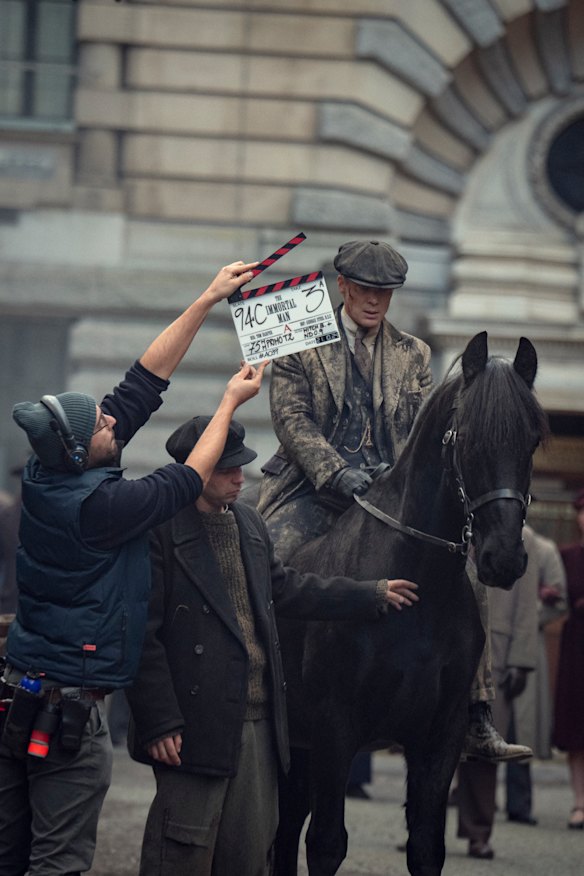
But Tommy is removed, physically and mentally, from all. He’s isolated himself with a trusted bodyguard/caretaker in a house so remote that he rides a horse to the gate when his sister dares visit.
Six years have passed since Tommy rode off on a white horse at the series’ end. It’s not just that his hair has greyed; he looks as if his soul has greyed. Haunted by ghosts, including his young daughter Ruby’s, Tommy is tortured. He’s writing, trying to make sense of his miseries, of two world wars, losing so many relatives and loves.
Tommy’s self-imposed exile is “a very crude form of self-therapy, or self-analysis,” Murphy explains. “He’s trying to figure out his legacy. I love that line, when he says to Ada, ‘I was never a parent. I was a form of government.’ He’s realising that children aren’t just chattel; they’re actual human beings, and they carry the consequences of how well or how badly you look after them. And that’s what [Tommy’s son] Duke is, the embodiment of all of that.”
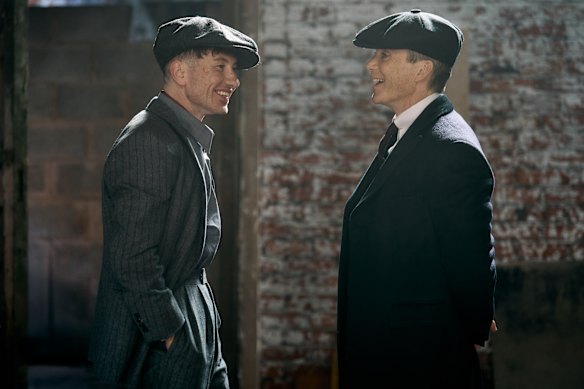
Last season, Tommy discovered Duke, his illegitimate son. Conrad Khan played him in the series. Now, Barry Keoghan plays the heartless thug who’s been running Peaky Blinders in recent years. Scenes between father and son radiate intensity, a space where Murphy shines.
His roles in Christopher Nolan’s films prove that. He was Scarecrow in The Dark Knight trilogy, a soldier in Dunkirk, and won the best actor Oscar in 2024 for playing J. Robert Oppenheimer in Oppenheimer.
Part of television’s appeal is that it left Murphy time to pursue film and stage projects. He lives with his wife and sons near Dublin after leaving London more than a decade ago. “The motivation was just to raise Irish children,” he explains.
Murphy acknowledges he’s “very unsentimental about work”, eager to move on to whatever’s next.
With Peaky Blinders, he kept returning, and it wasn’t as immediate as one would think – getting back into Tommy’s skin. Something as minor as lighting a cigarette is a Tommy original. He never just grabs a cig and lights it. No, he rubs it across his lips – a minor habit, certainly, but one that is kept throughout.
“It’s a funny thing,” Murphy says. “It’s never been easygoing getting into character. It always takes a number of months where I just have to cancel everything and just get into it physically and mentally. But each season, when I started, I always used the image of him as he starts driving the car, or he’s driving the motorbike, and I’m in the sidecar, and it becomes strangely kind of like subconscious, and you begin to exchange atoms of the character.
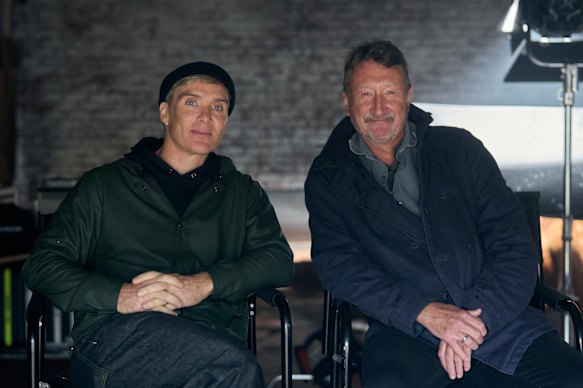
“And Steve [Knight, series writer and creator, who also wrote the film] began to write for the character through the way I was playing it. And I began to play, or sort of respond more to the writing. And so, it was all this kind of circular thing, which is a gift of doing something for such a long time. You know, it gets richer and richer if you really go for it.”
Plumbing a character over this long of a period is a challenging acting exercise. While a stage and movie role remain constant, Tommy changed along with the world.
“It’s a very different experience, because you are kind of growing a lot,” Murphy says. “You’re ageing parallel to the character. You don’t get to do that in a play or a film. It’s just a snapshot of that time in the character’s life and in your life, whereas this was very different. So, it’s a completely unique freak experience for me, and I’ll never experience it again.”
After a couple of seasons, casts regularly refer to themselves as family and promote one another on Instagram. Murphy, however, doesn’t buy into Hollywood tropes and isn’t on social media. “I always described it less like a family and more like an extremely violent boarding school, delighted to get released for the holidays,” he says.
In the beginning, Peaky Blinders could have been just another grim BBC drama; a second season was not a given.
“No one could have ever predicted it would become this global phenomenon,” Murphy says. “And would run and run, and that people in Buenos Aires and Turkey and wherever would be such huge fans of the show, and that people would have Peaky Blinders weddings and tattoos. We don’t know how or why – it just happened.”
Peaky Blinders: The Immortal Man is released in cinemas now and streams on Netflix from March 20.
Find out the next TV, streaming series and movies to add to your must-sees. Get The Watchlist delivered every Thursday.
Disclaimer : This story is auto aggregated by a computer programme and has not been created or edited by DOWNTHENEWS. Publisher: www.smh.com.au