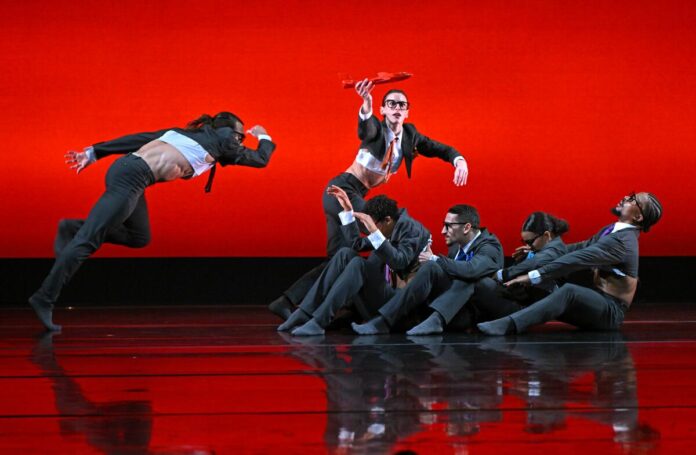
After 20 years as one of the city’s most respected and energetic homes for contemporary dance in Los Angeles, Bodytraffic plans an intentional sunset in July at the conclusion of its current season, the company is expected to announce Thursday. The company’s end wasn’t planned, but it became necessary when its artistic director and co-founder, Tina Finkelman Berkett, decided to step back from her role, citing fundraising fatigue and a desire for change.
“Over these past years, I got to realize the dream I had for this company, and what I wanted to give Los Angeles,” Berkett said. “The fundraising aspect of this job has been amongst the hardest parts of my life for 20 full years, and it’s taken quite a toll on me. Over the past year, I started to feel ready for the next chapter.”
The news of Bodytraffic’s unexpected closure comes shortly after the company received a $1-million multi-year general operating support grant from the Perenchio Foundation in September 2024, and then announced Trey McIntyre as creative partner and Lucinda Lent as executive consultant that November.
Over the years, Bodytraffic commissioned works by choreographers Micaela Taylor, Kyle Abraham, Victor Quijada, Matthew Neenan and Juel D. Lane, among others. It became one of the first L.A.-based dance companies to adopt the repertory model similar to Hubbard Street Dance Chicago and Alvin Ailey Dance Theater.
With the investment of board president Gillian Wynn, Bodytraffic was one of the few companies to provide living wages, health insurance and physical therapy for its dancers. As a community leader, the company had partnerships with educational and community organizations, including Everybody Dance LA!, L.A. County High School for the Arts and Boys & Girls Club of Metro Los Angeles, emphasizing outreach to youth and people with disabilities.
Bodytraffic became one of the first L.A. dance companies to offer health insurance and physical therapy for its dancers.
(Kevin Parry)
When Berkett decided to step away, she initially went to the board for insight on how to proceed. They deliberated, considering a successor or a new business model. Ultimately, the board found there was no way to replicate the commitment and energy Berkett put into the company, both artistically and financially. They decided that the right choice was to celebrate what the company has done over the last two decades and close strong with a final national season, “Tour of Thanks.”
Bodytraffic’s last L.A. shows are scheduled to take place at the Wallis from June 4 to 6. The company’s final performance will be with Aspen Santa Fe Ballet on July 25. In the meantime, the board and leadership will assist its dancers in successfully transitioning out of the company and into other opportunities.
“I hope that people who came to love dance and performing arts because of us continue to invest in our city,” Berkett said. “People have to go out and support the arts, actively, to keep them alive, and I know that I will have a lifelong commitment to furthering this cause.”
Berkett co-founded the company in 2007 with Lillian Barbeito at the age of 23. As someone who grew up in New York City, Berkett dreamed of performing at the Joyce, even as she started a company in Los Angeles. She recalled her family and teachers feeling uncertain about her move to the West Coast, especially since L.A. wasn’t considered a hub for contemporary dance. Finally bringing Bodytraffic to the Joyce in 2012 proved the idea wasn’t as unreachable as it seemed.
“At the end of the show, the company bowed, the curtains closed, and Lillian and I collapsed on that stage and cried,” she said. “We sobbed and sobbed. I’ll never forget that moment.”
Shortly after, a New York Times review described the performance as offering “signs of life from the Los Angeles dance scene.”
Bodytraffic quickly became a beacon for contemporary dance in a city where such a company was a rarity. Katie Garcia, who has been with the company for six years, discovered Bodytraffic while studying at Juilliard, where Berkett taught workshops to seniors. Although Garcia never met Berkett during her time at the school, she reached out to her via email with her materials, asking about the possibility of joining. She’s been with the company since and holds onto memories of touring and the obligatory “company meetings” that Berkett turned into surprise birthday celebrations for the dancers.
“Arts organizations are really struggling right now with the current climate, and it’s made it increasingly difficult for small organizations to sustain their work and their artists, but I’m really proud of the lasting impact that I know our company has had in creating opportunities for artists, connecting with our community and contributing to the cultural fabric of our field,” Garcia said.
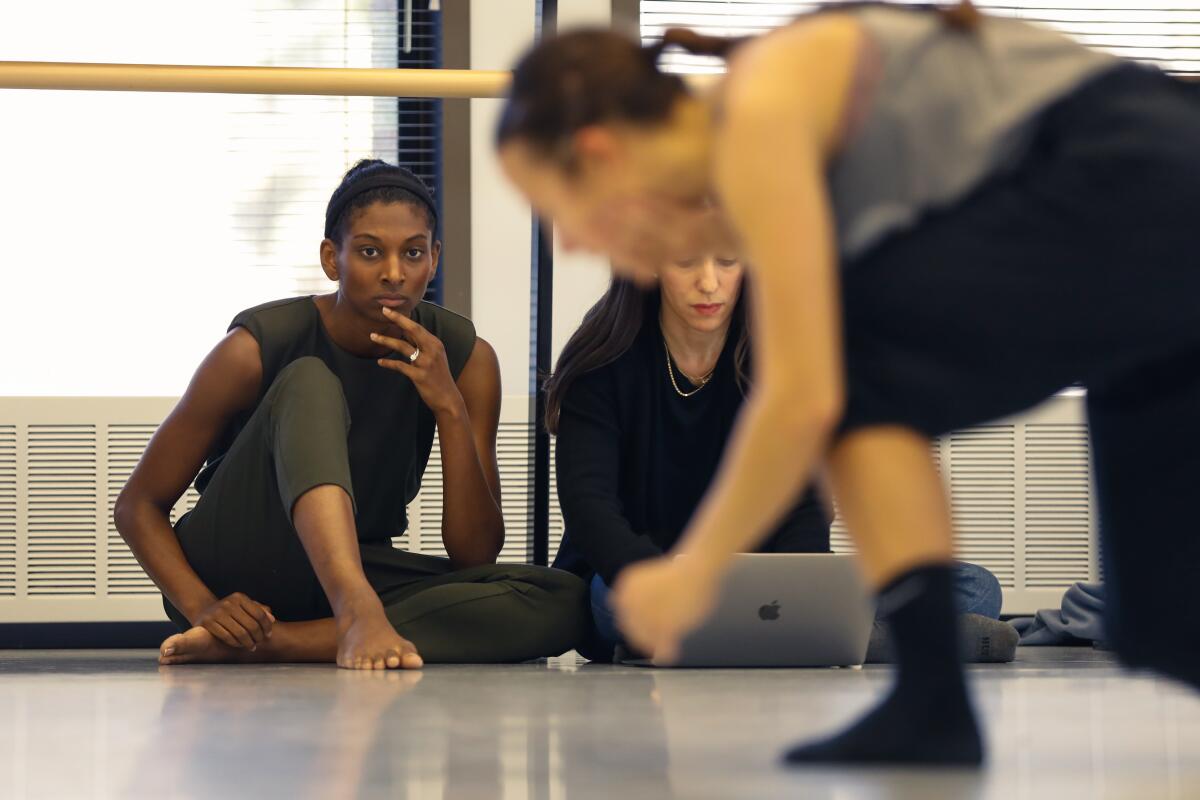
Choreographer Micaela Taylor working with Bodytraffic on October 17, 2022. The company hosted many exciting artists over its 20-year history.
(Christina House / Los Angeles Times)
Dancer Chandler Davidson is one of the company’s more recent additions. They attended the summer intensive in 2024, and Berkett recruited them as a guest artist, even though they were in the last year of college at the University of North Carolina School of the Arts. Upon completion of their bachelor of fine arts degree in May 2025, they joined full-time.
“Tina made my dream come true,” they said. “When you hear ‘company,’ you think of New York City, but I’ve always had the dream of living in Los Angeles. She literally handed me that dream on a platter, so I’m nothing short of grateful.”
Berkett primarily focused on giving dancers a path forward, whether or not they continued with the company. Garcia transitioned into the position of rehearsal director and discovered a love for nurturing the company culture. Meanwhile, dancers Joan Rodriguez and Jordyn Santiago got to choreograph new work under Berkett’s supervision. Telling the dancers about Bodytraffic’s end was difficult and sad for Berkett, but she says she was met with gratitude and empathy for her desire to evolve.
“It’s super-bittersweet, and I hope that the community can see this, not just as a loss, but also a win,” Davidson said. “It’s easy to become the dancer first before the human, and I hope that this inspires leaders, dancers, admins and people in the industry to listen to themselves.”
As Bodytraffic comes to an end, it leaves behind a legacy of artistry and community building through dance. Berkett plans to relish every second of it.
“I’ve spent almost 20 years fundraising,” she said. “This will be the first time that I’m going to stop asking people for money, and I am going to savor these five months. I am going to take in every last bit of enjoying my dancers and loving my job.”
More to Read
Disclaimer : This story is auto aggregated by a computer programme and has not been created or edited by DOWNTHENEWS. Publisher: latimes.com