-
In his first public remarks as Iran’s supreme leader, Ayatollah Mojtaba Khamenei apparently called for national unity and said that all US bases in the region should close or face attacks. The strait of Hormuz will remain closed in order to pressure Iran’s enemies, Khamenei reportedly said. He was not seen in the broadcast and the statement was delivered by a newsreader.
-
Khamenei said Iran will avenge the those who were killed in US-Israeli airstrikes, including the dozens of seven to 12-year-old girls who were killed in an airstrike that hit a school in Minab. He also offered financial compensation for Iranians who suffered damage from the attacks.
-
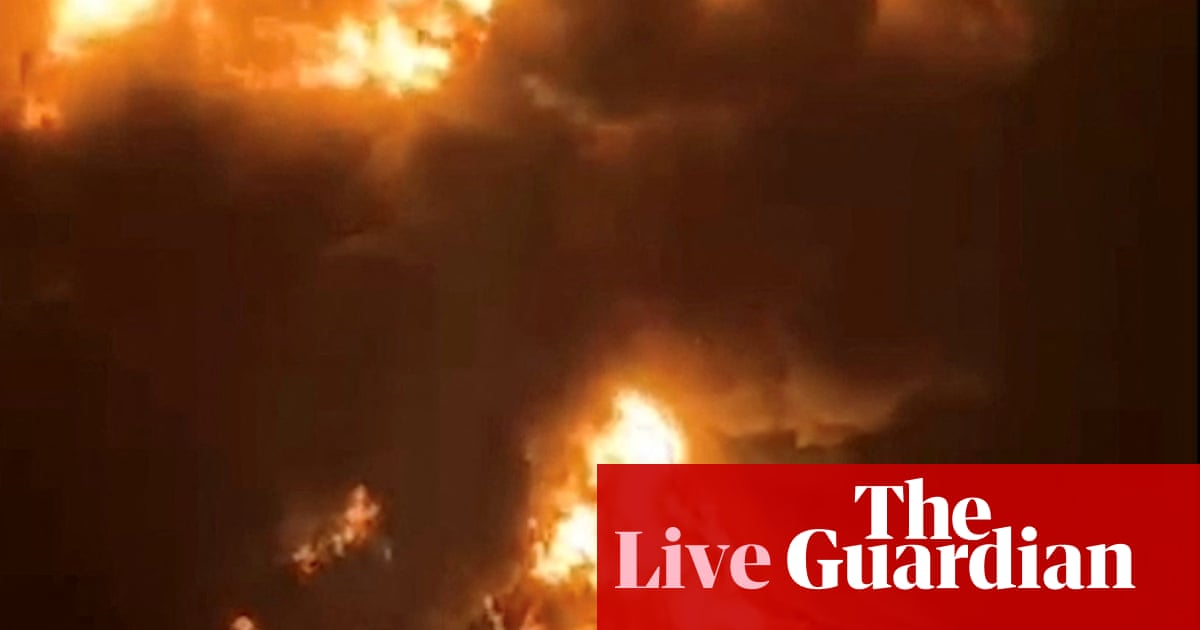
Iran appeared to have set two tankers ablaze on fire in Iraqi waters, killing one crew member, as it stepped up strikes on oil and transport facilities around the Middle East.
-
Thailand’s foreign ministry on Thursday said it had requested an apology from after a Thai bulk carrier was attacked in the strait of Hormuz yesterday. Three ships were hit by unknown projectiles in the strategic strait abutting Iran. While two of the ships sustained damage, the crew was forced to evacuate the Thai bulk carrier after it caught fire.
-
US energy secretary Chris Wright told CNBC on Thursday that the navy cannot escort ships through the strait of Hormuz now but it was “quite likely” that could happen by the end of the month. The issues with protecting oil tankers in the strait were discussed by US military officials in a classified briefing to top lawmakers on Tuesday, according to a person familiar with the matter.
-
As many as 3.2m Iranians have fled their homes to find safety from the joint US-Israeli aerial bombing campaign bombarding the country, according to preliminary assessments by the the UN refugee agency. “Most of them are reportedly fleeing from Tehran and other major urban areas towards the north of the country and rural areas to seek safety,” the UNHCR said in a statement on Thursday afternoon.
-
Oman’s foreign minister, and the mediator in the US Iran nuclear talks, has claimed the US will not achieve as much through war as it could have achieved in the peace talks. Badr bin Hamad Al Busaidi was speaking to Omani reporters in Muscat and appears to challenge the premise that the war is about Iran’s nuclear program, arguing it was designed to weaken Iran politically.
-
Oil prices, which shot up earlier in the week to nearly $120 a barrel before retreating, jumped almost 10% back above $100 a barrel before dropping to $98 a barrel amid renewed fears about supply disruption. A spokesperson for Iran’s military command had earlier warned in remarks directed at the US: “Get ready for oil to be $200 a barrel, because the oil price depends on regional security, which you have destabilised.”
-
Vladimir Putin’s “hidden hand” lies behind Iran’s military methods, the UK defence secretary, John Healey, has said, after a night in which drones struck a camp used by western forces in Erbil, northern Iraq. Healey was speaking after British officers at the UK’s military headquarters in north-west London had told him that Iranian and Iranian proxy drone pilots were increasingly adopting tactics “from the Russians”.
-
Iran wants to ensure that a war will not be imposed on it again in the future, deputy foreign minister Majid Takht-Ravanchi told AFP, as the conflict raged with the United States and Israel. “We want to see that war is not going to be imposed again on Iran,” said Takht-Ravanchi in an interview with AFP in Tehran.
-
The International Maritime Organization (IMO) will convene an “extraordinary session” next week to discuss threats to shipping in the Middle East and particularly in the strait of Hormuz, the agency said Thursday. The meeting, scheduled for 18-19 March at the IMO headquarters in London, was requested by several council members.
-
Israeli forces conducted a drone strike on an area of Beirut where displaced residents were sheltering in tents. At least eight people were killed in the attack on the capital’s beachfront.
-
The Israeli military issued a warning on Thursday to residents of a village in Lebanon located about 64 kilometres (40 miles) east of Beirut. It also announced that it had begun yet another widescale wave of strikes on Iran. The IDF also said that Israeli forces had struck a nuclear program site in Iran earlier this week, but the Guardian was not able to independently verify that statement.
-
Amid the Israeli strikes on Lebanon and Iran, displaced Palestinians in a tent encampment near Gaza City said they received a call from the Israeli military on Wednesday night ordering them to evacuate in five minutes. Video shows the camp then getting struck.
-
Drones struck Kuwait international airport on Thursday, causing some material damage. It is unclear who is responsible for the attack, which came one day after four people were injured when air defences intercepted two drones near Dubai airport in the United Arab Emirates. Soon after the attack, the Dutch carrier KLM canceled all flights to Dubai up to and including 28 March.
-
An Italian military base in the Kurdish region of Iraq was attacked, Italian foreign minister Antonio Tajani said in a post on X. Tajani said he strongly condemned the attack in Erbil, but didn’t say if authorities knew who was responsible for it. He said all soldiers on the base were safe.
-
About 2,000 people have reportedly been killed in the war launched almost two weeks ago, while Unicef said more than 1,100 children had been killed or injured.
Here are some images coming out of Beirut amid the latest wave of Israeli strikes on the Lebanese capital.
A reminder that at least 687 people have been killed and over 1,500 others injured in Israeli airstrikes across Beirut’s southern suburbs and the IDF’s ground invasion of villages in southern Lebanon.
More than 800,000 people have been displaced since Israel began its deadly assault on 2 March, after Hezbollah launched rockets towards Israeli territory following the US-Israeli assassination of Iran’s supreme leader at the start of the war.
The Israeli military claims it is targeting Hezbollah infrastructure and personnel with its widespread aerial and ground assault on Lebanon.
Qatar’s defence ministry has said that it intercepted two ballistic missiles, one cruise missile and multiple drones launched from Iran on Thursday.
The US Navy, perhaps with an international coalition, will escort vessels through the strait of Hormuz when it is militarily possible, US treasury secretary Scott Bessent has told Sky News.
My belief, that as soon as it is militarily possible, the US Navy, perhaps with an international coalition, will be escorting vessels through.
The plan to escort ships would go ahead as soon as the US has “complete control of the skies and … [Iran’s] rebuilding capabilities for the missiles completely degraded,” he said.
Bessent added:
There are, in fact, tankers coming through now, Iranian tankers, I believe some Chinese flag tankers have come through. So we know that they have not mined the straits.
Earlier, US energy secretary Chris Wright told CNBC that the navy cannot escort ships through the strait of Hormuz now – but it was “quite likely” that could happen by the end of the month.
US-Israeli strikes on Iran and Tehran’s subsequent response have paralysed shipping through the critical waterway, disrupting vital oil and gas flows and sending global energy prices soaring.
The IDF has announced it has launched an “extensive wave” of strikes across Tehran. It claims it is targeting the infrastructure of the regime.
Earlier, Donald Trump said the Iranian national football team was “welcome” to participate at this summer’s World Cup – which is taking place in the US, Canada and Mexico – but, extraordinarily, added:
I really don’t believe it is appropriate that they be there, for their own life and safety.
The US president didn’t elaborate on the nature of the risk.
Iran are scheduled to play three group matches in the international football tournament, which begins on 11 June. They’re due to face New Zealand and Belgium in LA on 15 and 21 June respectively, and Egypt in Seattle on 26 June.
Trump’s warning comes after Iran’s sports minister Ahmad Donyamali told state media on Wednesday that “under no circumstances” could the country’s football team participate in the competition, given that US-Israeli strikes on Iran have killed the supreme leader and more than 1,348 civilians.
Considering that this corrupt regime has assassinated our leader, under no circumstances can we participate in the World Cup.
Our children are not safe and, fundamentally, such conditions for participation do not exist.
Given the malicious actions they have carried out against Iran, they have forced two wars on us over eight or nine months and have killed and martyred thousands of our people.
Therefore, we certainly cannot have such a presence.
Jillian Ambrose and Callum Jones
Oil markets are facing the “largest supply disruption in history” as the US-Israeli war on Iran continues to block tankers from producing and shipping millions of barrels of crude each day, the world energy watchdog has warned.
The International Energy Agency (IEA) said the supply shock ignited by Iran’s effective blockade of the strait of Hormuz meant the world faced a deeper crisis than after the Yom Kippur war of 1973 and the 2022 outbreak of war in Ukraine.
The warning came as Iran issued a statement that was said to be the first from its new supreme leader, Mojtaba Khamenei, to call for the vital trade artery to “remain closed”, in a blow to hopes of a resolution to the crisis.
In response, global oil prices again passed $100 (£75) a barrel on Thursday as widespread Iranian attacks on energy facilities in the Middle East overshadowed a vast release of government reserves.
Here’s the full report:
US defense officials told senators on the armed services committee that the cost of the war on Iran totaled more than $11.3bn in the first six days alone, according to multiple reports.
The New York Times was first to break the news about the conflict’s price tag, citing three people familiar with the closed-door briefing on Tuesday.
According to the Times, the figure did not include many of the costs associated with the operation, such as the buildup of military hardware and personnel ahead of the first strikes. For that reason, lawmakers expect the number to grow considerably as the Pentagon continues to calculate the costs that accumulated during the first week of military action on Iran.
Several reports note that the White House is expected to submit additional funding requests for the conflict, despite the fact that Donald Trump claimed last week the US has a “virtually unlimited supply” of medium and upper grade ammunition that is primarily being used in the war.
The administration has not provided a public estimate of the cost of the conflict, and has offered confusing messages about its timeline. Trump said on Wednesday that “we won” the war but that the US will stay in the fight to “finish the job”.
Indian prime minister Narendra Modi on Thursday spoke to Iranian president Masoud Pezeshkian, Modi said in a post on X.
“The safety and security of Indian nationals, along with the need for unhindered transit of goods and energy, remain India’s top priorities,” he wrote.
-
In his first public remarks as Iran’s supreme leader, Ayatollah Mojtaba Khamenei apparently called for national unity and said that all US bases in the region should close or face attacks. The strait of Hormuz will remain closed in order to pressure Iran’s enemies, Khamenei reportedly said. He was not seen in the broadcast and the statement was delivered by a newsreader.
-
Khamenei said Iran will avenge the those who were killed in US-Israeli airstrikes, including the dozens of seven to 12-year-old girls who were killed in an airstrike that hit a school in Minab. He also offered financial compensation for Iranians who suffered damage from the attacks.
-
Iran appeared to have set two tankers ablaze on fire in Iraqi waters, killing one crew member, as it stepped up strikes on oil and transport facilities around the Middle East.
-
Thailand’s foreign ministry on Thursday said it had requested an apology from after a Thai bulk carrier was attacked in the strait of Hormuz yesterday. Three ships were hit by unknown projectiles in the strategic strait abutting Iran. While two of the ships sustained damage, the crew was forced to evacuate the Thai bulk carrier after it caught fire.
-
US energy secretary Chris Wright told CNBC on Thursday that the navy cannot escort ships through the strait of Hormuz now but it was “quite likely” that could happen by the end of the month. The issues with protecting oil tankers in the strait were discussed by US military officials in a classified briefing to top lawmakers on Tuesday, according to a person familiar with the matter.
-
As many as 3.2m Iranians have fled their homes to find safety from the joint US-Israeli aerial bombing campaign bombarding the country, according to preliminary assessments by the the UN refugee agency. “Most of them are reportedly fleeing from Tehran and other major urban areas towards the north of the country and rural areas to seek safety,” the UNHCR said in a statement on Thursday afternoon.
-
Oman’s foreign minister, and the mediator in the US Iran nuclear talks, has claimed the US will not achieve as much through war as it could have achieved in the peace talks. Badr bin Hamad Al Busaidi was speaking to Omani reporters in Muscat and appears to challenge the premise that the war is about Iran’s nuclear program, arguing it was designed to weaken Iran politically.
-
Oil prices, which shot up earlier in the week to nearly $120 a barrel before retreating, jumped almost 10% back above $100 a barrel before dropping to $98 a barrel amid renewed fears about supply disruption. A spokesperson for Iran’s military command had earlier warned in remarks directed at the US: “Get ready for oil to be $200 a barrel, because the oil price depends on regional security, which you have destabilised.”
-
Vladimir Putin’s “hidden hand” lies behind Iran’s military methods, the UK defence secretary, John Healey, has said, after a night in which drones struck a camp used by western forces in Erbil, northern Iraq. Healey was speaking after British officers at the UK’s military headquarters in north-west London had told him that Iranian and Iranian proxy drone pilots were increasingly adopting tactics “from the Russians”.
-
Iran wants to ensure that a war will not be imposed on it again in the future, deputy foreign minister Majid Takht-Ravanchi told AFP, as the conflict raged with the United States and Israel. “We want to see that war is not going to be imposed again on Iran,” said Takht-Ravanchi in an interview with AFP in Tehran.
-
The International Maritime Organization (IMO) will convene an “extraordinary session” next week to discuss threats to shipping in the Middle East and particularly in the strait of Hormuz, the agency said Thursday. The meeting, scheduled for 18-19 March at the IMO headquarters in London, was requested by several council members.
-
Israeli forces conducted a drone strike on an area of Beirut where displaced residents were sheltering in tents. At least eight people were killed in the attack on the capital’s beachfront.
-
The Israeli military issued a warning on Thursday to residents of a village in Lebanon located about 64 kilometres (40 miles) east of Beirut. It also announced that it had begun yet another widescale wave of strikes on Iran. The IDF also said that Israeli forces had struck a nuclear program site in Iran earlier this week, but the Guardian was not able to independently verify that statement.
-
Amid the Israeli strikes on Lebanon and Iran, displaced Palestinians in a tent encampment near Gaza City said they received a call from the Israeli military on Wednesday night ordering them to evacuate in five minutes. Video shows the camp then getting struck.
-
Drones struck Kuwait international airport on Thursday, causing some material damage. It is unclear who is responsible for the attack, which came one day after four people were injured when air defences intercepted two drones near Dubai airport in the United Arab Emirates. Soon after the attack, the Dutch carrier KLM canceled all flights to Dubai up to and including 28 March.
-
An Italian military base in the Kurdish region of Iraq was attacked, Italian foreign minister Antonio Tajani said in a post on X. Tajani said he strongly condemned the attack in Erbil, but didn’t say if authorities knew who was responsible for it. He said all soldiers on the base were safe.
-
About 2,000 people have reportedly been killed in the war launched almost two weeks ago, while Unicef said more than 1,100 children had been killed or injured.
Iran security chief says will not relent until US “sorry for grave miscalculation”.
Iranian security chief Ali Larijani said Thursday that his country would not give up fighting until the United States came to regret the “grave miscalculation” of launching its war against the Islamic republic.
“Trump says he is looking for a speedy victory. While starting a war is easy, it cannot be won with a few tweets. We will not relent until making you sorry for this grave miscalculation,” Larijani said on X.
As two tankers burn in the waters, Greenpeace has warned that the 85 tankers currently sitting in the Persian Gulf, carrying a cumulative 21bn litres of oil, are an environmental disaster waiting to happen.
Greenpeace Germany has been mapping oil tankers trapped in the area and potential impacts of an oil spill if they are damaged.
The strait of Hormuz and the adjacent waters of the Persian Gulf and the Gulf of Oman contain sensitive ecosystems such as coral reefs, mangrove forests, and seagrass meadows, which provide vital habitats.
Even in peacetime, these ecosystems are exposed to extreme and significant human pressures from the vast scale of the shipping oil extraction, seawater desalination, and coastal development in the region.
On Thursday, filmed from the shore of the port of the Iraqi oil port of Basra showed two ships engulfed in massive orange fireballs that lit up the night sky, after attacks which Iraqi authorities blamed on explosive-laden Iranian boats.
“Right now, there are dozens of tankers carrying billions of litres of oil trapped in the Persian Gulf as mines are being laid and missiles are hitting ships,” said Nina Noelle, a spokesperson for Greenpeace Germany.
“This is an environmental disaster waiting to happen. A single oil spill in the Gulf could damage this fragile marine habitat beyond repair with devastating consequences for people, animals, and plants in the region, adding to the terrible human toll this illegal war has already taken on local communities.”
Greenpeace have produced an interactive map simulating the potential consequences of oil spills in the Persian Gulf if tankers are damaged. Noelle said: “The strait of Hormuz and adjacent waters are home to pristine coral reefs, mangrove forests, and seagrass meadows.
“This is an ecological ticking time bomb and represents an enormous risk that further increases instability and human suffering in the region.”
Iran wants to ensure that a war will not be imposed on it again in the future, deputy foreign minister Majid Takht-Ravanchi told AFP, as the conflict raged with the United States and Israel.
“We want to see that war is not going to be imposed again on Iran,” said Takht-Ravanchi in an interview with AFP in Tehran.
“When the war started last June, after 12 days there was so called cessation of hostilities… but after eight or nine months, they regrouped and they did it again,” he said, referring to the US and Israel.
“We do not want to be treated like this again in the future.”
Iran issued its first message in the name of its new supreme leader, Mojtaba Khamenei, on Thursday, saying it would keep the strait of Hormuz closed and continue to attack US bases in the region.
The missive was read out on state TV rather than delivered live or on video, however, and will do little to satisfy those seeking proof that the son of the late Ayatollah Ali Khamenei is actually alive.
In the message, Khamenei said he would demand compensation from the US for its attacks, and that if Washington refused he would order the destruction of its assets equivalent to the amount Iran is owed.
With doubts circulating about his health after the lethal attack on his father’s compound on the first day of the US-Israeli assault, the message read out on state TV is bound to be examined closely for the first clues of the kind of leadership the previously backroom politician intends to provide.
Described as a hardliner close to the Islamic Revolutionary Guards Corps, Khamenei, 56, said little in his message about the recent internal divisions in the country save to praise “the masses of people who have gathered in magnificent assemblies to reaffirm their allegiance to the system”.
“There must be no harm to the unity of the nation among the individuals and groups of the nation which usually becomes specially evident in times of hardship,” he said, calling for “points of disagreement” to be overlooked. He also showered praise on the Iranian people for standing up to the aggressor, saying it had brought admiration from friends and astonishment from enemies.
Oman’s foreign minister, and the mediator in the US Iran nuclear talks, has claimed the US will not achieve as much through war as it could have achieved in the peace talks.
Badr bin Hamad Al Busaidi was speaking to Omani reporters in Muscat and appears to challenge the premise that the war is about Iran’s nuclear program, arguing it was designed to weaken Iran politically.
In the official account of the meeting it is said “in describing the background of the war, the minister stated that the decision was not fundamentally linked to the Iranian nuclear program”.
He noted that recent negotiations had reached a very advanced stage, including an Iranian pledge not to possess nuclear material capable of producing a bomb, a commitment not to accumulate or store enriched materials and to convert existing stockpiles into irreversible fuel.
He emphasised that the United States could not have obtained greater concessions through war than those achieved through negotiation.
He added that the true objective of the war was to weaken Iran, reshape the region, and advance the normalisation process within a broader context that also included attempts to prevent the establishment of a Palestinian state and to weaken any country or institution that supports or stands with the Palestinian statehood project.
In response to a question about Oman’s position on the ‘peace council’, he stated that Oman would not join the council and would not normalise relations with Israel.
The minister considered the American and Israeli attacks on Iran a new link in a “dangerous chain of violations witnessed in recent years” and said they threatened to undermine the legal framework that had provided protection and stability to the countries of the region for decades.
Disclaimer : This story is auto aggregated by a computer programme and has not been created or edited by DOWNTHENEWS. Publisher: theguardian.com