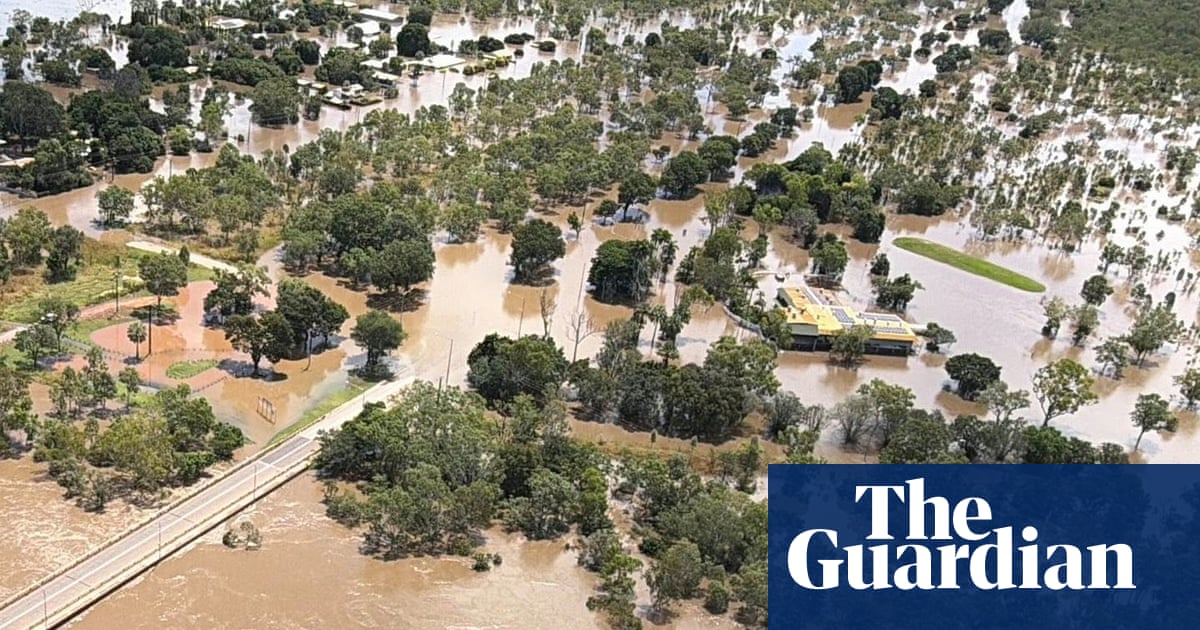
The Northern Territory government will freeze rental payments for public housing tenants affected by historic floods spreading across the Big Rivers region.
Monsoonal rainfall has inundated remote Aboriginal communities in the region over the past two weeks. The Daly River area was hit hardest on Wednesday, with Dorisvale Crossing reaching 23.93 metres by 1.30pm, the highest level ever recorded. The nearby Katherine River peaked at 19.2 metres last Saturday, its highest level since floods in 1998.
The NT’s department of housing confirmed the emergency rent pause on Friday, saying flood-affected public housing tenants did not need to apply to receive the reprieve.
“The rent pause will be applied automatically for eligible public housing tenants,” a department spokesperson said. “While the response is under way, we continue to survey and assess conditions for entry to communities, followed by scoping of properties for safety.”
The spokesperson said the department “remains focused on supporting displaced residents, assessing damage as quickly as possible, and helping affected public housing tenants”.
Aboriginal Housing NT chief executive Leeanne Caton, said pausing rent payments was “show of good will” until people were able to return to safe homes, clean them out and make them habitable.
“We’re talking about the most disadvantaged people in the territory – or probably in this country – who are now technically homeless, because they have been evacuated from their communities,” she said.
“These people are in poverty already, and they’re just living and camping where they can in the regional centres.
Caton added: “The real point here is that these people are human beings and they should be treated as such. With respect and government should be doing whatever they can to help them in whatever way they can. Just because they live in a remote community, doesn’t mean they don’t deserve respect.”
The announcement came three days after the North Australian Aboriginal Justice Agency (NAAJA) wrote a letter to federal and NT governments criticising the “patchwork response” to support communities outside Katherine.
As of Wednesday, people living outside the Katherine local government area were unable to access emergency flood-relief payments, which drew criticism from multiple Aboriginal peak bodies.
CEO of NAAJA, Ben Grimes, said remote Aboriginal communities housed some of the “most vulnerable people” in the region, many of whom were now displaced.
“Many of our clients are living in social housing and low-lying areas hardest hit by flood waters. Some households have lost everything. The system isn’t built to quickly support them in a crisis – it’s making recovery slower and more painful than it needs to be,” he said.
Grimes called for a freeze on rent for social housing tenants in flood-affected areas, with refunds for any rent paid since 6 March. He also raised concerns that people from the homeland communities of Emu Point, Woodycupidiya and Uminyuluk homelands were experiencing food shortages.
An NT government spokesperson said food security concerns were “being appropriately addressed”. They also said due to multiple emergency events “occurring “simultaneously”, flood-relief payments were being rolled out with “different timelines”, which affected when specific relief measures could be activated.
Food relief payments for affected areas – including the Roper Gulf, West Daly, Victoria Daly, Coomalie, Belyuen, Wagait, West Arnhem, Litchfield, Darwin, Palmerston and greater Darwin areas – were added to joint state-territory emergency Emergency funding arrangements on Thursday.
Residents from the remote communities of Naiyu (Daly River) and Palumpa have been evacuated to the Darwin showgrounds, with no timeline on when they can return to their homes. Meanwhile, Kakadu has been completely cut off.
Shadow minister for housing, Dheran Young said the NT government needed to support rebuilding communities when flooded waters receded.
“That approach matters because overcrowding is already a serious challenge in many remote communities, with real consequences for health, safety and wellbeing, and recovery efforts should reduce that pressure rather than make it worse,” he said.
A federal government spokesperson said they supported states and territories with the costs of providing relief and recovery assistance through the jointly funded disaster recovery funding arrangements, but that the responsibility for distributing that assistance rested with the states.
Disclaimer : This story is auto aggregated by a computer programme and has not been created or edited by DOWNTHENEWS. Publisher: theguardian.com