
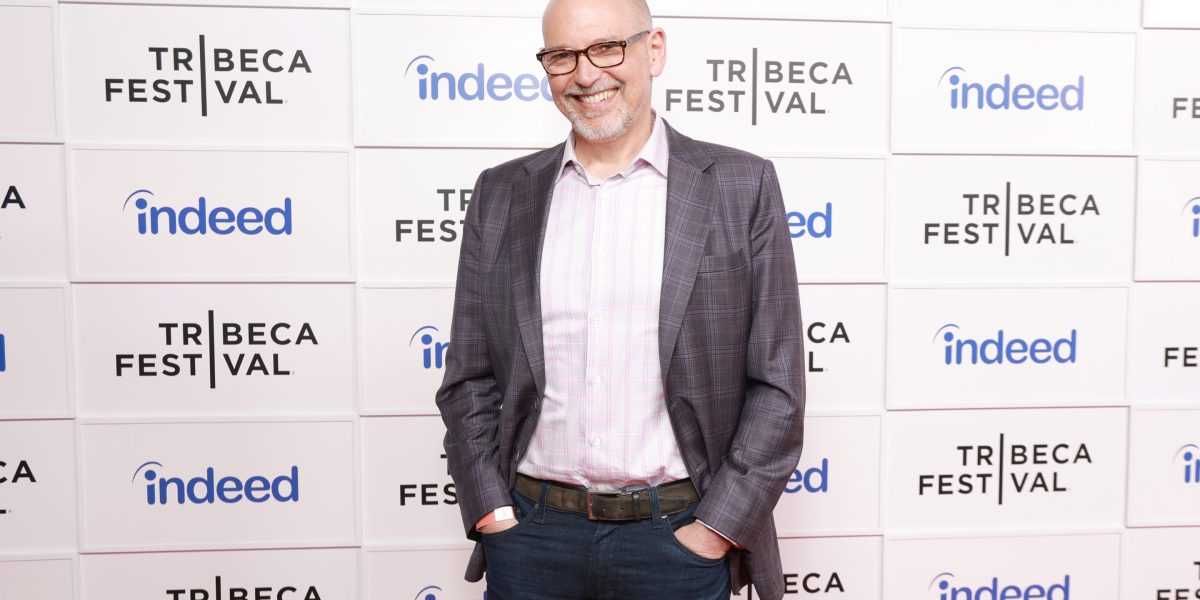
Good morning. Former Indeed CEO Chris Hyams didn’t leave Big Tech because he lost faith in AI. He left because he lost faith in the way it’s being unleashed.
“There’s so much counter‑messaging around AI that’s either utopia or doom,” Hyams told me yesterday. “I’m a big believer in the potential of the technology, but I have extraordinary concern about the people who are responsible for driving it.”
The people he’s referring to are leaders like OpenAI CEO Sam Altman, Meta’s Mark Zuckerberg and Elon Musk, who tend to share a utopian narrative that AI will make work optional and our lives longer. None go out of their way to encourage AI regulation or limits on how their technology is used. Hyams singles out the beleaguered Dario Amodei of Anthropic as the “one bright light” and “best of the bunch,” noting that standing up for what’s right has required being private or a founder with considerable power.
Hyams left Indeed in June after more than six years as CEO, saying he wanted to work on making sure technology was being developed with humanity at its core. It sounded like another anodyne press release: a CEO leaving for personal reasons, perhaps with a grudge. But that’s not true. Hyams stayed on as an advisor and spoke highly of parent Recruit Holdings and its CEO, “Deko” Hisayuki Idekoba, who took on his Indeed role. Hyams started his career as an addiction counsellor, then a special education teacher, a musician, a programmer and later an entrepreneur before joining Indeed in 2010. He’s long been vocal about the income gap, DEI and the need to see AI as “the civil rights and human rights issue” of our time.
So he’s teaching about it at Huston-Tillotson University, a historically black university in Austin, Texas. “I’m the former CEO of a multibillion-dollar tech company who’s now teaching at an HBCU. That’s the byline that I want.” And that’s the byline he got when co-writing this commentary about the issue in Fortune this week. He admits that he has a freedom now to speak his mind that wasn’t there as CEO under the Trump Administration, which has targeted those pursuing DEI programs or seen as a critic of the president. “My own personal beliefs are not more important than the economic survival of the company.”
For Hyams, the most urgent problem and the most intriguing solution is labor.
“The only reason these trillion-dollar valuations are happening is that AI is pointed at creating autonomous systems that outperform humans at all economically valuable work: how do we replace people?” he says, noting that the tech billionaires preaching a job-free AI future are certainly not embracing its socialist implications. “Labor action is the thing that has the most likely potential for impact, because it can be targeted very explicitly at AI companies, or even with more leverage at companies that are buying services from them.” And I’d add that, in a democracy, each person also gets a vote.
Contact CEO Daily via Diane Brady at diane.brady@fortune.com
Top leadership news
Adobe CEO to step down
Adobe CEO Shantanu Narayen announced plans to step down amid investor concern that artificial intelligence could undermine demand for traditional software products. The company has yet to name a successor, and Narayen will continue to serve as chair of Adobe’s board.
Study finds Google AI overviews are more negative than OpenAI
A new study from the SEO firm BrightEdge suggests Google’s AI Overviews are 44% more likely to show negative information about brands than OpenAI’s ChatGPT. A Google spokesperson disputed the findings, telling Fortune the report relied on flawed methodology and that the actual difference in negative responses was just 1%.
OpenAI CEO at BlackRock summit
Speaking at this week’s BlackRock Infrastructure Summit, OpenAI CEO Sam Altman observed that “almost every company that does layoffs is blaming AI, whether or not it really is about AI.” He added that capitalism’s rules may need to evolve as artificial intelligence shifts society from an economy of scarcity to one of abundance.
The markets
S&P 500 futures are down 0.2%, following a 1.5% drop during yesterday’s session. Japan’s Nikkei 225 fell 1.2%, South Korea’s KOSPI is down 1.7% and Hong Kong’s Hang Seng Index is down 1.o%. Japanese carmaker Honda Motor fell 5.6% after warning of a rare annual loss. India’s Nifty 50 is down by 1.6%; the STOXX Europe 600 fell 0.8% in early trading. WTI Crude is hovering around $95/barrel, Bitcoin rose past $71,000.
Around the watercooler
The U.S. Mint dropped the olive branch from the dime. What does that mean for the country? by Catherina Gioino
Goldman just raised recession odds to 25%. Here’s what Trump’s war economy is doing to jobs by Nick Lichtenberg
Inside the Binance accounts internal investigators say helped transfer more than $1 billion to Iran-linked entities: A 79-year-old VIP Chinese trader and a suspected Iranian gold smuggler by Leo Schwartz and Ben Weiss
Trump might get away with his new tariffs: The law he’s relying on survived over 3,600 legal challenges, and even Biden used it by Jake Angelo
Today’s edition of CEO Daily is compiled and edited by Joey Abrams, Nicholas Gordon and Lee Clifford.
Disclaimer : This story is auto aggregated by a computer programme and has not been created or edited by DOWNTHENEWS. Publisher: fortune.com



