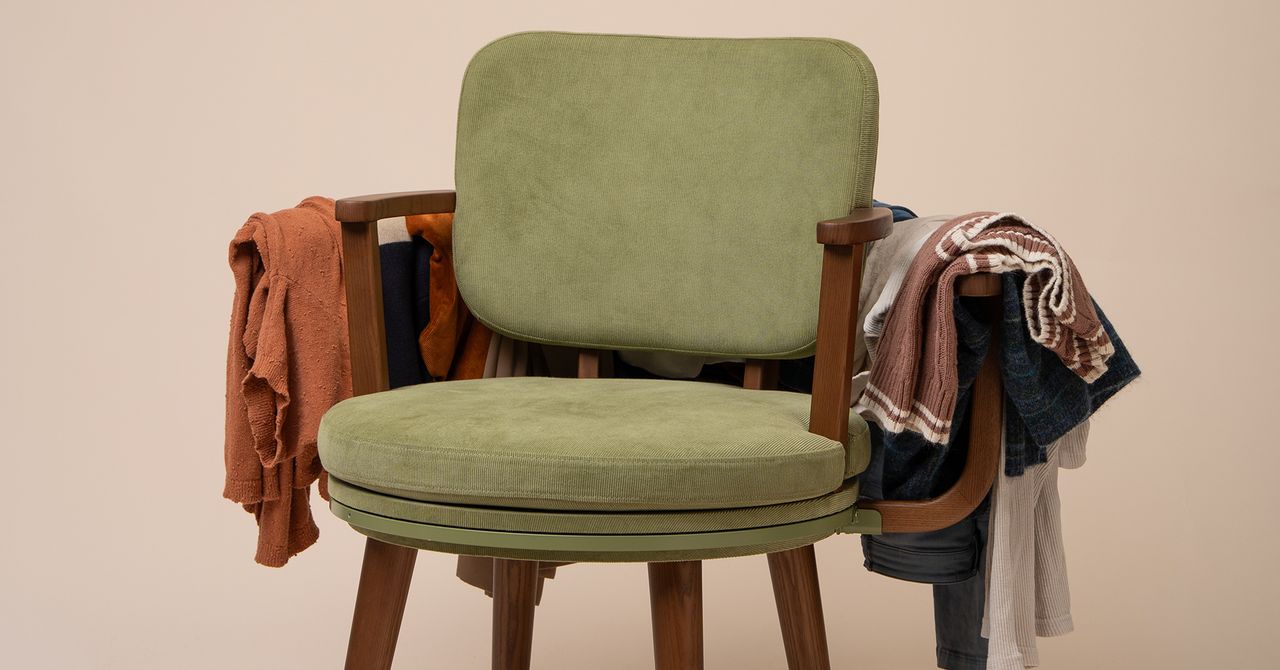
Do you have a shirt or a pair of pants that are not quite clean but also not quite stinky enough to put in the hamper yet? You’ve probably just thrown them on that one chair, right? You know, the chair in your bedroom or living room that seems to have spent more of its life holding a pile of clothes than being a usable seat.
This is the seemingly universal shared experience that inventor and YouTube star Simone Giertz wanted to solve. To do that, she built a Laundry Chair, meant to hold laundry and function as a chair at the same time. No more compromises.
“You can pin it to my reluctance for behavioral change,” Giertz says. “This was one of those projects where I was like, I can’t believe this isn’t already a thing.”
After making a video of building the chair more than a year ago, Giertz is turning it into a real product you can buy. It started as a Kickstarter campaign—launched today, and is already funded—though Giertz says the plan was to make the product regardless of whether or not the campaign succeeded. The starting price is $1,100, though there are discounts for backers (the first 50 got free shipping).
“It’s a little bit of a chore thorn in everybody’s side, an eyesore and something you have to deal with,” Giertz says. “I had it on my list of ideas for a long time—something that honored the chair’s job of holding clothes, acknowledged that, and actually tried to do the job properly.”
The Laundry Chair indeed looks like and works as a chair, the key difference being that the arm rests are constructed as a rotatable semicircle. A ball-bearing mechanism lets you smoothly spin the rail around, like a lazy Susan. Turn it around to the front, and you can hang clothes over the bar like you would on a clothesline or drying rack. Spin the rail back around, and the clothes slide neatly behind the chair, out of sight, leaving the seat free. Whether laden with laundry or not, the chair looks quite nice, with a solid hardwood frame and corduroy cotton upholstery.
Giertz has built a following on inventive, wild creations, like a robot that flings soup, or that time she turned a Tesla EV into a pickup truck. Over the years, she shifted her focus from building “shitty robots” to creating genuinely useful projects, like a screwdriver ring or the playfully maddening all-white puzzle with one missing piece.
Many of these are available for sale at Yetch Studio, the product shop named after the way you pronounce Giertz’s name. Giertz says these products are geared toward making life’s many “unglamorous problems” more bearable. The Laundry Chair is one of those—after the Kickstarter campaign—aiming to solve that universal pain-in-the-ass clothing pile many people can relate to; something that isn’t a big enough deal to think of as a true problem.
Giertz has tackled the laundry problem before, with products like the Coat Hinger, a coat hanger that can fold in half to save space in the closet. While Giertz says laundry “has become something of a muse” for her, it is not the only household chore annoyance she is coming for.
“I have a long list of things that have slightly wronged me,” Giertz says.
On that list are projects that have manifested in YouTube videos but not yet the Yetch store, like a fruit bowl that changes size depending on how much is in it. Giertz says she wants to fix small things she feels annoyed by, like her habit of leaving kitchen cabinets open. Her plan for other inventions in the immediate future involves making wall art that doubles as storage for common household items. “Imagine an old Renaissance painting, but the person in the painting is actually holding a real knife,” Giertz says.
Her focus on product design is function first, with form as an afterthought. Eventually, an idea takes shape and manifests into something useful. Ideally, it’s something that taps into a problem that people can relate to, like the Laundry Chair.
“All the objects that we have around us are just a long lineage of people iterating and making them different,” Giertz says. “Nothing’s sacred, everything is up for grabs, and you can be one of those people who’s like, ‘Hey, this object, how do I wish that it was different?’”
Disclaimer : This story is auto aggregated by a computer programme and has not been created or edited by DOWNTHENEWS. Publisher: wired.com