

What in the World, a free weekly newsletter from our foreign correspondents, is sent every Thursday. Below is an excerpt. Sign up to get the whole newsletter delivered to your inbox.
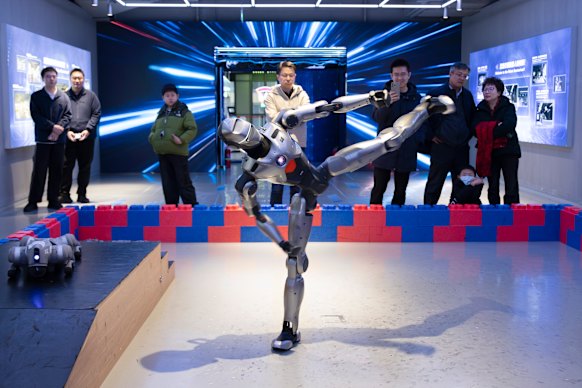
Beijing: On a showroom floor in the heart of Beijing’s tech district, humanoid robots play soccer, shoot hoops, dance and box.
Dubbed the “Robot Mall”, this store, which opened last year, is one of the first in China to sell the latest generation of robotic tech directly to consumers.
It also showcases China’s bigger aim – to bridge the gap between gimmick and genuine innovation, as it races to outdo the United States in the artificial intelligence and advanced manufacturing industries.
Fancy your morning latte being brewed and poured by mechanical arms? How about it being served with your own face staring back at you from the milky foam? Prepare to fork out 359,000 yuan ($73,500) for the Xbox Coffee Robot, which comes with a latte art function.
An interactive lady bot in a powder-blue suit, designed by Chinese company UBTech, is ready to be employed as an AI receptionist or as emotional support for the elderly. She comes with a 500,000 yuan price tag. Sadly, her arms were malfunctioning on the day I visited.
Yes, the future’s up-front costs are not cheap.
In the long run, replacing humans with robots for mundane tasks – and even increasingly sophisticated ones, particularly in manufacturing – may cut employers’ payroll costs and it may speed companies towards the prize of continuous efficiency gains.
But what about the broader social costs of job erasure while balancing a fragile employment market and a laggard economy?
Beijing is banking on a future where it can navigate this dilemma while going all-in on AI. President Xi Jinping sees the race for AI supremacy as a whole-of-country mission to drive a new model of economic growth that puts China on the cusp of an “epoch-making major technological revolution”.
China’s latest five-year economic blueprint, rubber-stamped by the nation’s ceremonial parliament this week, mentioned AI more than 50 times and contained an “AI plus” action plan that sets a goal of having tech “intelligence” integrated across 70 per cent of key sectors, such as manufacturing and healthcare, by 2027.
Robotics are at the forefront of this push. The Chinese government is throwing billions at the sector, including through a 1 trillion yuan fund to channel subsidies into high-tech start-ups over the next 20 years.
China has some 2 million robots working in factories across the country, and it is installing more annually than the rest of the world combined, according to the International Federation of Robotics.
At the cutting edge, the achievements are as impressive as they are unsettling. Chinese carmaker Aion says robots in its “intelligent dark factory” (so named because it can operate in darkness, without humans) can assemble a car in 60 seconds.
But when it comes to humanoid robots, the commercial demand is still unclear. These still lack the sophistication and dexterity to be valuable members of a family household capable of doing the laundry or washing the dishes.
There are also growing concerns that robotics will be the next industry to face the over-competition problems that have plagued other heavily subsidised sectors in China, such as electric vehicles, leading to zombie start-ups being kept alive by state funds and tax breaks rather than by generating profits.
“Humanoid robotics could absolutely follow a similar trajectory,” says Lizzi C. Lee, a fellow on the Chinese economy at the Asia Society Policy Institute.
“Many companies are betting that these machines will eventually play roles in logistics, elder care, manufacturing and service industries – but the timelines and economics are still very speculative.”
In November, China’s top economic body warned of a potential bubble in the humanoid robotics industry, which already has more than 150 start-ups.
At the Robot Mall, innovation is still skewed towards the entertainment end of the spectrum, though there are examples on display of how robotics can be deployed in operating theatres and dentistry.
A red dog called Xiao Bai comes when it is called and it can sit, dance and spin around on command. I watched it stretch out its electronic paw to “shake” hands with a small child. Man’s best friend, I assure you, has nothing to fear from these faux pooches.
But it’s easy to see Xiao Bai’s future taking a dark turn. In military drills in 2024, China’s army showcased a robot dog with an automatic machine gun strapped to its back.
The use of automation and robotics in surveillance in China is also well-documented. I once saw a robocop vehicle on patrol in a central Beijing park pull up alongside a group of Chinese grandmothers doing tai chi before it zoomed away.
Adjacent to the mall, there is a restaurant where a five-piece robot band sometimes plays.
They must have had the day off because it was quiet when I popped in. But humanoid bartender Xiao Qi was up for a chat, though she hadn’t yet acquired the skills to fix a stiff drink from the shelves of whisky behind her.
“Are robots going to take over the world?” I asked.
No, they are focused on serving humanity and improving quality of life, she told me.
 Lisa Visentin is the North Asia correspondent for The Sydney Morning Herald and The Age based in Beijing. She was previously a federal political correspondent based in Canberra.Connect via X or email.
From our partners
Disclaimer : This story is auto aggregated by a computer programme and has not been created or edited by DOWNTHENEWS. Publisher: www.smh.com.au


