
It is too early for dictionaries to declare their word or phrase of the year, but “house burping” has emerged as an early contender for 2026.
In the first two months of this year, the term has been trending on Google and there has been a flurry of posts by lifestyle influencers on Instagram, TikTok and other platforms about what it is and why you should do it.
Most of the content is for the northern hemisphere where the climate and building standards are different and the seasons are reversed. So what is house burping and how is it relevant to Australia?
Simply put, it means opening your windows to let in fresh air, in a specific way that doesn’t undermine energy efficiency. It is not something Australians traditionally have had to think about much because most of our housing stock is not airtight.
“Many of us are living in a glorified tent, just letting whatever happens outside, come inside,” says Tim Forcey, author of My Efficient Electric Home Handbook.
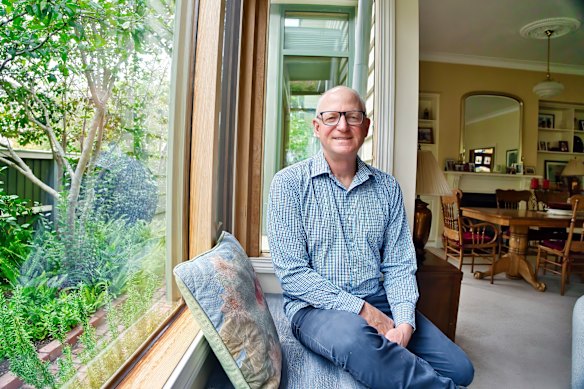
But as we increasingly heed the call to make our homes fully electric and more energy efficient with better insulation, so-called house burping should also be on the agenda.
The social media trend took off during the northern winter, which has been warmer than average overall but with severe cold snaps. Since homes in Europe and North America are generally closed up tight to stay warm, opening windows for a short time each day is recommended.
Allowing fresh air into the home expels the build-up of carbon dioxide in the air, as well as volatile organic compounds from off-gassing of carpets and furniture.
In Germany, they call it “lüften” – airing out. When it is really cold and the windows are flung wide open for five to 10 minutes only, it is “stoβlüften” – shock airing out. In France, it’s “aérer”. The Europeans have been doing this for centuries, and it is reportedly a legal requirement in many rental agreements.
Americans have decided to call it “house burping”, and the name has helped it go viral. The Europeans have clapped back with posts mocking Americans for “discovering fresh air”.
A key point for Australians is that fresh air is just as relevant in the context of combating rising urban heat. The best way to keep a home cool in summer is to keep the windows and doors shut with blockout blinds or curtains during the day to prevent the hot air getting inside, energy efficiency experts say. But once the outside temperature drops, it’s time to open up.
House burping really comes into its own in the context of home improvements for electrification and energy efficiency. The basic premise of electrification is that you switch gas heating, hot water and stove to efficient electric appliances, turn off the gas connection, and then seal up any vents and cracks in the house to ensure it is well insulated. Ideally, the home would be powered by rooftop solar too.
The big causes of draughts are chimneys, evaporative cooling vents in the ceiling, and old wall vents, Forcey says. The wall vents were originally essential safety features for homes with open fires, he says, and they remained useful when homes moved to gas heating or cooking because the gas usage pollutes the air inside the house.
Forcey says fully electric households should plug up these small leaks once they disconnect any gas supply. A reverse-cycle air conditioner – or electric fans and space heaters – can keep the house cool or warm, but they will have to work harder if there are draughts.
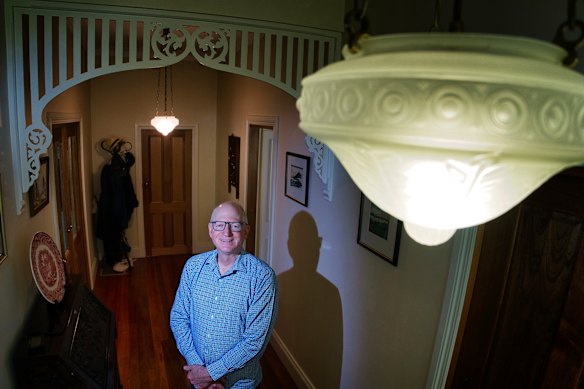
Better insulation will save you money, but it comes at the cost of ventilation. That makes house burping even more important – though Forcey’s preferred term is stoβlüften.
“By draught proofing, it puts you in control,” Forcey says. “We’re replacing uncontrolled air leakage with managed ventilation. Most of the time that means opening windows a lot at the appropriate times. But if there’s a lot of smoke out there [or it’s humid], you don’t have to open the window.”
Forcey has followed this playbook for his 1904 weatherboard cottage in Sandringham, Melbourne. He has devices that measure the carbon dioxide in his home, and finds it builds up overnight while he is sleeping. He opens his windows wide when he first gets up, and closes them again after 15 minutes.
By doing it first thing, before he has heated or cooled his home, he avoids wasting power. The short duration means he only loses energy from the air because the thermal mass of the walls, floors and furniture does not have time to heat up or cool down.
Other times of day might work too – many Australians will know the pleasure of opening up the house to enjoy the cool change at the end of a hot day.
Sydney-based electrification advocate Sarah Aubrey has a double-brick federation home in the inner west. She has sealed all the gaps, and put weather strips around the doors and windows to make it airtight.
“You’ve got to be conscious that when we describe ventilation or a vent, it’s something that you can manually control,” Aubrey says. “A hole in your wall is not ventilation, that’s just a hole in the wall, but you can manually control ventilation just by opening doors and windows.”
In summer, Aubrey is conscious about opening up the house at the beginning of the day before it gets hot or at the end of the day when it cools down.
In winter, she will air the house for shorter spells, and she has a carbon dioxide monitor in the living room.
Mechanical ventilation
An alternative to house burping or a leaky home is mechanical ventilation.
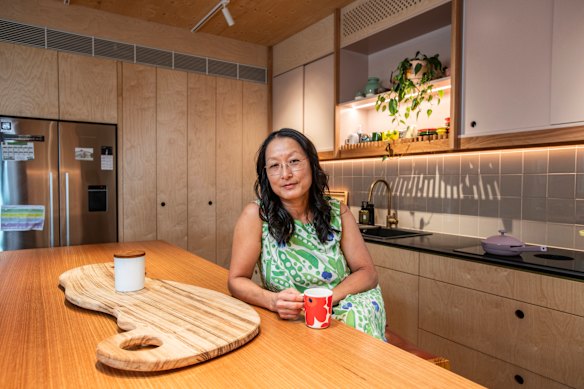
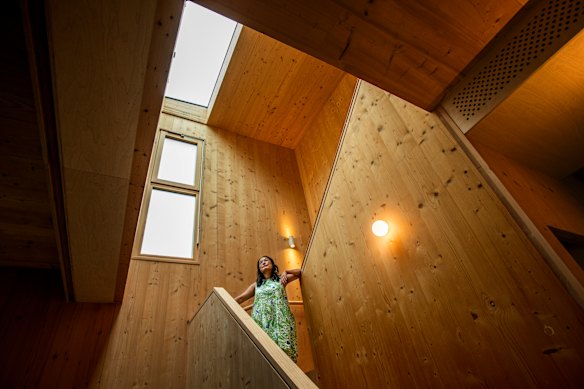
Susan Chan and her husband and three children moved into a newly built home with four bedrooms, a study and a craft room in Putney, Sydney, almost two years ago. Designed by architect Nina Still, the home has Passivhaus certification, which means it meets high standards for energy efficiency and thermal comfort.
Still, the owner of Still Space Architecture, says the home is insulated and sealed. The windows open, but even where they are closed, there is a constant flow of fresh air through the mechanical ventilation. The air is filtered, dehumidified and temperature-adjusted before entering the home.
“It’s a real pleasure living in this temperature-wise very comfortable house,” Chan says. “We don’t open up the windows too much, except when the nighttime temperature is cooler during summer and that lets all the hot air escape during nighttime.”
If the house does get hot, she can cool it with airconditioning powered by her own solar panels and home battery. The family opened the house for Sustainable House Day last year.
In Melbourne, Richard Stokes also uses mechanical ventilation for his flat in a former 1970s-era office building in Parkville.
Their renovation, which will be open to the public for Sustainable House Day on May 17 this year, included fully insulating the floors and walls, adding double-glazed windows, reverse-cycle airconditioning and electrifying everything.
“[Opening the windows] would be a wonderful thing to do, but like many apartments in the city, it’s right next to a major road,” Stokes says.
Controlling humidity
The other advantage to an airtight home with either mechanical or manual ventilation is that it lets you control the humidity inside the home. High humidity and condensation is a big cause of health problems and mould.
There are sources of humidity from inside the home. One is unavoidable – the moisture from residents exhaling.
The other is avoidable – drying laundry on clothes racks or radiators or in older style clothes dryers, all of which emit evaporated moisture into the air. Forcey and other electrification advocates recommend energy-efficient heat pump dryers. Of course, hanging clothes on an outdoor clothesline is an option for many people.
Yet house burping alone cannot control humidity, since the air outside might be humid itself.
Relative humidity is expressed as a percentage of moisture in the air versus what the air can hold – when it reaches 100 per cent, it will fall as precipitation. Warm air can hold more moisture than cool air and global humidity has already gone up about 7 percentage points in line with 1 degree of warming.
Research from 1986, known as the Sterling study and still the gold standard on the topic, says the best environment for human health is 40-60 per cent relative humidity.
Australian coastal cities are mostly higher than that. The average annual relative humidity at 9am is 70 per cent at Melbourne’s Kew weather station, but it can be as high as 80 per cent in June. Brisbane Aero is 65 per cent annually and a high of 70 per cent in June, and Perth Metro is 63 per cent and 80 per cent in July.
The most humid months in Sydney are summer. At Sydney Olympic Park, the annual average is 66 per cent, and the highest months are February and March at 72 per cent.
Forcey, who suffers allergic rhinitis, regularly runs a dehumidifier in his bedroom. He finds running it for four hours in winter will draw a litre of moisture out of the air, house structure and furnishings.
Aubrey has also used a dehumidifier in winter. But they are expensive to run and emit heat, so in summer she prefers the dry mode on her reverse-cycle air-conditioner. Aubrey says it uses about a third of the electricity to achieve the same effect as cooling.
Aubrey battled damp and mould issues during Sydney’s post-pandemic run of wet years. “Since we’ve closed everything up and done all the draught proofing, we’ve never had mould,” she says.
Get to the heart of what’s happening with climate change and the environment. Sign up for our fortnightly Environment newsletter.
Disclaimer : This story is auto aggregated by a computer programme and has not been created or edited by DOWNTHENEWS. Publisher: www.smh.com.au