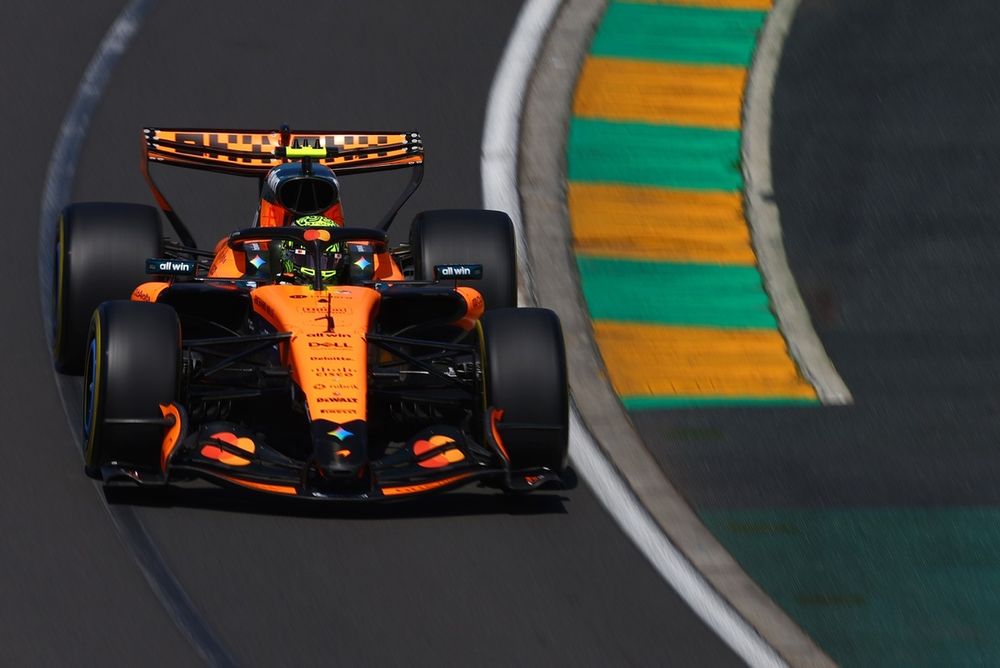
McLaren had to settle for the third row in Shanghai, with Oscar Piastri fifth ahead of Lando Norris, both around half a second off polesitter Kimi Antonelli in the Mercedes. There are obvious signs of improvement compared to Melbourne, where the team failed to optimise its performance in qualifying and was still learning on the job as it tried to get the most out of its complex new Mercedes power unit.
With McLaren gradually learning more about its engine, a more straight-forward China qualifying session uncovered other areas of both strength and weakness compared to the works team as well as 2026’s second-fastest team Ferrari.
GPS traces show McLaren’s Oscar Piastri and Lando Norris lost time to the Mercedes runners, and to a lesser extent Ferrari, through Shanghai’s notoriously tricky first corner complex. Other mid to high downforce corners also indicate a deficit to its rivals, such as the fast Turn 7-8 combination and the final left-hander, Turn 16, where Norris shipped more time than Piastri on their final tours. Comments from Norris also suggested a driver error in the final corner prevented him from qualifying higher, but the data doesn’t appear to indicate more than half a tenth of lap time loss, which may have helped him beat Piastri but not the Ferraris.
The McLaren appears to have the strongest traction and acceleration out of slower corners, but then gets overhauled by Mercedes on the long back straight. With its identical Mercedes HPP grunt, McLaren still has a small edge on the Ferraris, although the difference is much smaller than the works team.
Some of that can be explained by Mercedes still being more advanced than its customer in terms of exploiting the energy deployment, but according to McLaren team principal Andrea Stella, the data also show McLaren lacks aerodynamic load as well as efficiency, with the MCL40 being relatively too draggy across the range of downforce it produces.
“In Australia 50 percent of the deficit to Mercedes was related to exploitation of the power unit, and the other 50 percent grip in the corners,” Stella explained. “I think we have closed the gap a little bit from the power unit exploitation, but when it comes to the corners, the gap we have is pretty much similar to what we saw in Australia.
“This is related to not having enough aerodynamic load. There’s obviously grip that you generate by using the tyres in the right window, but I think we pretty much all understand how to use these tyres in qualifying, so the qualifying is a good reference to see actually what the deficit is from an aerodynamic point of view.”
Lando Norris, McLaren
Photo by: Guido De Bortoli / LAT Images via Getty Images
Stella was keen to set the record straight on any perceived disgruntlement from McLaren over how far behind Mercedes it felt on the power unit usage, with both Stella and fellow Mercedes customer Williams scratching their heads at just how advanced the works team looked in Australia qualifying.
“I don’t think I ever used any word like dissatisfaction, not even indirectly,” the Italian said. “It’s a very complex power unit, and when you are in a position of a customer team you need to learn, and this is pretty natural,” the Italian said.
“When the product you receive is relatively simple to understand and exploit, then that’s not a big gap. But in this case, it’s so complex because of these unique sensitivities. I don’t recall ever seeing anything like that in a power unit in previous championships. Then you kind of need to go through a journey, and we are thankful to [Mercedes] HPP for how supportive they are. They have given us the information we need, but somehow you need to run on track and learn.
“Obviously, when you are a works team, it’s normal that you will be more integrated. There is no IP. There is no protection of data. You just work as one entity. So fair enough that there’s a little bit of an advantage from this point of view. We’re not complaining about it.”
Stella added that there is still more for McLaren to unearth there, which can be seen as a positive as it’s performance that is readily available with the package it has, whereas its aero deficit will require a range of upgrades in May and beyond.
“We are in a better position than we were in Australia, so I think we are now able to extract more performance from the power unit,” he said. “It looks like we still have some performance that we can extract, so this is positive, because we can further improve the lap times. So, more to come in the coming events.”
We want your opinion!
What would you like to see on Motorsport.com?
– The Motorsport.com Team
Disclaimer : This story is auto aggregated by a computer programme and has not been created or edited by DOWNTHENEWS. Publisher: motorsport.com