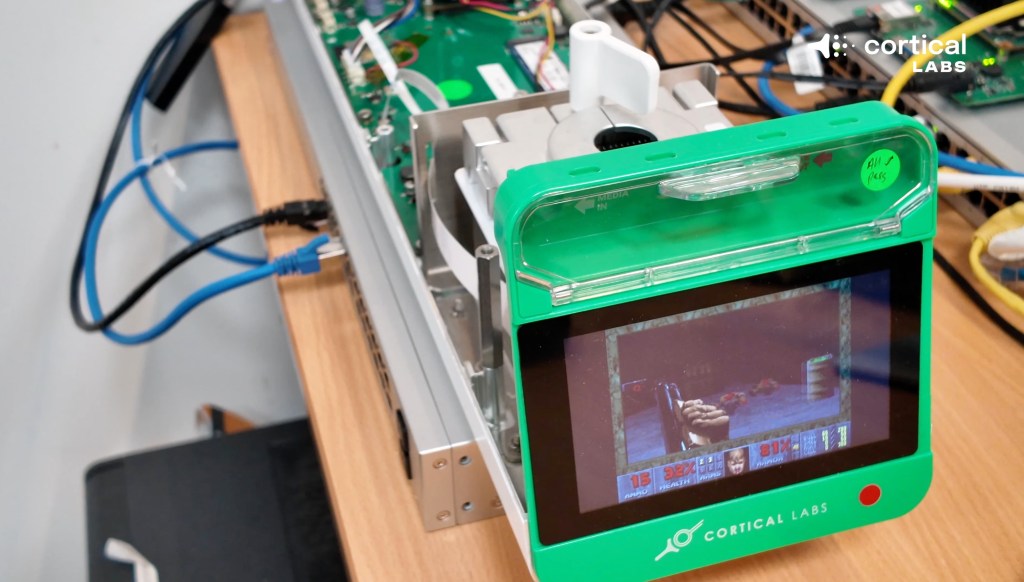
Scientists placed 200,000 living human brain cells on a microchip and taught it how to play a doomsday video game — and are now using the dystopian tech to power AI data centers.
Australian biotech group Cortical Labs went viral last week when they revealed that their neuron-using bio-chip, called CL1, was trained to play “Doom.”
The small cluster of cells was able to interact with the video game environment, moving the character in four directions, aiming, and shooting at the demons and skeletons in the 3D video game.
The Dr. Frankensteins at Cortical Labs said their bio-chip monster showed “real-time adaptation and learning” by syncing up the signals of the game with electrical inputs in the neurons using a highly honed software program, a company rep explained in a YouTube video.
“Real neurons are grown directly on our custom chips, creating an intelligence that learns intuitively, with remarkable efficiency,” the company says on its site. “Unlike traditional AI, our neural systems require minimal energy and training data to master complex tasks.”
“This isn’t just a new computer. It’s computing, reimagined,” the company boasts.
The process of developing the neurons for the microchips is practically biological magic.
Blood cells harvested from adult volunteers are converted into stem cells. Those are turned into neuron cells which are grown directly on the microchip by Cortical Labs.
Not content with a video hellscape, the company is now building entire data centers using the neuron technology right out of “The Matrix,” where human bodies are harvested for electrical power.

Cortical Labs has constructed one bio-data center in Melbourne, Australia, using 120 of their brain-draining “CL1” units, the company announced Tuesday, Bloomberg News reported. A second brain-battery plant will be built in Singapore. It is not clear when the data centers will be operational.
The neuron chips are so energy efficient they could one day run standard AI data centers out of business. One of the CL1 units powered by neurons requires less electrical power than a handheld calculator, according to Bloomberg.
Disclaimer : This story is auto aggregated by a computer programme and has not been created or edited by DOWNTHENEWS. Publisher: nypost.com