In the three years since Los Angeles County declared an end to COVID-19 as a public health emergency, mask sales have dwindled, unopened tests have expired in their boxes and people have returned to in-person school, work and socializing.
But for thousands of L.A. County residents living with the complex, chronic condition known as long COVID, the emergency has never ended. And as the virus continues to circulate, more people are being forced to reckon with a life-altering yet often invisible disability whose relative newness offers few answers for the future and few avenues for support.
“You’re not just becoming disabled,” said Elle Seibert, 31, who has dealt with debilitating fatigue and cardiac symptoms since 2020. “You’re realizing how easily society at large and people in your life will abandon you when you cannot offer them things.”
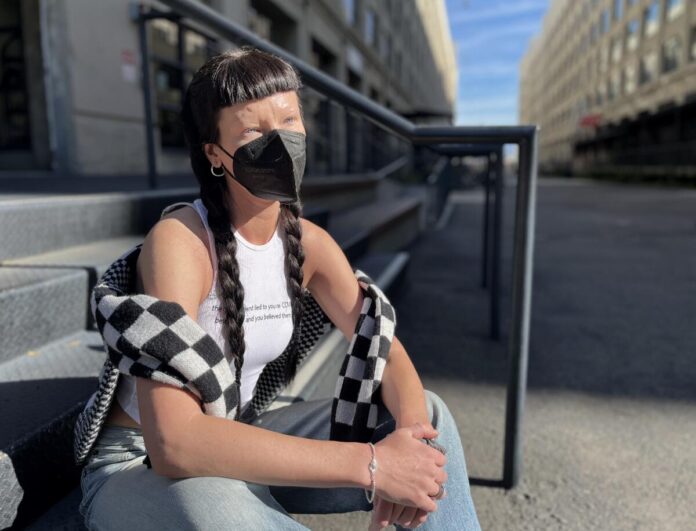
Elle Seibert, 31, has been living with long COVID.
(Christina House / Los Angeles Times)
Long COVID is an infection-associated chronic condition, a class of illness triggered or worsened by viral, bacterial or parasitic infections. Symptoms typically affect multiple organs or body systems, and cluster around fatigue, cardiovascular problems, cognitive issues and pain.
“What causes long COVID is an abnormal immune system response [plus] dysregulation of the nervous system,” said Dr. Caitlin McAuley, director of the Keck Medicine of USC’s COVID Recovery Clinic, one of two dedicated clinics in the county (the other is at UCLA).
Researchers have also found that long COVID patients are more than twice as likely as people without the condition to have particles of the SARS-CoV-2 virus lingering in their blood — remnants of original infection that could be causing ongoing inflammation.
Though the condition strikes across age, gender, race, vaccination status and patients’ previous levels of health or activity, a few demographic patterns have emerged. Women, people of Hispanic origin, people with severe initial infections and people who have not been vaccinated against the virus appear more likely than other groups to develop long COVID.
Severity of the initial disease can’t perfectly predict the aftermath: debilitating symptoms have set in for people with mild initial infections. Patients arrive at a diagnosis once symptoms have persisted for at least three months and all other explanations have been ruled out.
Lawrence Totress, 51, was busy working full time and volunteering as his church’s office manager when he tested positive for COVID in July 2022.
For two weeks, he had the same fever, shortness of breath, dizziness and fatigue that his friends experienced. But while his fever eventually lifted, frighteningly intense cognitive symptoms descended.

Lawrence Totress, 51, at his apartment in Los Angeles. “It’s not like we’re twiddling our thumbs and trying to get some money. This is a very serious condition,” he said.
(Ariana Drehsler / For The Times)
“I could not find words,” he said recently from his home in South Los Angeles. “I would have phone calls with my supervisor, with my insurance, and I would just cry because I couldn’t even finish the conversation.” At one point, he could not recall the name of the person he’d reported to for the last two years. He scrolled through his phone contacts until he saw “Supervisor” typed below a name.
A trip to the bathroom or the front door left him without energy to return. He cycled through migraines and bouts of postural orthostatic tachycardia syndrome, or POTS, a common long COVID symptom that sent his heart rate skyrocketing when he stood up.
Through occupational therapy at Keck’s long COVID clinic, he learned skills that have allowed some semblance of independence: hydration, rest, careful management of his time and energy.
Where he once bounced from task to task, he now clears a whole day for a grocery store outing. On a bad day, he may not make it past the produce before he’s hit with fatigue so intense he can’t recall why he’s there.
He can no longer work; bills are still piling up. Like every patient interviewed for this story, his application for long-term disability was denied, despite a thick stack of medical records.
“It’s not like we’re twiddling our thumbs and trying to get some money. This is a very serious condition,” he said. “Take it as it being serious, and allow us to have the resources.”
There is no reliable data for county long COVID cases, nor for the number of people disabled by the condition.
The official county count for total confirmed COVID infections ended in mid-2023 at 3.5 million. Given the World Health Organization’s estimate that 6% of infections result in long COVID, just the first two years of the pandemic may have yielded up to 175,000 long COVID cases, a number that has only grown as the virus has continued to circulate.
In 2023, 15.6% of respondents to a countywide health survey said they had experienced COVID symptoms for at least three months after testing positive. A follow-up county survey currently underway asks more precisely whether respondents have had long COVID symptoms within the last 12 months, said Barbara Ferrer, director of the L.A. County Department of Public Health. Those results will be available later this year.
Ferrer compared the current state of public understanding to the early days of the HIV/AIDS epidemic. In both cases, she said, a new virus created a large population of people living with a complex, chronic condition with far-reaching implications for their health, housing and economic security.
“COVID-19 really has had a profound impact in terms of long-lasting symptoms that affect all kinds of different parts of the body, at a much higher rate than we usually see from other viruses,” Ferrer said.
This month, the public health department formed a physician and patient advocate working group that for 12 months will study policies and services that could help long COVID patients, Ferrer said, such as a clearer pathway to disability payments and better education for healthcare providers.
“We still hear stories about people who are saying, you know, my physician dismissed it or misdiagnosed it, or told me to just go home and wait,” Ferrer said.
Patient advocates have lobbied the county Board of Supervisors to establish a similar task force, thus far unsuccessfully.

Beth Nishida, 64, at Creekside Park in Walnut. She retired from special education administration due to the ongoing effects of a 2022 infection.
(Ariana Drehsler / For The Times)
“The goal really, in my opinion, should be how do we fix it, not just how do we count it,” said Beth Nishida, 64, of Walnut, who retired from special education administration due to the ongoing effects of a 2022 infection. “I know [long COVID] is new, but it’s not as new as it was. At some point, we have to start learning things and implementing them.”
The outlook at the federal level is grim. Last year, the Trump administration closed the Office for Long COVID Research and Practice and canceled grants for long COVID research.
“The COVID-19 pandemic is over, and HHS will no longer waste billions of taxpayer dollars responding to a nonexistent pandemic that Americans moved on from years ago,” a Department of Health and Human Services spokesperson told the magazine Science.
Yet new COVID infections are producing new long COVID patients. People who were healthy and active just a few months ago are still arriving at USC’s clinic with cardiovascular and cognitive problems that have upended their lives.
“There has been a societal move to go past COVID as if it’s not around anymore — but it definitely is,” McAuley said. “If it’s not on people’s radar, it’s never going to be addressed. And people will bounce in and out of the ER, and they will potentially have a degree of disability [to] the point where they just lose their job, and no one really is addressing it.”
More to Read
Disclaimer : This story is auto aggregated by a computer programme and has not been created or edited by DOWNTHENEWS. Publisher: latimes.com