

Updated ,first published
It was a language banned under years of British rule – and UNESCO still classifies it as “definitely endangered” – but Seán McLoughlin says Irish, or Gaeilge, might be having a moment.
More media for Millennials and Generation Z, from rap music to podcasts, is being produced in Irish, which is one of the fastest-growing languages on learning app Duolingo.
“It’s become cool in Ireland, and then, by extension, everywhere,” said McLoughlin, president of Scoil na Gaeilge Sydney, the city’s Irish language school.
The most recent census data, from 2021, showed 1875 Australians spoke Irish at home, a slight decrease on 2016. But, if enrolments at Scoil na Gaeilge Sydney are anything to go by, that could be turning around.
Two years ago, it had 20 or 30 students attending lessons, now it has between 70 and 80.
Students are getting younger too. Two years ago, 90 per cent were over 60. But today, McLoughlan says there is an even split either side of 50.
Brisbane 20-year-old Maia Weatherstone has been learning Irish for almost three years, inspired by her Irish soccer coach.
Unlike most learners, she has no Irish ancestry, just a fascination with Irish culture and history.
“To be able to learn about that history through language, and through the perspective of people who speak that language … is especially important.”
Weatherstone thinks the recent proliferation of Irish music in popular culture is attracting new, younger, learners.
McLoughlin agreed, noting the popularity of Northern Irish rap trio Kneecap, who perform in Irish.
But McLoughlin said younger people also seem to have a much stronger sense of an Irish identity.
“[They want] to find out about their cultural background and [are] valuing it,” he said. “We get a lot of people who … say, ‘I’m really interested in learning the language of my forebears’.”
About half of Scoil na Gaeilge Sydney’s students were born in Ireland. The rest are mostly Australians with Irish ancestry.
The school runs two-hour classes every Monday night at the Gaelic Club in Surry Hills. McLoughlin, a former primary school teacher originally from Dublin, has been teaching there for three years.
Proverbs are an important tool in his teaching belt. The Irish word for proverb is seanfhocal: sean means “old”, fhocal means “a word”.
“Seanfhocal, old word: Words of wisdom from the older generation,” McLoughlin explained.
McLoughlin said the proverbs were an excellent way to begin a language lesson. “We take just one proverb, we talk about its meaning. We look at the structure, the syntax, what can it tell us about grammar… [it’s] a great little nugget of the language.”
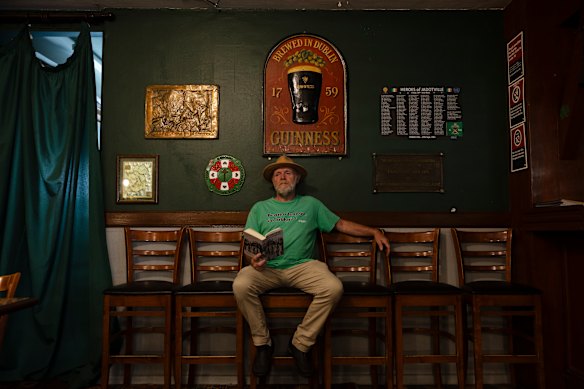
McLoughlin’s shirt was emblazoned with one of these proverbs: Beatha teanga í a labhairt: “the life of a language is to speak it”.
It’s a sentiment particularly relevant to Irish, a language banned for centuries by the English government.
“When 70 people come in here on a Monday night … they’re helping to keep it alive and help it grow,” he said.
The Morning Edition newsletter is our guide to the day’s most important and interesting stories, analysis and insights. Sign up here.
From our partners
Disclaimer : This story is auto aggregated by a computer programme and has not been created or edited by DOWNTHENEWS. Publisher: www.smh.com.au


