Have you ever met a child who’s never seen a pencil?
Mumbai-based artist Rouble Nagi recalls her interaction with one. It was during an art workshop she was conducting in one of the city’s bastis(slums). The child gave her a quizzical look when she handed them a pencil, and then asked what it was. Rouble was startled.
She felt a tangible shift in the way she viewed the world. Was this experience unique to that child, or were we as a society failing underprivileged communities? “I decided to make it my life’s mission to create a world where every child would know what a pencil was,” Rouble says. “I decided to create a world where every child would be in school.”
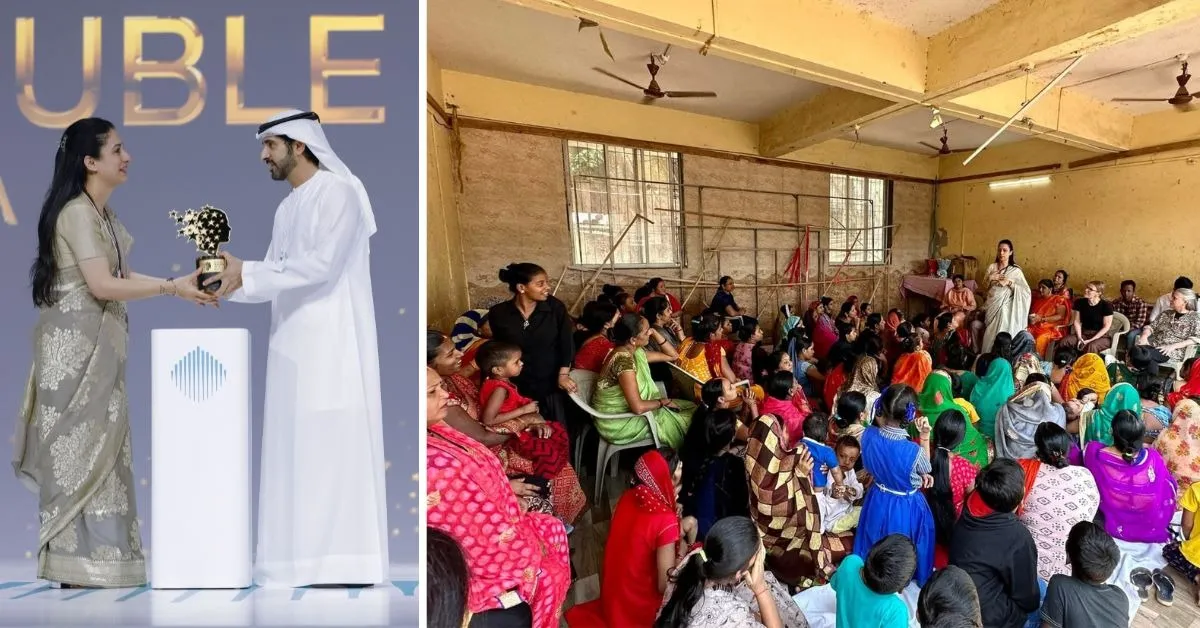
Today, those dreams and the efforts to realise them have culminated in Rouble winning the $1 million GEMS Education Global Teacher Prize, a Varkey Foundation initiative organised in collaboration with UNESCO. She was selected from among 5,000 nominations and applications from 139 countries.
Breathing life into abandoned walls
You can only teach a child who wants to learn.
It’s a lesson Rouble learnt early on in her career. She recalls an instance where she was painting a mural on the wall of a Mumbai slum. “One child came and told me that he’d seen the person (a freedom fighter) whose picture I was painting, in his textbook. I asked him to bring his book to me, and began telling him the story of the freedom fighter.” Each time a child posed a question, an animated discussion would follow between Rouble and the child; she’d impart knowledge while bringing their community walls to life.
/filters:format(webp)/english-betterindia/media/media_files/2026/03/12/rouble-nagi-1-2026-03-12-12-27-25.jpg)
She treasured (and continues to treasure) these interactions. It takes her back to her own childhood days. “When my father, an army officer, was posted in smaller towns and villages, I’d often spot children who did not go to school — children living along the side of the road or working in shops. When I would ask my father why they weren’t in school, he’d say I was too young to understand.”
But the question never left Rouble’s mind. Instead, over time, it deepened, transforming into a quest for a solution, now called the Rouble Nagi Art Foundation, which, through art, is redefining educational opportunity and welfare for communities.
Since 2011, the foundation, funded through CSR, has established more than 800 learning centres across India where first-generation learners can begin structured learning and be guided back into mainstream education. Its timeline is a beautiful tapestry of how art can inspire change.
/filters:format(webp)/english-betterindia/media/media_files/2026/03/12/rouble-nagi-2-2026-03-12-12-29-02.jpg)
Rouble shares, “Initially, we observed that a lot of children coming to these centres were not going to school. So we told them we would prepare them for school, give them basic learning, and then enrol them in schools.” At the centre, children are taught through art-based methods — recycled materials, storytelling, and murals. Their visual vocabularies are enhanced; every lesson is integrated with practical skills like hygiene, awareness, and emotional safety.
While children of all ages are supported, Rouble says their primary focus is on reaching them in their early years to reduce the long-term effects of missing foundational education. “As the child grows older, their academic age is also advancing. We don’t want any child to be left behind,” she reasons.
In her understanding, “Education must first heal before it can teach. Creating a safe space where children feel seen, respected, and joyful is the foundation of every learning.”
Where art becomes empowerment
If you stop by Colaba’s Dhobi Ghat neighbourhood in Mumbai, you’ll spot multiplication tables, grammar rules, maps of India, science diagrams, and constitutional values, and inspiring national figures appear on the walls, forming what Rouble calls a ‘living textbook’. The murals are at different stages of their vibrant lives. It’s an exercise in style as well as in storytelling.
/filters:format(webp)/english-betterindia/media/media_files/2026/03/12/rouble-nagi-3-2026-03-12-12-30-29.jpg)
The kaleidoscope outside reflects the one within children’s minds, as they dream big, believing nothing is out of reach. It is in this neighbourhood’s Rajak Bal Vidya Mandir that teacher Shashikala Prasad has spent a decade teaching children different concepts using art as a medium.
She shares, “Take, for example, the topic of water conservation. There are so many ways to save water: closing taps that are open, fixing ones that are leaking, avoiding wastage, etc. Instead of elaborating on these concepts, we make drawings and diagrams and teach the children. They understand the lesson better, and it stays with them for longer.”
In her decade of teaching children using art, Shashikala has seen their interest burgeon. “The difference between using art to teach a concept versus just teaching it through theory is that art brings about behavioural changes in the child; they actually start following the habits we are teaching them instead of it being limited to the textbook.”
And what’s amazing is that learning does not stop at the centre but continues beyond it.
From slum classrooms to officers, artists, and graduates
Rouble explains, “When we first entered slums and villages across India, we realised that children were dropping out not because they lacked ability, but because they lacked engagement, support, and dignified learning spaces. Our response was to build education and skill centres within walking distance of their homes, so that continuity, comfort, and community participation became part of their everyday learning.” This is what sparked their flagship initiative, ‘Misaal India’.
/filters:format(webp)/english-betterindia/media/media_files/2026/03/12/rouble-nagi-4-2026-03-12-12-32-25.jpg)
Settlements that once reflected neglect are cleaned, repaired, and painted. Concepts are carved into walls, turning them into curriculum-based learning tools. Through the initiative, the foundation has painted and repaired more than 1,50,000 homes and now works across more than 163 slums and villages in India.
And the outcome is validated by the reduction in school dropout rates — approximately 50 percent pan India, Rouble’s team shares. As Rouble shares, “Several students from our centres have gone on to complete their bachelor of fine arts degrees. Some are now preparing for the civil services examinations; others are training to become officers in the Indian Army. These journeys, from slum and village classrooms to professional degrees, competitive exams, military training, and economic independence, are the clearest indicators of educational progress.”
While Misaal India is one project, the others are ‘Rounak’, through which art camps are held for underprivileged children from various slums in Mumbai and Delhi; ‘Crayon’, which sees young artists, whose travel is restricted by physical and financial restrictions, being selected for a touring exhibition across the globe; ‘Learn’, which includes vocational training programmes in art; and ‘Mahila Saksham Yojana’ which empowers unskilled women from villages and slums to make handicrafts and khadi fabric products.
But at the root of effecting any change in society lies the weighty task of tackling mindsets.
‘Inko school bhej ke kya hoga? (What’s the point of sending them to school?)’
Rouble recalls her early years, where a majority of her time was spent counselling reluctant parents that their children needed to be in school.
“But they wanted the child to work and earn,” she explains. She would often reason with them that a better life and education could go hand in hand.
/filters:format(webp)/english-betterindia/media/media_files/2026/03/12/rouble-nagi-5-2026-03-12-12-34-22.jpg)
While these conversations have gotten easier over the years, she says it’s a constant effort. “You cannot assume that one conversation will change everything. I have always believed that art brings dignity to neglected spaces, and education brings dignity to neglected lives. The goal is to move learners from survival to self-reliance by connecting education to livelihoods. Once that happens, you see the numbers grow, and the community begins to participate.” Art, after all, has the power to invite, not intimidate.
Recalling her own college days, Rouble wishes she had someone who had integrated art into tough concepts. “I used to have nightmares before a maths exam. If I had a choice, I would skip every maths class,” she says. Though her teachers were excellent, she simply couldn’t understand numbers.
When she began working with children and turned art into playful, game-based learning for mathematics, she saw them grasp concepts faster. “I often wish one of my teachers had taught me that way,” she reflects. “Perhaps a subject I was so bad at could have become one I was good at, just with a different approach.”
And now she intends to be that beacon for other children. The $1 million prize money brings her a step closer to that dream. Rouble plans to use the money to build a skilling institute, offering free vocational and digital literacy training to help transform the life chances of millions more marginalised children and young people.
The journey often begins with the simplest tools of imagination.
And sometimes, all it takes is a crayon.
You can volunteer with the foundation here.
All pictures courtesy Rouble Nagi Art Foundation
Sources
Global Teacher Prize – Rouble Nagi.
Disclaimer : This story is auto aggregated by a computer programme and has not been created or edited by DOWNTHENEWS. Publisher: thebetterindia.com