
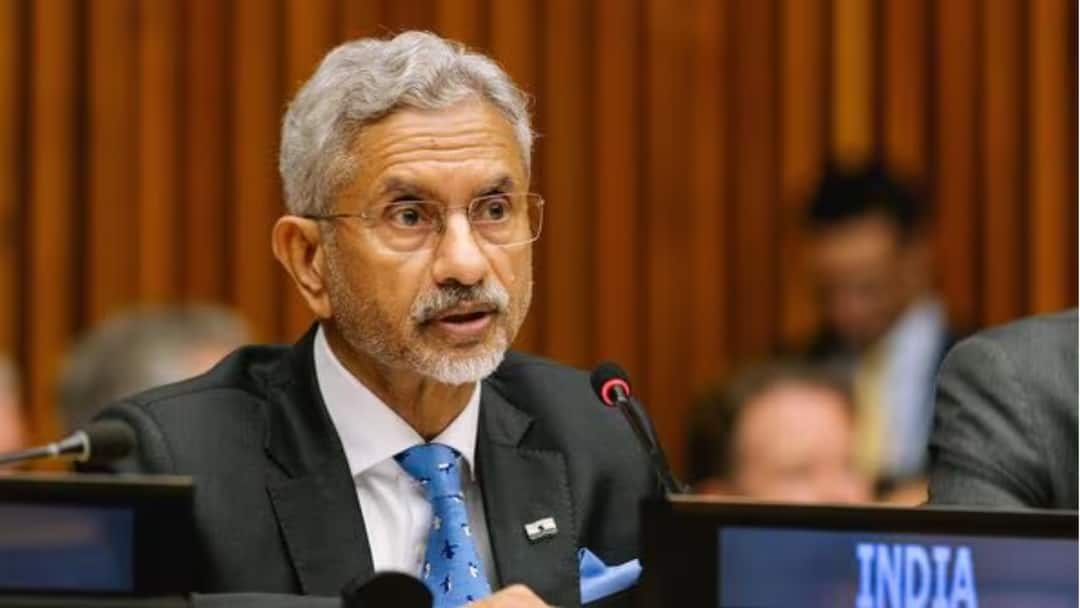
External Affairs Minister S. Jaishankar has clarified that India did not offer any concessions to Iran after two Indian-flagged gas tankers were allowed to pass through the Strait of Hormuz, saying the transit was the result of ongoing diplomatic engagement and the long-standing relationship between the two countries.
In an interview with the Financial Times, Jaishankar said discussions with Tehran were continuing and had already yielded some results.
“I am at the moment engaged in talking to them, and my talking has yielded some results. This is ongoing. If it is yielding results for me, I would naturally continue to look at it,” he said, adding that it was better for India to “reason and coordinate” with Iran to find a solution.
No ‘Blanket Arrangement’ With Iran
Jaishankar stressed that there was “no blanket agreement” with Tehran for the movement of Indian vessels through the crucial maritime route.
“There is no blanket arrangement. Every ship movement is an individual happening,” Jaishankar said, adding that India preferred to “reason and coordinate” with Iran to find practical solutions.
Jaishankar also dismissed suggestions that Iran received anything in exchange for allowing the ships to pass.
“It’s not an exchange issue. India and Iran have a relationship… which is the basis on which I engaged,” he said, describing the ongoing conflict in the region as “very unfortunate”.
Two Indian LPG Tankers Cross Hormuz
The clarification comes after two Indian-flagged LPG tankers, Shivalik and Nanda Devi, safely transited through the Strait of Hormuz despite tensions linked to the war involving the United States, Israel and Iran.
The vessels are carrying about 92,700 metric tonnes of liquefied petroleum gas and are expected to arrive at Mundra Port and Kandla Port in the coming days.
The Strait of Hormuz, the only maritime gateway connecting the Persian Gulf to the Arabian Sea, handles nearly 20 per cent of global crude oil and natural gas shipments. Iran has restricted movement through the waterway amid the ongoing conflict, raising concerns over energy security in major importing countries such as India and China.
Diplomatic Talks Still Ongoing
Jaishankar said India would continue diplomatic engagement with Tehran as several more Indian vessels remain in the region.
“These are still early days. We have many more ships there. So while this is a welcome development, there is continuing conversation because there is continued work on that,” he said.
Earlier, Prime Minister Narendra Modi also spoke with Iranian President Masoud Pezeshkian and discussed the movement of goods and energy supplies through the strategic waterway.
India is the world’s fourth-largest buyer of liquefied natural gas and the second-largest importer of LPG, much of which comes from the Middle East. The disruption of shipping routes has already raised concerns over fuel supplies and impacted several industries dependent on natural gas.
Related Video
Middle East War: Trump–Starmer Discuss Strait of Hormuz Crisis as Middle East War Enters Day 17
Disclaimer : This story is auto aggregated by a computer programme and has not been created or edited by DOWNTHENEWS. Publisher: abplive.com



