
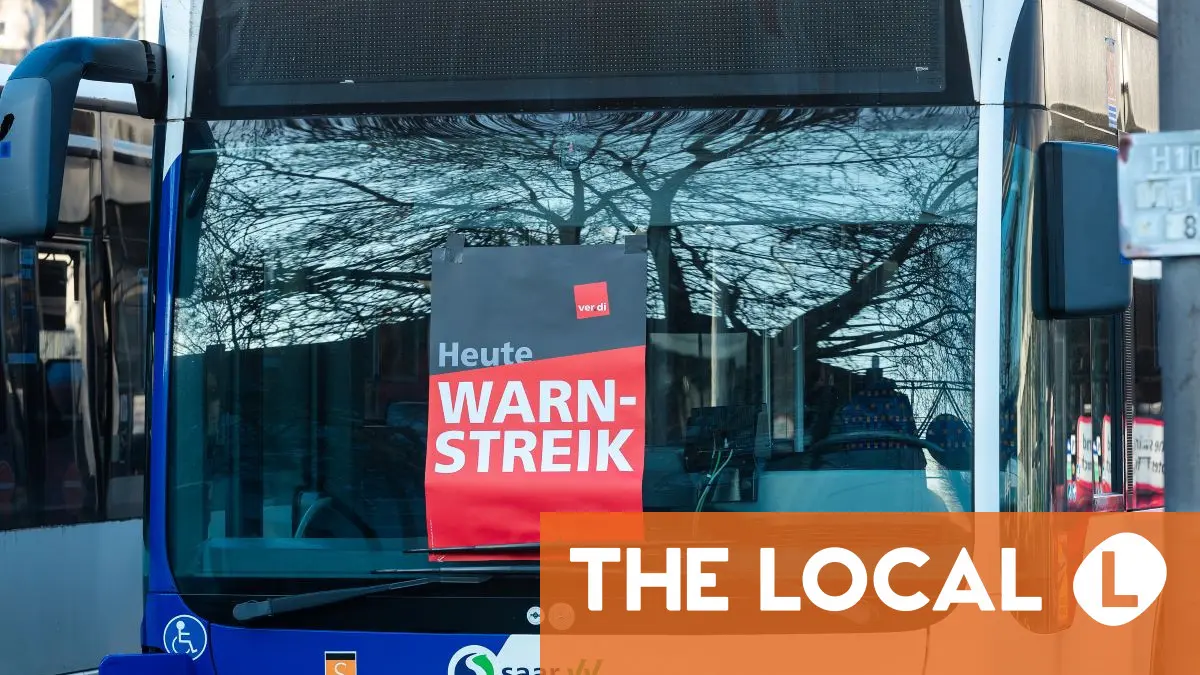
Public transport strikes are expected across Germany this week, culminating in a major, multi-state day of action on Thursday. North Rhine‑Westphalia and Saxony are expected to be hit hardest.
Public transport users across Germany are facing a difficult week, as the Verdi trade union calls for a new round of warning strikes affecting local buses, trams and light rail services.
A major multi-state day of action is expected on Thursday, when buses, trains and trams are set to remain in depots in several federal states. But disruptions are expected to begin earlier in some states.
In Saxony, parts of the public transport network were already affected on Monday.
In North Rhine‑Westphalia, the strike action is expected to escalate sharply on Tuesday, when bus and tram traffic is set to come to a near standstill across most of the state.
Where disruptions can be expected
In North Rhine‑Westphalia (NRW), Verdi has announced a staggered strike schedule.
On Tuesday, buses and trams should come to a standstill across almost all of the state. Verdi has announced that most vehicles would remain in their depots.
On Wednesday, the union has called on employees at workshops and maintenance facilities to strike. Verdi has not specified how strongly this will affect services, but knock‑on effects are possible.
On Thursday, NRW public transport workers are expected to take part in a coordinated, multi-state day of action.
READ ALSO: What are the rules in Germany for being late to work due to strikes?
According to Verdi, suburban and regional trains would not be affected by the strikes, and some operators are expected to operate normally or partially, including in Aachen, Leverkusen, Monheim, Münster, Hamm, parts of Duisburg, and parts of the Lower Rhine.
In Saxony, warning strikes began on Monday when employees at Regiobus Mittelsachsen and Regionalverkehr Westsachsen walked off the job, causing major disruptions in Döbeln, Freiberg, Chemnitz and surrounding areas.
On Tuesday, large parts of the eastern state can expect further disruptions, including services run by Görlitzer Verkehrsbetriebe, Regionalbus Oberlausitz and DB Regio Bus Ost in Zittau.
Thursday: multi‑state day of action
On Thursday, strike actions are set to be felt in more German states, with bus and train services to be affected in Bavaria, Saarland, Brandenburg, North Rhine‑Westphalia and Hamburg.
Decisions on participation in Hesse and Bremen were still pending at the time of writing. Verdi described the action as the third large‑scale, coordinated warning strike in the current round of negotiations.
Why are workers striking – and what happens next?
The union-employer dispute centres primarily on working conditions for public transport employees, though pay is also an issue in some states.
Verdi is reportedly pushing for a reduction in the working week from 39 to 37 hours for full-time employees, longer rest periods between shifts and higher premiums for Sunday work.
Torsten Herbert, managing director of the Municipal Employers’ Association of NRW, described Verdi’s demands as “unrealistic”, citing the financial pressures on transport companies.
Negotiations are set to resume on March 24th.
Disclaimer : This story is auto aggregated by a computer programme and has not been created or edited by DOWNTHENEWS. Publisher: thelocal.de





