I don’t have statistics, but just from the disappearance of bowling alleys from the local landscape, most recently Santa Monica’s midcentury Pico Bowl, with its fine coffee shop, I’d guess that the sport is not the ubiquitous American pastime it once was. Still, many if not most of us will have gone bowling at least once in our life, either in the company of parents, or at a birthday party, or as part of some cocktail-fueled hipster fun — to have heard the special music of balls hitting wood and pins crashing, to have traded your street shoes for the bowling kind. (Unless you have your own, in which case I salute your commitment.)
I have bowled, as a child, and later with friends, when it enjoyed a renaissance back in the last century — it was pre-cocktail bowling, the beer years. I am very, very bad at it, but as with every other sport — none of which I have any talent for — I can be drawn in as an observer by the drama, the human interest and the physics of a game. All these elements are present in “Born to Bowl,” a sprightly five-part documentary, directed by James Lee Hernandez and Brian Lazarte (HBO’s “McMillions”) that follows five bowlers — four champs and one aspirant — on the Professional Bowlers Assn. tour, a four-month season running from January through April and comprising 19 tournaments, five of which are big-money “majors” that pay the winner $100,000.
Bowling, you may know from experience, is not easy; professional bowling is grueling, a grind. It has little cachet; it won’t make you rich the way some sports will, and lacks snob appeal, like, say, golf. (Though Ben Stiller, an executive producer, does make a cameo appearance late in the series.) Its reputation is as a working- to middle-class sport; even the big players drive themselves from tournament to tournament in their own cars, leaving their families to follow an itinerary of what a touring rock band would regard as secondary markets — Reno; Indianapolis; Akron, Ohio; Springfield, Mo. — playing in alleys that from the outside might resemble a giant warehouse, with maybe a big bowling pin for decoration. They haul their various balls, each with its own character, along with the odds and ends they’ll need to make a home of the mid-range hotel rooms they typically share with a competitor (or competitors) for the sake of economy but also amity; to judge by “Born to Bowl,” rivals on the lanes may be close friends off them.
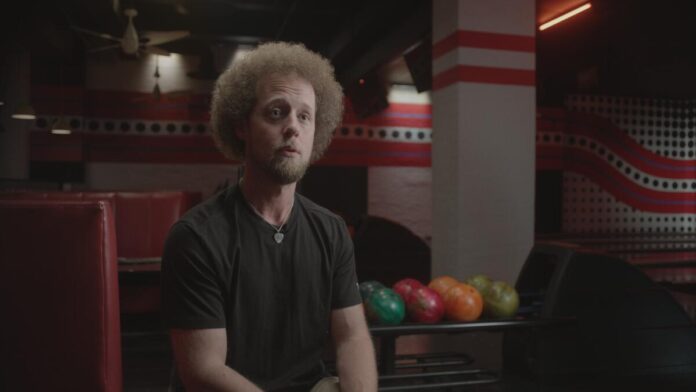
Kyle Troup, another bowler featured in the series, calls himself “the Bob Ross of bowling.”
(HBO)
Let’s meet the players. There is Kyle Troup, the ginger haired “Pro with the Fro” — “I guess I’m the Bob Ross of bowling,” he says, though you may also think of Richard Simmons — clownish, with colorful dress. Anthony “Simo” Simonsen, the youngest person ever to win a PBA major title at 19, is battling a back problem, has a temper and swears a lot; he dropped out of high school at 15 and began bowling “to survive.” “Without bowling I’d probably be homeless,” he says. (Off season, he drives a forklift.)
Cameron Crowe, a cheery Black bowler, is the newer kid, good enough to play in this company, but with no PBA titles to his name. (The Black bowling tradition, while not explored here, would make a good documentary of its own, if anyone’s listening.) Australian Jason “Belmo” Belmonte, a dominant force with many titles to his name, pioneered a once-controversial, now common two-handed style. At 41, he has to defend himself from questions of being over the hill. E.J. Tackett, who has been on a winning streak, is the one he’s out to beat, “You’re chasing to be perfect,” Tackett says, “but it’s never achievable or attainable … but it is really fun chasing it.”
All have bowled since they were kids. Tackett’s parents owned a bowling center, which he now runs. (“When I’m not fixing a toilet, I can just go bowl.”) Belmonte’s parents ran one as well. Troup’s father, Guppy Troup, is in the PBA Hall of Fame, and was a renowned party animal in his prime. (“I spent as much time in a bar as I did on the lanes. Maybe more.”) Troup would bowl with his mother on Saturday mornings: “If I beat Mom, I got $5.”
Each of them starts the season confidently, but the narrative doesn’t obey the rules of (cheap) fiction. Unlike many sports documentaries, it is as much or more about the agony of defeat as about the thrill of victory. A title can turn on a single pin.

Cameron Crowe is one of the sport’s newer athletes, who is looking to win a title.
(HBO)
By the end, some will appear less than happy to have a film crew over their shoulder and in their face; but all are happy to analyze their strengths and weaknesses for the camera, what went right and what went wrong, if unhappy with the result, as they compete for a place in “the show,” which is to say the television show — the broadcast finals that pay big money and make a career. (All but Crowe are stars already; Belmonte is “famous enough to be a question on ‘Jeopardy’ but not famous enough that all the people know [the answer] — I think that’s a perfect blend of fame.”) But the show may be over: A deal between the PBA and Fox Sports is ending, and “if there’s no deal, there’s no season, and if there’s no season, there’s no prize money.”
With its several unrelated contests, in no particular order of importance, “Born to Bowl” can be a little hard to keep track of, as the bowlers win and lose, but it’s interesting all the way through, and the directors do a good job of communicating the drama of the game and its emotional consequences. Along the way you’ll learn about the different oil patterns applied to a lane that are the sport’s “secret obstruction”; what goes into and inside a bowling ball; and the job of the ball rep, a sort of caddy cum cut man, who offers advice and encouragement to the bowler.
Its only fault, really, is the winking, ironic tone the narration (spoken by Liev Schreiber) sometimes takes, as if the sport isn’t quite worth the trouble the film is going through. (And there are way too many “balls” puns, when even one was one too many.) But I did enjoy the montage of people sliding on slippery lanes; that stuff never gets old.
Nor does bowling for these five warriors. “I think i just like the idea of throwing something down the lane,” says Belmonte, “watching it and then having it come back to you and just doing that over and over.”
More to Read
Disclaimer : This story is auto aggregated by a computer programme and has not been created or edited by DOWNTHENEWS. Publisher: latimes.com