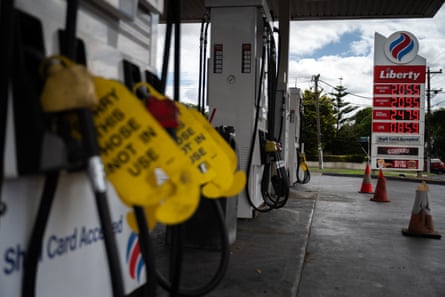
Chris Bowen has insisted the country’s fuel supply is yet to be affected by the war in the Middle East while criticising a rush to buy jerry cans to fill up with petrol as “un-Australian”.
The energy minister made the comments after an emergency meeting with major fuel suppliers and retailers that was convened by the Australian Competition and Consumer Commission (ACCC) to demand explanations for the recent surge in petrol prices.
Australian fuel prices have soared amid a 40% rise in global oil prices in the past fortnight, in response to the Middle East conflict and closure of the strait of Hormuz, a crucial shipping channel largely controlled by Iran.
The government has said it was concerned some retailers were price gouging and that panic buying has exacerbated the situation. Some regional retailers have also run out of fuel in recent days.
Bowen on Tuesday said while he could not guarantee what would happen if the war were prolonged, fuel supplies were arriving into Australia as expected, and importers had told him they expected the deliveries to continue “well into April”.
“Every ship that we have expected to arrive has arrived – whether it is diesel, petrol or jet fuel,” he said.
“All the companies say to me that they fully expect deliveries into March and well into April, but we are in internationally uncertain times.”
He reiterated his call for people to stop panic buying, which he said was “very much causing the problem”.
“People going to Bunnings and buying out all the … jerry cans – that is unhelpful. That is un-Australian.”
Bowen would not speculate about the possibility of fuel rationing, saying only that the government was working “non-stop” to deal with any supply issues.
While determining the direct impact of global oil prices on the cost of fuel for consumers has been difficult, petrol prices have started to push past $2.30 a litre in most state capitals.
The ACCC’s meeting was among a handful of snap talks held by the federal and state governments this month to try to ensure the stability of both fuel supply and retail prices.
Representatives of companies – including Chevron, BP and Ampol – were called to the ACCC meeting to address the government’s concerns about price-gouging across the retail petrol sector.
The ACCC chair, Gina Cass-Gottlieb, said the regulator was closely monitoring the market.
“We reiterated that the ACCC stands ready to use its authorisation powers to assist with effective fuel distribution throughout the country,” Cass-Gottlieb said.
The government had already allowed fuel companies to temporarily sell lower-quality petrol and release about a fifth of their mandatory stockpile, with regional Australia to be prioritised.
In Victoria, the premier, Jacinta Allan, convened an emergency cabinet subcommittee to monitor the fuel supply situation, which met for the first time on Monday night.
Allan said she would chair an industry forum with fuel suppliers, business groups and agricultural representatives on Tuesday afternoon to understand the situation on the ground and outline the actions the government could take.
Since last week, Allan said 289 inspections were carried out by Consumer Affairs Victoria to ensure petrol stations complied with reporting their fuel prices, finding 23 unregistered stations and 16 that were not reporting.
Regional and independent petrol stations have reported difficulty accessing fuel after suppliers prioritised supply to regular customers, cutting off smaller groups that buy fuel on the spot market.
Additionally, some rural service stations have reported simply not being able to replenish their stocks quickly enough to meet the surge in demand.
The New South Wales government also held crisis talks with fuel suppliers and key industries on Monday, where industry bodies agreed to share more information with the government so fuel could go where it was most needed.
Disclaimer : This story is auto aggregated by a computer programme and has not been created or edited by DOWNTHENEWS. Publisher: theguardian.com