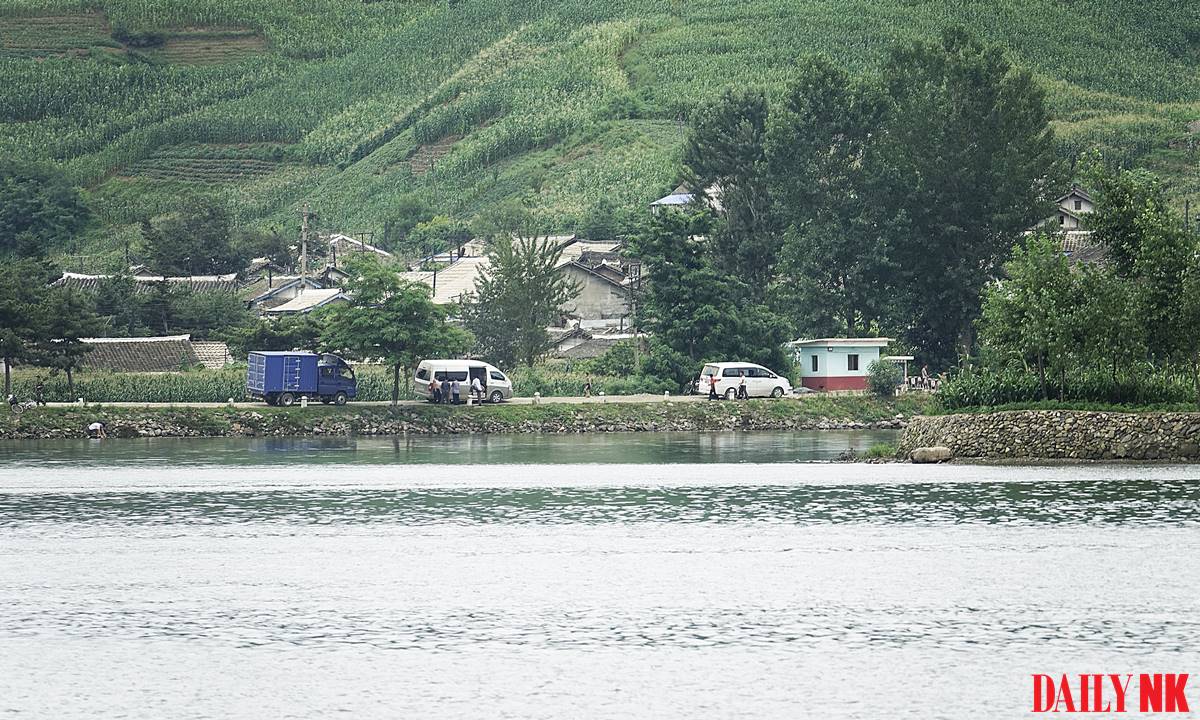
Young North Koreans with wealthy parents are buying vehicles they cannot drive and hiring drivers to run them as taxis or freight haulers, turning private car ownership into a key income-generating asset, multiple Daily NK sources inside North Korea reported Monday.
The trend has been spreading across several parts of the country in recent months, particularly among North Koreans in their 20s and 30s whose parents are donju (wealthy private entrepreneurs). Even without a license, they are able to hire drivers and pocket a steady income from passenger fares or cargo transport fees.
One such case involves a woman in her 20s from Hyesan, Ryanggang province, who pestered her donju parents for more than three months before they agreed to buy her a van. Unable to drive, she hired a driver at a fixed monthly wage and works alongside him as a fare collector, managing ticket revenue directly.
“She hired someone who can drive, pays them a set amount, and rides along as the conductor to collect fares and keep the income herself,” a Ryanggang province source told Daily NK.
The role of conductor involves riding the vehicle, collecting fares from passengers, and overseeing the cash flow on behalf of the owner. Monthly earnings from taxi operations typically reach around 6,000 Chinese yuan (approximately $830 USD), sources said. With fares set at 5 yuan per five li (roughly two kilometers) in town, and vehicles routinely carrying two to three times their official passenger capacity, taxi work has gained a reputation as a reliable source of income in Hyesan.
Wealth gap widens as vehicles become income tools
The pattern is not limited to Hyesan. A man in his 30s from Hamhung, South Hamgyong province, purchased a 10-ton truck with his parents’ support and entered the freight transport business. Although he obtained a driver’s license, he hired a more experienced driver to handle the vehicle while he manages operations. The truck runs cargo routes between Hamhung and Hyesan, generating income from haulage fees.
“Unlike taxis, freight transport involves hauling goods, so there is almost no way for the driver to skim money on the side,” a South Hamgyong province source told Daily NK. “If you find the right person, you can sit back and earn money without doing the driving yourself. That’s why the trend now is to buy a vehicle and hire someone to run it, even if you can’t drive.”
Sources say the spread of private vehicle ownership for commercial purposes reflects a broader shift in how young North Koreans think about economic life. In the past, owning a car was out of reach for most people. The relaxation of restrictions on private vehicle ownership has turned cars and trucks into investable assets for those with capital.
“In their parents’ generation, a woman in her 20s would be married and taking care of her husband,” the Ryanggang province source said. “But young women today often don’t think about marriage at all, and instead throw themselves into making money. The direction of life they’re pursuing is completely different from their parents’ generation.”
The shift points to a North Korean youth cohort that prioritizes economic activity above all else, a development consistent with broader marketization trends analysts have tracked across the country in recent years.
But the vehicle ownership boom deepens inequality for those on the wrong side of the wealth divide. A single vehicle costs between 70,000 and 150,000 Chinese yuan (approximately $9,700 to $20,700 USD), putting ownership entirely out of reach for families struggling to afford basic necessities.
“Young people from households that can barely put food on the table can’t even dream of owning a vehicle,” the Ryanggang province source said. “The wealth gap existed before, but it keeps getting wider. The rich get richer and the poor get poorer. These days there’s a saying going around: ‘The rich eat until they burst, and the poor starve to death.’”
Reporting from inside North Korea
Daily NK operates networks of sources inside North Korea who document events in real-time and transmit information through secure channels. Unlike reporting based on state media, satellite imagery, or defector accounts from years past, our journalism comes directly from people currently living under the regime. We verify reports through multiple independent sources and cross-reference details before publication.
Our sources remain anonymous because contact with foreign media is treated as a capital offense in North Korea — discovery means imprisonment or execution. This network-based approach allows Daily NK to report on developments other outlets cannot access: market trends, policy implementation, public sentiment, and daily realities that never appear in official narratives.
Maintaining these secure communication channels and protecting source identities requires specialized protocols and constant vigilance. Daily NK serves as a bridge between North Koreans and the outside world, documenting what’s happening inside one of the world’s most closed societies.
Disclaimer : This story is auto aggregated by a computer programme and has not been created or edited by DOWNTHENEWS. Publisher: dailynk.com