
Water shapes life in every part of India, but the ways people care for it can look very different from one region to another.
In some places, it is stored as ice. In others, it is held in old stepwells, protected by forests, or cared for through the rhythms of a lake. What connects these stories is simple. People pay attention to the land they live on, and over time, they find ways to make water stay.
On World Water Day, these practices offer something worth looking at closely. They show that water conservation is not always about grand plans. Very often, it begins with observation, memory, and the decision to work with nature instead of against it.
Ladakh’s answer arrives in winter
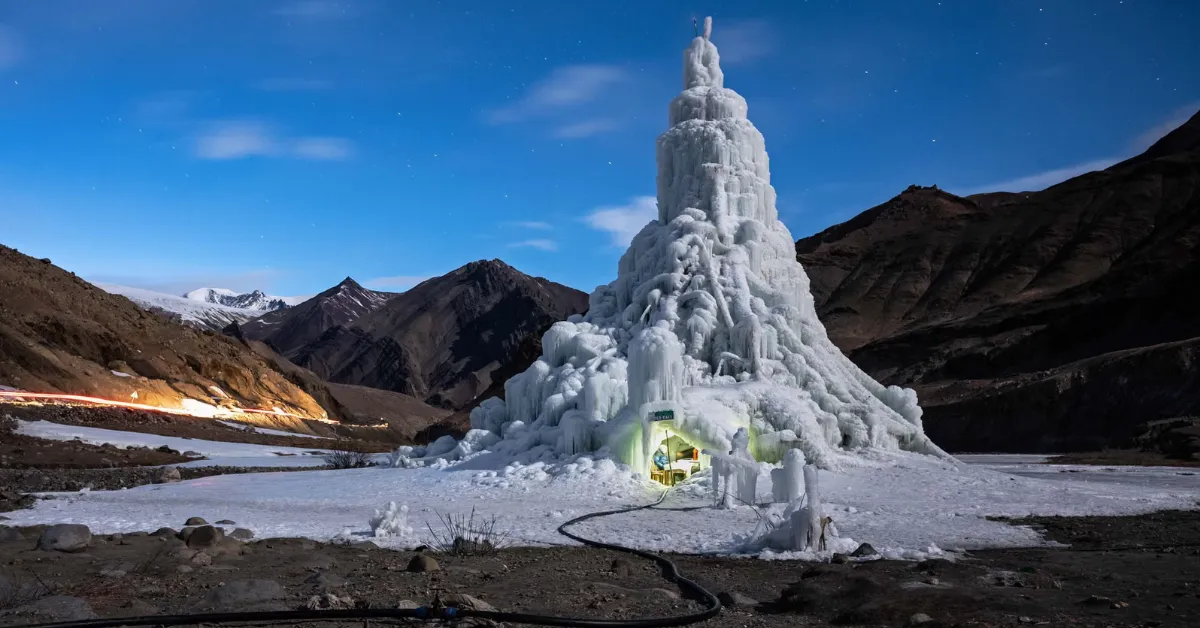
In Ladakh, the problem is often one of timing. Glaciers feed streams, but when farmers need water for sowing, the flow begins to reduce. To bridge that gap, communities build ice stupas, which are cone-shaped structures made by spraying water into freezing winter air. When spring arrives, the ice melts and releases water into the fields.
There is something deeply human about this solution. It comes from knowing the land well enough to understand that winter is not only a harsh season. It can also be a time to prepare. Water that might otherwise pass unused is held for later, and that makes all the difference when the growing season begins.
Rajasthan returns to old wisdom
In Rajasthan, the story begins with scarcity. Rain arrives for a short span, and what matters is how much of it can be saved. That is why traditional systems like stepwells and johads, or small earthen check dams, became such an important part of life in dry regions. They helped collect rainwater, recharge groundwater, and support farming long after the monsoon had passed.
What makes this story compelling today is not only that these systems existed, but that people are returning to them. In many places, old water structures are being restored, cleaned, and brought back into use. When that happens, what returns is not only water. A familiar relationship returns too, one in which a community sees a water body as something to care for, not something to ignore until a crisis arrives.
In Meghalaya, water begins in the forest
In Meghalaya, people understand that water does not begin at the tap or even at the stream. It begins much earlier, in the forest.
That is one reason the living root bridges of the Khasi hills feel so powerful. These bridges are grown over years by guiding the aerial roots of rubber trees across rivers with the help of bamboo. The process can take 15 to 30 years, and the bridges remain alive as they continue to grow.
/filters:format(webp)/english-betterindia/media/media_files/2026/03/18/featured-img-1-2026-03-18-04-11-49.png)
The bridges are remarkable in themselves, but they also point to a larger way of thinking. Healthy forests hold rain, help it sink into the soil, and feed streams over time. So when communities protect these landscapes, they are also protecting their water sources. That kind of care asks for patience, but it leaves behind something lasting.
In Chilika, water supports an entire world
Odisha’s Chilika is a different kind of water story. It is a vast brackish lagoon, recognised as a Ramsar site, and it supports a rich mix of marine, brackish, and freshwater life. Every winter, migratory birds arrive in large numbers, turning the lake into the largest wintering ground for migratory waterfowl in the Indian subcontinent.
/filters:format(webp)/english-betterindia/media/media_files/2026/03/18/featured-img-2-2026-03-18-04-15-09.png)
But Chilika is not only about biodiversity. It also supports the lives of large fishing communities around it. That is what makes the lake so moving as an example. Here, ecology and livelihood are tightly bound together. Caring for the water body means protecting birds, fish, and dolphins, but it also means protecting homes, work, and the future of the people who depend on the lake every day.
Sources
‘Can Ancient Indian Stepwells Teach Us How to Solve Today’s Water Crisis?’: by The Better India, Published on 15 April 2025
‘25+ Traditional Water Harvesting Systems Across India’: by The Better India, Published on 22 March 2025
‘Before Summer Water Shortages Hit, Here Are 3 Community Solutions You Can Replicate’: by The Better India, Published on 13 February 2026
‘VIDEO: These “Ice Stupa Glaciers” Are a Solution to Water Crises in Ladakh’: by The Better India, Published on 04 January 2017
‘The Remarkable Journey of One Farmer’s Decade-Long Battle To Revive the Purna River & Save 6 Villages’: by The Better India, Published on 05 January 2026
‘Conserving the Living Root Bridges of Meghalaya’: by United Nations Development Programme, Published on 19 August 2024
‘Living Root Bridges’: by Meghalaya Biodiversity Board, Published on 06 December 2017
‘Chilika Lake’: by UNESCO World Heritage Centre, Published on 15 April 2014
‘Environments’: by Chilika Development Authority, accessed on 18 March 2026
Disclaimer : This story is auto aggregated by a computer programme and has not been created or edited by DOWNTHENEWS. Publisher: thebetterindia.com



