A warmonger in the White House is now responsible for a rate hike that will further squeeze mortgage holders and small businesses in Australia (“RBA warns recession may be unavoidable after raising rates again”, March 18). Real wage growth has flatlined. GDP per capita is currently up by an anaemic 0.9 per cent. So where are the domestic-driven inflation pressures? Reserve Bank Governor Michele Bullock points to strong employment growth but so what? The majority of employed workers are not spending big but rather struggling to make ends meet. It appears the Strait of Hormuz will be central to monetary policy for a while. Judging by the close vote to lift rates, there appear to be at least four level heads who hopefully see the bigger picture and can bring some sense to the debate (“A 5-4 vote says everything about the Reserve Bank’s dilemma”, March 18). The governor herself did not discount a recession. That means the budget, which was being touted as a “generational change” by a progressive treasurer, is now toast. A timid prime minister will see to that. Mike Kenneally, Manly
A telling comment from Michele Bullock is that the cash rate is the only tool the bank has to fight inflation. In light of this, surely it’s time the government did more of the heavy lifting and explored the options available to it. The RBA may be independent but that does not mean the government cannot heed its advice and work together for the benefit of ordinary Australians. Philip Cooney, Wentworth Falls
Well done to the RBA board members who voted to punish young families with mortgages for the inflationary effects of Trump’s war against Iran. I don’t know how presumably privileged people such as these can sleep at night, knowing they are causing further unnecessary financial and emotional distress to their fellow Australians. Martyn Yeomans, Sapphire Beach
Grave new world
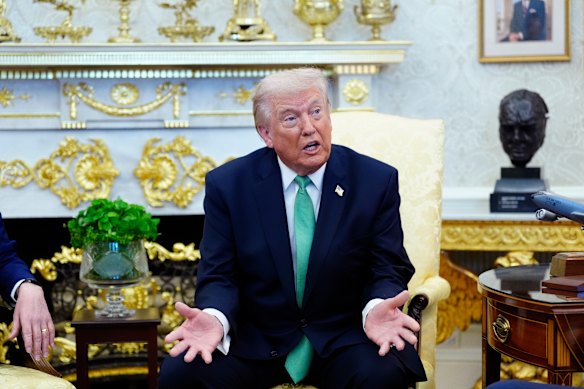
US President Donald Trump pretends to “great things” but is actually signalling the dawn of a new world order. With Europe’s and the Indo-Pacific’s refusal to be drawn into another US-led misadventure, we are witnessing the emergence of a post-American world in which previous power alliances cease as former allies say enough is enough (“Trump lashes out at NATO allies, Australia over Iran war”, March 18). The US/Israeli war on Iran will only lead to worldwide confusion and economic hardship. Countries are rightly deciding to realign and map futures without the Big Brothers of warmongering deciding the next steps. How Australia’s future will unfold while we remain enmeshed in the AUKUS web is anyone’s guess. Frederick Jansohn, Rose Bay
Having failed to deliver on his boast that he would end the war in Ukraine, Trump turned his attention to Iran. With no convincing result there, he seems to be bored and so has selected the much smaller and closer target of Cuba for his next war game. When no one took his claims on Greenland and Canada seriously, he dropped those ambitions. Like the string of failed business ventures he has left in his wake, he is moving on from one country to another without a care for the human cost. How will America and the world survive another two years of this? Eric Scott, Bondi Junction
Fuel for thought
As fuel shortages loom, it’s worth noting that buffer stocks are owned by fuel companies, which no doubt purchased them when barrel costs were much lower than they are now. Suppliers can thus sell the old fuel at today’s high market rates, potentially banking huge profits. The Australian government does not currently have a mechanism to claw back those extra profits, nor to charge a release fee. Then there is the additional state revenue from the state fuel tax of about 50 cents a litre. It would therefore seem that the coffers of suppliers and state governments will grow while the public suffers through higher fuel prices and rising inflation. Geoff Ball, Worrowing Heights
As usual, it is the working class and service workers who are the first to feel the pain of increasing petrol costs. In a trip to the Scandinavian countries a decade ago, our mouths were agape seeing the uptake of electric vehicles and charging stations all over their major cities. That this initiative was coming from a country with trillions of dollars in a sovereign wealth fund derived from oil, as in the case of Norway, was simply astounding. Meanwhile, in Australia, the next decade was marked by a Coalition government spruiking the benefits of petrol-guzzling monster utes with nary an incentive for motorists to switch to EV. Now we are left to suffer from our dependency on oil, all thanks to the short-sightedness and dogmatic beliefs of the previous government. Cristina Corleto, Stanmore
It was not just Michaelia Cash who started the ridiculous campaign against EVs (Letters, March 18). We must also include ex-prime minister Scott Morrison. It was part of their usual bag of tricks to scare the voters in the 2019 election. They stood side by side in front of the cameras, chortling that Labor’s electric vehicle targets would “ruin the weekend” and “steal the tradie’s ute”. They both need to take responsibility for our roads and car parks being crowded with petrol-guzzling monsters. With fuel prices soaring, I have a strong feeling that the coming Easter long weekend will be ruined for quite a few tradies anyway. Neil Quinn, Vincentia
Heavy toll
How courageous of Orly Lavee to write about her damaging experience of domestic violence (“Private harm not a public spectacle”, March 18). Clearly, her plea for the anonymity of victims should be considered and hopefully implemented. To become a “public spectacle” as Orly did was harrowing. Domestic violence is a serious national problem. Women are mainly the victims. According to the Australian Bureau of Statistics, about one in four Australian women are DV victims, compared with about one in 14 men. We must keep fighting this scourge as it has such dire consequences for a victim’s life chances. Ron Sinclair, Windradyne
As a social worker, I commend the opinion piece by Orly Lavee. Dr Lavee describes the impact of sensationalism by the media and identifying the victims of domestic violence, so that survivors and their children have no privacy or safe space to heal when their life has been turned upside-down by violence and manipulation by an ex-partner. To heal and to seek justice takes great courage. Rhyan Andrews, Faulconbridge

Super compensation
On the subject of women’s finances (“The talk women can’t afford to avoid”, March 18), it’s important to point out that while superannuation has been made more attractive to the rich (mostly men) since inception – e.g. allowing self-managed funds to invest in holiday homes, business premises, vintage cars, wine and boats – there has been no indexation of the spouse contribution in 30 years, stuck at $3000 per annum, or the co-contribution, which has been stuck at $500 p.a. for more than 20 years. Meanwhile, there’s a growing plethora of methods for those with the means to boost their super way above and beyond actual retirement needs. If we care about women, we need to immediately boost these two methods, which allow low-income women to catch up the time they have sacrificed to care for others, such as children and sick or elderly parents. Anne Matheson, Gordon
Clear the air
Now that shock jock Kyle Sandilands has been silenced, can we please return radio to its golden era of intelligent, honest, respectful and courteous presenters (“Sandilands to fight $100 million KIIS termination”, March 18)? Please dispense with obnoxious radio personalities and bring back the integrity we enjoyed in the halcyon days of the ’50s, ‘60s and ’70s. Bitter, angry purveyors of misinformation and bias should not have such undue influence on our society. It’s time to do better. Jan Brahe, Armidale
Heat island
A picture speaks a thousand words. The Herald’s photograph of the modern housing development at The Ponds in Western Sydney points to another significant contributor to the “heat island effect” in fast-growing suburbs, beyond the concentration of black roofs (“End of the black roof? Draft policy shaping as a hot topic,” March 18). There doesn’t appear to be any room for air to circulate or for kids to play outside at The Ponds. A new policy that mandates minimum space between buildings is essential. It’s ironic that as we gradually move towards allowing all chickens to comfortably range free, people who consume poultry products are required to live in battery conditions. Glenn Johnson, Leura
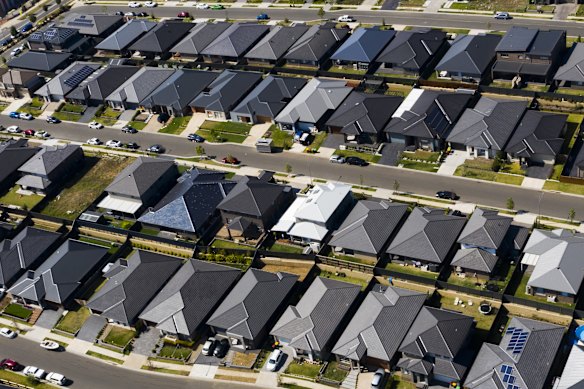
While it makes a lot of sense for a council to halt the growth of a heat drawing, black-roof landscape, there seems to be no policy for a green landscape. In the aerial shot of The Ponds estate there is not a green leaf in sight. Surely councils must realise the benefits of the life-giving oxygen produced by trees. Isn’t it even more important than the colour of one’s roof? The council seem completely oblivious to the need for a leafy, life-enhancing environment in which to live. A policy of at least one tree in every front or backyard should be just as important, as the green canopy soon grows, eliminating the urgency to change the colour of one’s roof. Greg Vale, Kiama
Tale of two taxes
There is anger toward property investors and their two tax breaks – negative gearing and capital gains tax. Correspondent Jack Bedson states we should get rid of both of these benefits (Letters, March 18). The problem is that not all people can buy a home and there will always be a need for investors (landlords) to provide rental properties. Without being able to make a reasonable profit they simply will not exist. The issue for government is to find the right mixture so that they can make their profits but not so much as to stop first home buyers getting into the market. In my view, negative gearing is the tax break that needs to be reduced or annulled as it provides too much advantage to property investors over first home buyers. The capital gains applied at point of sale should be reduced to ensure a reasonable profit. John Rome, Mt Lawley (WA)
Removing the tax on capital gains, as suggested by your correspondent, will mean that the gains will be completely tax-free. Investors would be more confident to buy up houses, pushing out even more potential homeowners. Sure, there would be more turnover of property, but mainly to another batch of investors. The gravy train would just keep on rolling. Michael Blissenden, Dural
Your correspondent correctly calls for the removal of capital gains tax on housing to encourage sales and increase supply. Labor’s 1985 CGT has been a major contributor to the housing and productivity crisis by making the tax-free family home about twice as attractive as productive investments in shares and businesses. Increasing the tax on rental properties will lock many of these out of the market for the life of the current owner. William S Lloyd, Denistone
New plan for NAPLAN
It is concerning to read about so many parents (and apparently their children, too) becoming so upset by a glitch in the NAPLAN testing procedures (“NAPLAN test failure run by same company as selective school chaos”, March 18). When so many children are being tested online we can expect difficulties and problems to occur. The test itself is only a guide to ensure that levels are being attained, it is not a tool for measuring IQ or creativity. I am not sure how children can be “disadvantaged” when the same problem affected all those being tested. Surely, this is a way of teaching our children to develop resilience when things don’t quite go to plan (or in this case NAPLAN). Sue Scott, Hornsby
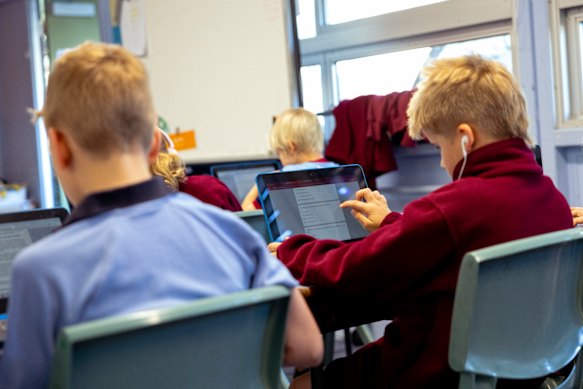
The simple answer to the NAPLAN fiasco – sack the IT company and get a refund. It has now failed twice. How do you repay the stress caused to students and parents plus the loss of faith among the community? It would be better to redirect the money to create a strong in-house Department of Education team that can do these things better than outsourced people with no skin in the game. Robert Mulas, Corlette
Thank you, Emily Kowal, for your HSC article, which mentioned Yass High School, my workplace for more than 30 wonderful years (“Revealed: The state’s most improved schools in the 2025 HSC”, March 16). We had our successes over the years – two first places in subjects in one year and a scattering of Band 6 results from time to time. What is not recorded, but most fondly remembered by me, are the many students who achieved results that were testament to their hard work and unfaltering enthusiasm, and also the dedicated teachers and parents. Living in the community, educating our sons here and seeing daily how the school has so valuably contributed to the community, has been a real highlight for my wife (also a teacher) and me. Phil Armour, Yass
The bigger picture
The offering of asylum in Australia is indeed selective (Letters, March 18). Perhaps it helps to be photogenic, like the Biloela family or the Iranian women’s soccer team. There’s no way of knowing the photogenic qualities of the asylum seekers still trapped in hostile conditions in Port Moresby, 13 years after Kevin Rudd’s infamous declaration because we have never seen their pictures. Out of sight, out of mind. And while there have been those allowed into Australia, many are denied the right to study, some even the right to work, and must endure the stress of reapplying for visas every few months. Only the kindness of everyday people keeps them alive and hanging onto threads of hope. It’s certainly not the federal government. Christine McNeil, Ballina
- To submit a letter to the Sydney Morning Herald, email letters@smh.com.au. Click here for tips on how to submit letters.
- The Opinion newsletter is a weekly wrap of views that will challenge, champion and inform. Sign up here.
Disclaimer : This story is auto aggregated by a computer programme and has not been created or edited by DOWNTHENEWS. Publisher: www.smh.com.au