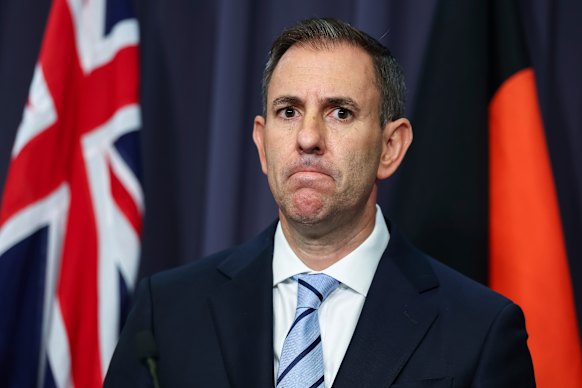
Treasurer Jim Chalmers has warned inflation could spike above 5 per cent if the Middle East war drags on, hurting living standards and wiping billions from the economy as business chiefs move to a COVID-style posture to avoid supply shocks in the construction, medical, and food sectors.
Prime Minister Anthony Albanese will appoint a national fuel co-ordinator when he meets with state and territory chiefs at a national cabinet on Thursday, with NSW Premier Chris Minns and Victorian Premier Jacinta Allan pushing for emergency co-ordination on fuel stocks.
The Strait of Hormuz shutdown is roiling commodity markets well beyond oil, threatening shortages in key products such as urea, used in fertilisers, and naphtha, used in plastics, and raising anxiety about a months-long slowdown.
A day after the Reserve Bank hiked the cash rate due to persistent inflation, Chalmers released modelling showing the economy could be scarred for years if neither United States President Donald Trump nor the Iranian regime brought a swift end to the war.
In a speech to Australian Business Economists on Thursday, Chalmers will say that if oil remains about $US100 a barrel for the first half of this year, “the prospect of inflation peaking in the high 4s or even higher this year is very real”.
If oil reaches $US120 a barrel and then takes three years to fall back to its pre-conflict level, inflation is likely to push towards 5.5 per cent or even higher.
Oil at $US100 a barrel clips about 0.2 per cent from economic growth. But higher-priced oil would leave a “bigger scar”, he said, although economists say the flow-on effect of the war remains unpredictable.
“There would be an immediate hit to output but it would build over time,” he will say. “Treasury estimates that GDP would be 0.6 per cent lower in 2027 and even by 2029 would still be below where it would have been without the conflict.”
The Reserve Bank is forecasting economic growth to slow to 1.6 per cent next year, below the long-term average.
Chalmers will say Treasury is modelling a third more drastic outlook. Some analysts have suggested oil could push beyond $US150 a barrel.
The opposition has been trying to remind voters that inflation had risen outside the bank’s target band from the back half of last year, well before the war, off the back of private demand and high federal and state government spending.
“If only you could pay your mortgage with Jim Chalmers’ excuses,” shadow treasurer Tim Wilson said on Wednesday. “The Reserve Bank has made it crystal clear in its statement. It was the second sentence: this is an interest rate hike off the back of inflation data in the second half of last year.”
Bank governor Michele Bullock warned of a recession on Tuesday and said: “Higher petrol prices will add to inflation but they’re not the reason for today’s decision”.
The US-Israel strikes and the indiscriminate Iranian missile barrage have upended the government’s planning for the May budget and locked ministers in near-daily national security committee meetings. Trump scolded Australia and other nations on Thursday after they declined to send forces to help reopen the Strait of Hormuz, through which a fifth of global oil supply normally passes.
Albanese said Thursday’s national cabinet meeting would focus on fuel security. He is also preparing to announce bailouts for Australia’s last two oil refineries, as first reported by this masthead on March 9.
Raising a comparison with the COVID supply shock, Albanese said he would be asking premiers to appoint a senior official to co-ordinate fuel distribution. “That will be about making sure that we deal with the issues that Australia and indeed the world is confronting, with the issue of fuel security,” he said in Tasmania.
“All of our ships have arrived at this point in time, but we’ve had a surge in demand, which is leading to some shortages in some areas, particularly of diesel.”
Several business chiefs spoken to by this masthead on Wednesday said the federal and state governments were making contingencies for worst-case scenarios over coming weeks. The Albanese government said on Tuesday that shipments of oil were safe until well into April.
“It’s a COVID-101 playbook that we’re learning from,” said Tim Piper, Victorian head of the Australian Industry Group.
Piper explained that government and industry groups were working together to make sure essential services such as water and waste management had sufficient fuel to operate.
Minns said: “Our biggest concern right now is diesel supply, which keeps trucks moving, farms and construction projects running, and goods and food getting around the state.”
“We’re keen to see a national plan that sets out a clear escalation pathway, including what further actions may be taken if the conflict continues and conditions worsen,” he said.
Allan said: “It’s important as a nation that we work together on having continuity plans in place”, adding that she had appointed a state controller as would exist in a natural disaster.
Industry Minister Tim Ayres will give a speech on Thursday arguing that an overemphasis on open markets and efficiency had hollowed out state capacity and weakened the national resilience of countries like Australia.
Ayres said Labor’s $23 billion Future Made in Australia policy was an attempt to reinvigorate Australia’s chemicals, steel and other sectors critical to national security. The opposition and Productivity Commission have questioned the reversion to industry policy.
“Australia lost touch with its economic and strategic vulnerabilities. The prevailing economic mantra was efficiency,” Ayres will tell the John Curtin Research Centre.
“The Iranian regime might blockade the Strait of Hormuz, but it cannot stop Australian wind from driving Australian turbines to power Australian blue-collar industry.”
Cut through the noise of federal politics with news, views and expert analysis. Subscribers can sign up to our weekly Inside Politics newsletter.
 Paul Sakkal is chief political correspondent. He previously covered Victorian politics and has won Walkley and Quill awards. Reach him securely on Signal @paulsakkal.14Connect via X or email.
 Shane Wright is a senior economics correspondent for The Age and The Sydney Morning Herald.Connect via X or email.
From our partners
Disclaimer : This story is auto aggregated by a computer programme and has not been created or edited by DOWNTHENEWS. Publisher: www.smh.com.au