In February, a user named EricKeller2 posted on Reddit. “I mapped every connection in the Epstein files,” he wrote. He had built a website and database of more than 1.5 million files related to the Jeffrey Epstein case. A giant interactive network graph showed the connections between 1,000-plus people in Epstein’s social world—through flight manifests, email exchanges, and other documents that connect them. The post included a link to the site: Epsteinexposed.com.
That post got 5.5 million views. Hundreds of thousands of people from all over the world visited the site in the days that followed. And EricKeller2 was busier than ever.
EricKeller2’s real name isn’t Eric Keller. He used a pseudonym to protect himself and his family from Jeffrey Epstein’s rich and powerful friends. A thirtysomething data engineer with a wife and kids, he’d been following the child sexual abuse case for years—reading court filings, depositions, materials from the Giuffre v. Maxwell case. But in the fall of 2025, as the initial deadline from the Epstein Files Transparency Act approached, he got more organized. And then he got obsessed.
Every day since then, Keller has been doggedly loading hundreds and hundreds of files into his database. Epstein Exposed contains material from many sources beyond the US Department of Justice’s file dump, including unsealed court records and FBI tips, and it focuses on exposing “the connective tissue,” as Keller put it, between the files. The site calls itself “the most comprehensive searchable database of every person, document, flight, and connection in the Epstein files.”
“There were nights I had to stop,” he tells me. “There are descriptions of things no human being should have experienced.” He remembers one 2017 email thread between Epstein and an intermediary, in which Epstein offers $300 to a girl for a topless massage. The intermediary tells him that the girl wasn’t available because she had school on Monday. Epstein then ups the offer to $400.
“You can build a mental wall between yourself and what you’re reading, but it doesn’t always hold up,” he adds. “Some nights it doesn’t hold at all.”
He has a personal reason for pouring himself into this project. “I am a survivor of childhood sexual abuse,” he tells me. It’s why he can’t seem to look away from the horror inside those files. And so he builds.
The Epstein Library on the Justice Department’s website is a model of disorganization. In early December, Keller was clicking through the tens of thousands of pages of documents in the library and feeling “frustrated disbelief” at the chaos—files that could be hundreds of pages long, text that was sometimes blurry or sideways, a wire transfer with no context, an email chain with half the names blacked out, a flight log with only initials. “It’s disorienting,” he says. “You’re reading fragments of something enormous and trying to figure out which fragments matter and how they connect.”
One night, he spent about four hours trying to trace a single person’s name across some 30 documents in the archive. “I just stopped and thought, I am doing by hand what a database could do in milliseconds,” he says. As a builder of database infrastructure at a midsize company, he knew exactly what to do next. “I opened a code editor and started building. By 3 am I had a basic search prototype working against a few hundred documents,” he says.
Around that time, a site called Jmail.world was making a splash as a tool for people to peruse Epstein’s emails as if using a Gmail interface. Launched in mid-November and built by a group of tech-savvy volunteers, it has since grown to include, among other things, his photos, flights, and Amazon purchase history, also displayed as if the reader is viewing Epstein’s own accounts. Keller used the tool and liked it. “Jmail was proof that the community could build better tools than the government was providing,” he told me.
It also helped him hone his own project. “Instead of thinking about one category of documents, I started thinking about the network,” he says. “How do you connect a person who appears in an email to a flight they were on, to a wire transfer, to a deposition they gave? That cross-referencing problem is what I wanted to solve.”
Then, on December 19, the Justice Department released its first big tranche, adding hundreds of thousands of new documents to the existing archive. Immediately, Keller’s workload ballooned to an all-time high. The prototype he had built earlier in the month became the foundation for processing all of it.
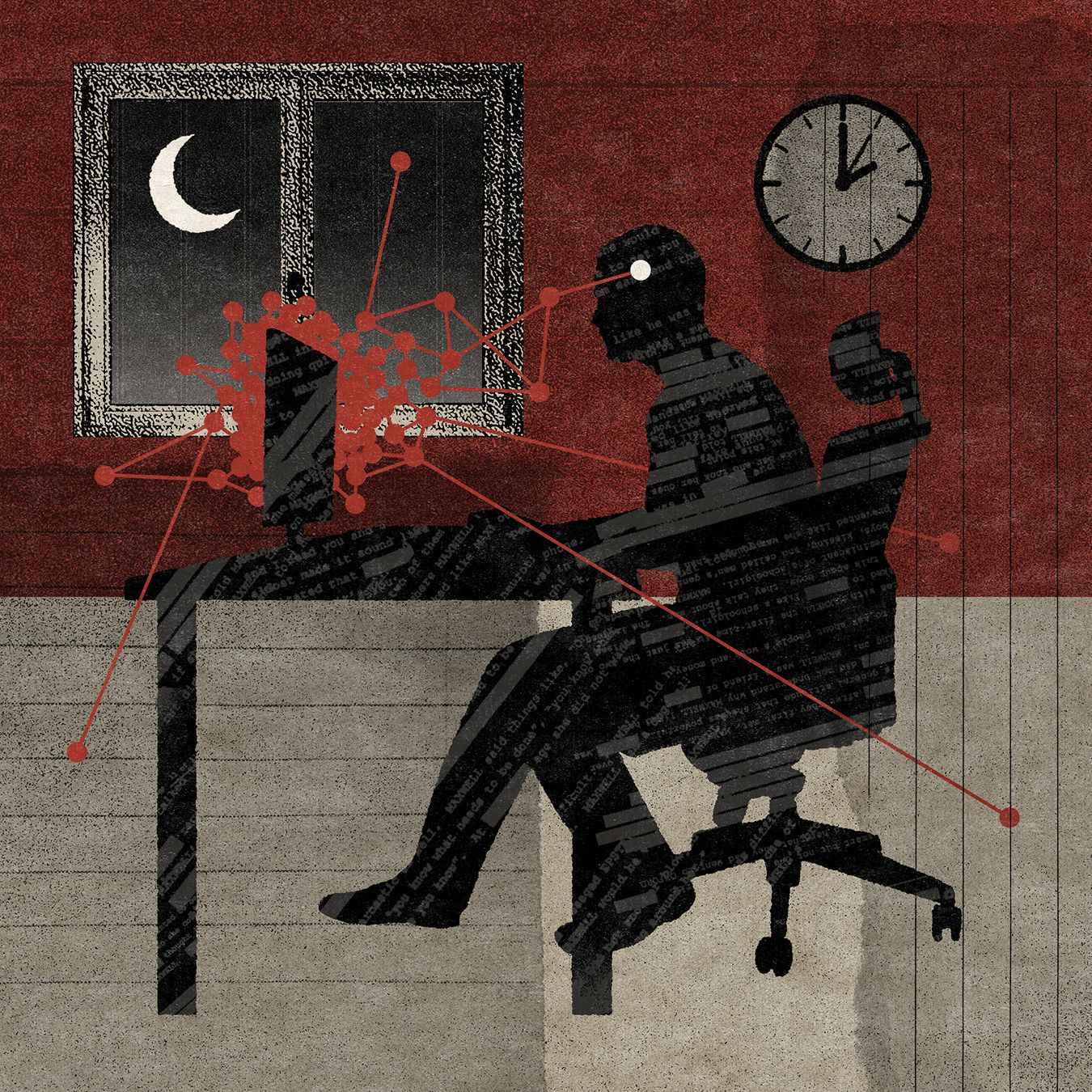
Most nights he worked until 3 or 4 am, sipping cold coffee while navigating a sea of open tabs.
Because of his childhood, he says, “when the first documents started dropping, I couldn’t look away. I understood at a gut level what was being described in those files.” In the evenings, he’d return home from his day job and, once everyone in his family was in bed, he’d hole up in his home office and spend hours scrolling through downloaded PDFs.
Many documents were posted as images, and he’d run each page through layers of software to convert them into searchable text—sometimes one system would fail to convert the text and he’d run it through a second or third. Then he’d use another system to extract important details such as names, organizations, dates, and locations. He’d perform hash verification—a process that checks whether the Justice Department’s files have been tampered with—and redaction analysis, to scan for inconsistencies in how the government blacked out information. He tracked all his work in a meticulous, digital, color-coded ledger. “It’s not uploading files,” he says. “It’s rebuilding a crime scene from 2 million fragments of evidence.”
At the end of January, the DOJ dropped an even bigger tranche, this one containing more than 3 million files. Although the workload swelled even more overnight, Keller says the file drop was validating. After all, the entire system he’d been building had been designed for that moment.
On February 5, Keller registered his domain. A week later, the number of files in his database had crossed a million. He’d also set up the first version of a colorful, interactive network graph that showed the connections between the powerful figures orbiting Epstein—financiers, politicians, academics, royalty. He decided he was ready to share it with the world, and he turned to Reddit.
With the sudden influx of visitors, the site needed constant attention. At one point it crashed in the middle of the night; Keller got it stable by dawn only to have it crash again that afternoon.
A former investigator messaged him, wanting to cross-reference a specific set of Deutsche Bank wire transfers against flight dates to see if money had moved on the same days that people had flown. A journalist from a major European outlet was using the site to investigate connections between Epstein’s financial network and someone in their country, and wanted help finding every document that mentioned certain company names. A forensic accountant specializing in financial crime reached out, offering to review a pattern of wire transfers that Keller’s site had surfaced; that person said that certain transaction patterns were consistent with layering techniques used in money laundering. “The response tells you something specific,” Keller said. “There is a real community of people who have been trying to get to the truth here for a long time, and the site gave them something they did not have before.”
The site kept crashing, and he was rewriting infrastructure deep into the night. In the mornings, he’d stagger into his day job and pretend that everything was normal. What fueled him was anger, he says—a sense that the DOJ had made the files practically unsearchable and that the public deserved better.
Twelve days after the launch of Epstein Exposed, Keller quit his job. On Reddit and through his site’s contact email, people were asking him how they could contribute, so he set up a donation page. “When I looked at what had come in, and what the site had become, it was clear that this was now the work.”
Even committing himself full-time to the site, he’s stretched thin. He forgets to eat, he says, unless his wife puts food in front of him. His back hurts. His eyes are constantly tired. He drinks too much coffee. Some mornings he forgets what day it is or when he last went outside. “My wife jokes that when this chapter is over I owe her about three months of normal,” he says.
He’s also under legal pressure. He has received formal demand letters from law firms representing individuals in the database. The letters arrive with 24-hour deadlines. “Some are on behalf of genuine victims, and I take those seriously,” he says. “I’ve redacted dozens of documents for verified survivors. But not all of them check out.”
Keller says the files force him to reflect on his own childhood trauma. “When I’m reading through testimony or looking at records of what was done to these girls and young women, I’m not seeing strangers. I’m seeing something I understand from the inside,” he says. Sometimes the emails stop him cold. In one from March 2014, someone writes to Epstein: “Thank you for a fun night. Your littlest girl was a little naughty.” Or there’s the email from 2017, in which someone tells Epstein they met a girl who’s “like Lolita from Nabokov, femme miniature,” and asks if they should send him “her type of candidates only.”
“They’re referencing a novel about a man raping a 12-year-old,” Keller says. “As scouting criterion. In an email.”
Keller can’t help but think about his own kids too. “There are moments where that connection hits you, and you have to stop and just sit with it. It’s part of what makes it hard to walk away at the end of the night.”

Scroll through the hundreds of replies to Keller’s launch post on Reddit and you’ll notice a recurring sentiment: He’s building the infrastructure that the government should have set up in the first place.
For some time now, online communities have been helping to fill holes left by institutions. Reddit in particular has stood out. Last month, when the DOJ gave lawmakers a strict window in which to peek at the unredacted Epstein files, many members of Congress felt overwhelmed. Congressman Maxwell Frost, a Democrat from Florida, knew he needed to “be strategic and act fast.”
“On Reddit, there was an active community (r/Epstein) crowdsourcing information and digging into the details, so we posted there to gather direct links to the DOJ’s website and better understand what to prioritize,” Frost told me. “Millions of people interacted with that post, which made clear that the American people want answers.”
As Keller sees it, the online community’s role in the Epstein saga is, primarily, to refuse to let the issue die—to spur new prosecutions and to help the victims see justice. “I think about them constantly,” he says of the survivors. “If they can come to this site and search and find documentation that confirms yes, this happened, yes, it was real, yes, the world knows,” he said, “that matters in a way I don’t have adequate language for.”
Since quitting his job, Keller has found himself burning through his savings faster than he expected. He says he spends roughly $3,500 a month to keep the server running, and some weeks the donations don’t cover it. But he says his wife understands why this matters to him and has been supportive. The database has now indexed 2.15 million documents, cataloged 1,500 people, and mapped tens of thousands of Epstein’s connections. “You don’t walk away from that,” he said. “Imagine where this can be in six months or a year from now. I believe this will make a difference. I have to. These things cannot be allowed to stand.”
Traffic to his site remains high for now, but Keller says he isn’t obsessed with those numbers. “Even if the traffic drops to 10 people a day, those 10 people might include a journalist working on a lead, a researcher writing a paper, or a survivor looking for their own name in the record. That’s enough,” he says.
The work is far from over. He recently finished building out a forensic finance system. More than 130,000 documents still need to have their text made fully machine-readable. Hash verification is only 64 percent complete.
Not to mention, community members are still submitting names and researchers are still flagging new connections between documents. It’s why he doesn’t think this project has a finish line. So for now, Eric Keller will do what he’s been doing for months: sit down at his monitor, sip some stale coffee, and get back to work.
Disclaimer : This story is auto aggregated by a computer programme and has not been created or edited by DOWNTHENEWS. Publisher: wired.com