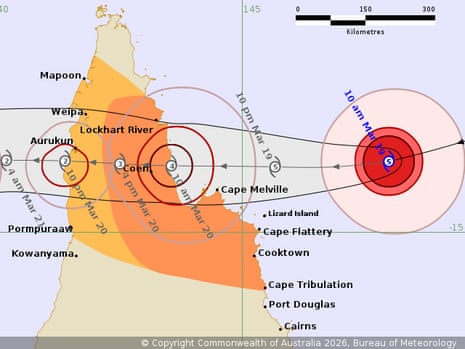
Severe Tropical Cyclone Narelle has now intensified to a Category Five storm – the highest category available – as it moves swiftly west towards the Queensland coast.
In the latest update from the Bureau of Meteorology, the storm is now about 500km east of Coen and is expected to make landfall on Friday morning.
But a change from the bureau’s earlier map now suggests Narelle will cross as a category four storm rather than a category five, as was being forecast earlier today.
A cat 4 storm is still very destructive and can cause “significant roofing loss and structural damage” with typical wind gusts between 225 km/h and 279 km/h.
Don’t be surprised if the outlook changes again as the storm gets closer to the coast.
Treasury has downgraded Australia’s growth prospects over the coming few years, compounding the near-term damage from a global energy shock which Jim Chalmers says will be “a defining influence” on the May budget.
In a speech to the Australian Business Economists in Melbourne, the treasurer revealed that officials expect productivity growth to recover towards a more normal level over the coming five years, instead of two.
Alongside some changes to population growth forecasts to include a slower fall in net overseas migration, “GDP is now likely to be a quarter to half a percentage point weaker in the middle years of the forward estimates,” he said.
Chalmers flagged yesterday that the Middle East conflict could deliver a multi-billion dollar blow to the economy while also pushing inflation above 5% in a worst-case scenario.
The treasurer in today’s speech said the country was already struggling with high inflation, weak productivity growth, and a highly volatile global environment:
This conflict is not the only major challenge we face in our economy, but it exacerbates the others.
It’s adding to inflation when it is already too high, intensifying uncertainty when it is already elevated, and straining our productive capacity when it is already close to its limit.
As flagged earlier, Chalmers promised that his fifth budget would deliver a trio of “ambitious reform packages” to rebuild fiscal buffers, make the tax system fairer, and lift the nation’s lagging productivity performance.
David Crisafulli says planning is already under way for expected recovery efforts.
I want communities to know that we’ll be there before, during and after the event. There can’t be daylight between that.
I know these communities are resilient and they’ve been here before and they know what wind and a lot of rain looks like.
This is a serious system though, and I’m asking people to take it seriously. Because it is the kind of event that doesn’t happen all that often.
To put it in perspective, not since the late 1800s in the far north of this state has a category five system crossed. Category five systems don’t cross the coast that frequently. It’s a serious event, but I can assure you we can get through it.
The Queensland premier, David Crisafulli, is addressing the media ahead of the expected arrival of Tropical Cyclone Narelle. Crisafulli says:
This system will provide the following challenges: strong winds, the potential for storm surge, heavy rainfall, and flash flooding.
All of those things are in play for a number of reasons including the intensity of the cyclone and the already flooded catchments.
Crisafulli says current modelling shows Narelle crossing the coast in conjunction with the high tide on Friday. That would create “added complexity” for the response.
A large system like this crossing on a high tide does come with the prospect of storm surges does add a layer of complexity and we’re planning for that …
There are challenges in this system, big challenges. But we have prepared for them. This is the last window that people have [to prepare] and people have to respond accordingly
Watkins says Wednesday brought unseasonable weather in Coen.
“Yesterday was very eerie,” she says. “It was bright, beautiful sunshine – like it could have been the dry season.”
Now, she says, a light breeze has picked up, some clouds have moved in.
“It is just like a standard wet season day today now,” she says. “It’s a day that you’d spend going fishing.”
Watkins says she hopes to reopen the shop on Sunday.
“I’ve got a whole bunch of hotdog rolls and sausages,” she says. “So, if it’s safe, we’ll do a sausage sizzle at the shop.”
A shopkeeper in Coen says she is selling gas stoves, canned meals and hardy vegetables as people in the remote Aboriginal community in far north Queensland prepare to feel the brunt of Severe Tropical Cyclone Narelle – and the days of isolation it could bring.
Sara Watkins runs one of two fuel and grocery shops in town, which she says will close at the end of today – or sooner, should the rains hit.
Watkins, originally from the UK, says the community was preparing for days without power, mobile coverage or access in and out of the landlocked town.
“The town is prepared. Everyone has been pulling together, cleaning up yards together,” she says. “Both shops have been preparing, taking down signage, sandbagging and everything else to reduce the damage. It’s been a really great community effort.”
“Of course”, she says, “everybody is anxious”.
“There are really old properties here that might not necessarily be cyclone-proof,” Watkins says. “[But] the town is incredibly resilient. We deal with isolation every single wet season. Coen is a very resilient place”.
Aussie shares plunge, oil price spikes as Iran war escalates
The Australian share market has fallen sharply after oil prices rose and gold prices plunged amid more geopolitical turmoil, AAP reports.
The benchmark S&P/ASX200 index had dropped 134.7 points, or 1.53%, at midday on Thursday, while the All Ordinaries had fallen 145.2 points, or 1.64%.
The losses left the S&P/ASX200 at its lowest level since late November and down 2.5% since the start of the year.
Meanwhile, the US central bank left interest rates on hold, as expected, but comments made by chair Jerome Powell diminished hopes for a rate cut later in the year.
Eight of the ASX’s 11 sectors were lower at midday and three were higher.
Possum found in Hobart airport gift shop’s toy section
We have an important video to break up the day:
Wind gusts up to 250km/h expected at remote Aboriginal community
More than 700 people are preparing to hunker down in the remote Aboriginal community of Lockhart River in far-north Queensland, where tropical Cyclone Narelle, an expected category five system is expected to hit early on Friday morning.
The community, about 600km north-west from Cooktown, issued an alert just before midday on Wednesday of destructive wind gusts that could exceed 230km/h to 250 km/h.
On Thursday, Mayor Wayne Butcher said council workers had been cleaning up debris from homes and public places, and that his office had been encouraging people to take shelter in concrete homes.
“The debris is our main concern because buildings and houses can withstand the wind but they can’t withstand any debris smashing into it during such an event,” he said.
We’re getting all of the community residents to place all of their loose items or debris out on the footpath and then the council team is going around with a truck and loading it all up.
We’re trying to make sure that everyone stays indoors, because the worst part is we’ve got overhead power lines and we’ll most likely get a few that will go down which always happens in the wet season.
We’ll just wait for the weather now and see what mother nature brings us.
Severe Tropical Cyclone Narelle has now intensified to a Category Five storm – the highest category available – as it moves swiftly west towards the Queensland coast.
In the latest update from the Bureau of Meteorology, the storm is now about 500km east of Coen and is expected to make landfall on Friday morning.
But a change from the bureau’s earlier map now suggests Narelle will cross as a category four storm rather than a category five, as was being forecast earlier today.
A cat 4 storm is still very destructive and can cause “significant roofing loss and structural damage” with typical wind gusts between 225 km/h and 279 km/h.
Don’t be surprised if the outlook changes again as the storm gets closer to the coast.
Impact of Tropical Cyclone Narelle still felt farther south
Rain and “bullets” of wind are buffeting far north Queensland’s Cooktown, as the harbour evacuates ahead of Severe Tropical Cyclone Narelle.
Cooktown Coast Guard deputy commander Nick Davidson says Thursday morning is the last window for boats to enter the designated safe havens.
“Most northern ports have cyclone plans,” he says.
And it’s an exercise in getting your boats up into the creeks and dropping a bow anchor and a stern anchor, running heavy lines port and starboard, securing the vessel mid stream, ideally, up in a creek.
And then you scratch your head and work out whether you are prepared to stay with the boat, or whether you are going to have to jump in a tender and head back to town and find a nice solid house to hide in – which is always my preferred option.
Davidson says the full brunt of the cyclone’s landfall would probably be felt hundreds of kilometres to the north, but that Cooktown was “very much in cyclone prep mode”.
The police have got a boat on the water door-knocking liveaboards, trying to track down vessel owners to find out what their plan is,” he says.
The swift-water rescue is in town, SES, firies, police are all very active on the ground.
Unlike areas farther north, where the eye of the storm is forecast to hit and conditions are still and calm, Davidson says Cooktown is overcast, rainy and feeling the first heavy winds.
The rain began with some pretty heavy rainfall last night,” he says. “There are a few gusts and bullets across the harbour, where if you’ve got a boat on mooring, it knocks sideways … and we expect those conditions to worsen over the next 24 hours.
Despite his preference to weather out the storm on land, the Coast Guard boat will be the last to be hunkered down, so it can be the first to hit the water again.
Some borrowers will soon have expenses beyond their incomes, RBA warns
More households will soon be spending more than they earn as interest rates and petrol prices rise, the Reserve Bank has warned.
The share of mortgage holders spending more than they earned had been falling steadily from about 4.5% owner-occupiers in 2023 to about 1.3% as interest rates and inflation eased, the RBA’s checkup of the Australian financial system showed.
That will now rise to at least 1.6% by the end of 2026, mostly due to rising interest rates, worsened by a slight rise in unemployment. With inflation set for an unpredictable surge, the share is likely to be higher.
However, those people whose expenses start outweighing their incomes this year will not likely default on their mortgages thanks to their strong savings buffers, the RBA said.
Borrowers are increasingly making extra mortgage repayments and generally have enough of a savings buffer to keep paying debts even if a recession or higher inflation and interest rates crunches their disposable income, the review found.
Even if a severe financial shock sent house prices crashing 40%, the recent surge in home values has been so strong that only one in five mortgage-holders would go underwater with loans bigger than their home values. The rest would be able to make the “difficult and disruptive” decision to sell their home, the review found.
The unemployment rate has lifted to 4.3% in February, from 4.1% the month before, despite a solid 48,900 increase in the number of employed Australians.
The mixed picture of solid jobs growth and a higher unemployment rate is a result of a lift in the workforce participation rate, the latest figures from the Australian Bureau of Statistics showed.
Employment growth was thanks to a 79,400 jump in part-time workers, offset by a 30,500 fall in full-time employment, the seasonally adjusted figures revealed.
Underemployment – which adds in those with work but who can’t get the hours they want – was steady at 5.9%.
The Reserve Bank has repeatedly pointed to a tight-ish labour market as part of its concerns around returning inflation back to its target range of 2-3%.
The jobless rate has been in the low fours for the past two years.
Disclaimer : This story is auto aggregated by a computer programme and has not been created or edited by DOWNTHENEWS. Publisher: theguardian.com