
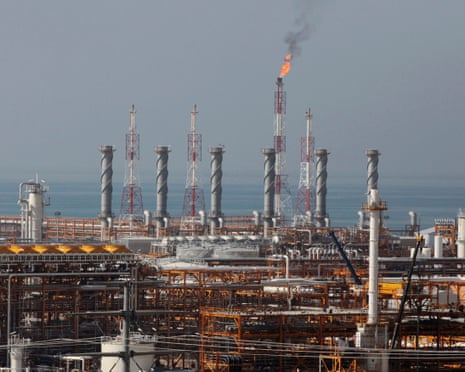
Donald Trump has threatened to “massively blow up” the entire South Pars gasfield in Iran if the country carries out any more retaliatory attacks on Qatar’s liquefied natural gas (LNG) facilities.
The US president also said in a post on his Truth Social platform that the US “knew nothing” about Israel’s earlier attack at the South Pars field, and nor did Qatar. He said that “no more attacks will be made by Israel” on the gasfield – unless Iran “decides to attack a very innocent, in this case, Qatar”. Trump added:
In which instance the United States of America, with or without the help or consent of Israel, will massively blow up the entirety of the South Pars Gas Field at an amount of strength and power that Iran has never seen or witnessed before.
Trump added:
I do not want to authorize this level of violence and destruction because of the long term implications that it will have on the future of Iran, but if Qatar’s LNG is again attacked, I will not hesitate to do so.
Qatari state-run energy company QatarEnergy – the world’s largest LNG producer – said earlier that several of its LNG facilities were targeted in missile attacks in the early hours of Thursday, causing “sizeable fires” and extensive damage. And earlier the country’s defence ministry said Iranian missiles had targeted the Ras Laffan Industrial City.
The Israeli strikes on Iran’s largest gasfield on Wednesday prompted the Islamic republic to threaten retaliatory attacks on energy infrastructure across the Gulf region. The South Pars field – shared by Iran and Qatar – is the biggest in the world and Iran’s main source of domestic energy.
We are closing this blog but you can continue to follow the latest on our new liveblog here. Thanks for reading.
Here is a summary of the latest developments:
-
Donald Trump has threatened to “massively blow up” the entire South Pars gas field if Iran carries out any more retaliatory attacks on Qatar’s LNG gas facilities. Trump said that “no more attacks will be made by Israel” on the field – unless Iran “decides to attack a very innocent, in this case, Qatar”.
-
The Pentagon “has asked the White House to approve a more than $200bn request to Congress to fund the war in Iran, according to a senior administration official”, the Washington Post reports.
-
The oil price climbed towards $110 a barrel on Wednesday as the mounting threat to the Gulf’s oil and gas infrastructure fuelled concerns of more disruption to global supplies, amid the continuing blockade of the strait of Hormuz.
-
QatarEnergy said “sizeable fires” caused extensive damage at its LNG facilities after Iranian missile attacks in the early hours of Thursday.
-
An attack set a ship ablaze early on Thursday off the UAE coast, authorities said. The United Kingdom Maritime Trade Operations centre said “a vessel has been hit by an unknown projectile, which has resulted in a fire onboard”.
-
French president Emmanuel Macron called for an immediate moratorium on striking civilian infrastructure, and said civilian populations and their needs must be “protected from military escalation”.
-
Three Palestinian women were killed in an Iranian missile attack in the occupied West Bank late on Wednesday, the Palestinian Red Crescent said, in the first deadly Iranian strike there.
-
A man was killed in central Israel in the latest round of Iranian missile fire, medics say. It brings the death roll in Israel from the war to 15.
-
Republicans in the US Senate blocked a measure that aimed to reign in Donald Trump’s power to wage war against Iran without congressional authorisation, winning a 53-47 vote.
Cathay Pacific suspends flights to and from Dubai until end of April
The Hong Kong aviation giant Cathay Pacific has suspended flights to and from Dubai over the war in the Middle East.
“In view of the developing situation in the Middle East, all Cathay Pacific flights to and from Dubai have been cancelled up to and including 30 April 2026,” the company said in a statement, adding that “further changes to our flight schedule may be needed in the coming days”.
Donald Trump has threatened to “massively blow up” the entire South Pars gasfield in Iran if the country carries out any more retaliatory attacks on Qatar’s liquefied natural gas (LNG) facilities.
The US president also said in a post on his Truth Social platform that the US “knew nothing” about Israel’s earlier attack at the South Pars field, and nor did Qatar. He said that “no more attacks will be made by Israel” on the gasfield – unless Iran “decides to attack a very innocent, in this case, Qatar”. Trump added:
In which instance the United States of America, with or without the help or consent of Israel, will massively blow up the entirety of the South Pars Gas Field at an amount of strength and power that Iran has never seen or witnessed before.
Trump added:
I do not want to authorize this level of violence and destruction because of the long term implications that it will have on the future of Iran, but if Qatar’s LNG is again attacked, I will not hesitate to do so.
Qatari state-run energy company QatarEnergy – the world’s largest LNG producer – said earlier that several of its LNG facilities were targeted in missile attacks in the early hours of Thursday, causing “sizeable fires” and extensive damage. And earlier the country’s defence ministry said Iranian missiles had targeted the Ras Laffan Industrial City.
The Israeli strikes on Iran’s largest gasfield on Wednesday prompted the Islamic republic to threaten retaliatory attacks on energy infrastructure across the Gulf region. The South Pars field – shared by Iran and Qatar – is the biggest in the world and Iran’s main source of domestic energy.
New Zealand’s prime minister, Christopher Luxon, has laid out a plan for the country’s response to the energy crisis sparked by the US-Israel war on Iran, while warning the public things “could get worse before they get better”.
Petrol prices have increased roughly NZ40-50 cents a litre, pushing the average price of Unleaded 91 to more than NZ$3 a litre since the conflict began. Meanwhile, some petrol stations have reported running out of petrol as people rush to stock up.
Luxon said New Zealand had roughly 41 days’ worth of fuel stock and that was still sufficient, but the government was preparing for “the worst-case scenario”.
We have sufficient fuel supplies, but even in the unlikely event the ceasefire is announced tomorrow, the effects on global supply chains and fuel supplies won’t be immediately resolved.
Ministers were in talks with fuel companies and countries such as Australia, the UAE and Qatar about alternative fuel supplies and would consider relief for a targeted section of society should the crisis worsen, Luxon said.
The government was also considering whether to move New Zealand up a fuel escalation level alert. It is currently at the lowest level.
New Zealand is particularly exposed to the energy shocks produced by the conflict – and to economic crises generally – with the small, isolated nation highly dependent on global trade and susceptible to disruptions in supply chains and shipping.
QatarEnergy is saying several of its liquefied natural gas (LNG) facilities were targeted in missile attacks in the early hours of Thursday, causing “sizeable fires” and extensive damage.
The state-run energy company said no casualties had been reported and that emergency response teams were deployed immediately to contain the damage.
Qatar’s defence ministry said earlier that Iranian missiles earlier had targeted the Ras Laffan Industrial City. QatarEnergy – the world’s largest LNG producer – said that attack caused “extensive damage” to its Pearl GTL (gas-to-liquids) facility.
In the US, Republicans in the Senate have blocked a measure that aimed to reign in Donald Trump’s power to wage war against Iran without congressional authorisation.
The 53-47 vote against taking up the measure fell almost completely along party lines on Wednesday, with no movement from earlier this month when Republicans blocked Democrats’ bid to limit Trump’s war-making power in the days after the joint US-Israeli strikes began across Iran.
“We do not know Donald Trump’s goals,” Chuck Schumer, the Democratic leader, said before the vote, urging Republicans to support the effort to force a debate on the war.
We do not know Donald Trump’s timeline. We do not know what victory even looks like in his eyes. Enough is enough.
The full report is here:
Conflict in the Middle East could trigger a shock that sends the world economy into a tailspin, the Reserve Bank has warned.
Risks to financial systems rose in recent weeks and an extended disruption to oil and other markets will increase the chance of a major shock, the Reserve Bank of Australia (RBA) has said in its twice-yearly check-up of the Australian financial system.
Oil prices surged to US$110 a barrel this morning after Iran and Israel attacked energy infrastructure. The review was finalised yesterday but said Australians should prepare for “a more shock-prone international environment”.
Australia has a “good degree of resilience” and banks are not heavily invested in the Middle East but international markets’ reaction to a major shock could still force global interest rates up and slash asset value, RBA analysts wrote.
Brad Jones, the RBA’s assistant governor for the financial system, said:
We see international risks as high and rising. In terms of financial risk, volatility has risen sharply … and further shocks could lead to markets becoming somewhat disorderly.
The United Arab Emirates early on Thursday denounced Iran’s attacks targeting its Habshan gas facility and Bab field as a “dangerous escalation” amid the escalating war in the Middle East.
Authorities in Abu Dhabi said the gas operations had been shut down after interceptions over the sites.
Iran also attacked gas facilities in Qatar after Israel attacked Iran’s South Pars offshore natural gas field it shares with Qatar.
Qatar’s ministry of defence said Iranian missiles targeted the Ras Laffan Industrial City and caused damage.
Iran said after the strike on its South Pars field that it would respond forcefully to any further attacks on its energy sector.
“If it is repeated again, further attacks on your energy infrastructure and that of your allies will not stop until it is completely destroyed,” the Revolutionary Guards said in a statement carried by Iranian media.
The South Pars field is the largest in the world and Iran’s biggest source of domestic energy in Iran. Peter Beaumont explains here why the attacks on so-called upstream gas production facilities in recent days are a significant escalation in the war and have potentially long-term consequences.
Iran’s threat of further retaliation came after Qatar’s state energy company said a missile strike sparked a fire causing “extensive damage” at its main gas facility, prompting Doha to expel two Iranian diplomats.
Saudi Arabia also said it intercepted drones targeting energy infrastructure in the east, while debris from a ballistic missile landed near a refinery south of Riyadh.
With agencies
A vessel has been hit near the Hormuz strait by an unknown projectile that caused a fire onboard, the United Kingdom Maritime Trade Operations has said.
The agency said the incident occurred east of Khawr Fakkan, an United Arab Emiratess port in the Gulf of Oman, and that it received the report at 23.00 GMT on Wednesday.
UKMTO said:
Vessels are advised to transit with caution and report any suspicious activity to UKMTO while authorities continue to investigate.
More on Emmanuel Macron now: the French president said in calling for an immediate moratorium on striking civilian infrastructure that civilian populations and their needs had to be “protected from military escalation”.
Macron posted on social media:
I have just spoken with the Emir of Qatar [Sheikh Tamim bin Hamad al-Thani] and President Trump following the strikes that hit gas production facilities in Iran and Qatar today.
It is in our common interest to implement, without delay, a moratorium on strikes targeting civilian infrastructure, particularly energy and water supply facilities. Civilian populations and their essential needs, as well as the security of energy supplies, must be protected from military escalation.
Disclaimer : This story is auto aggregated by a computer programme and has not been created or edited by DOWNTHENEWS. Publisher: theguardian.com



