
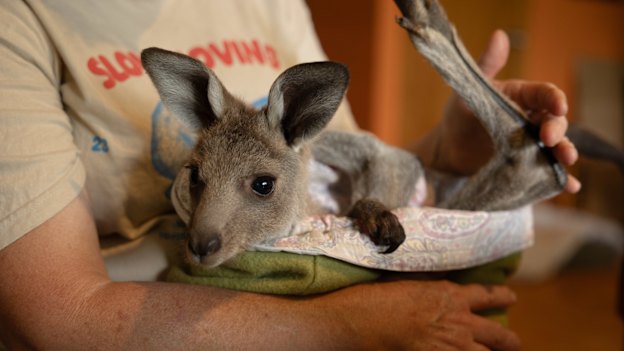
When more than $100 million in donations rolled in from around the world to help injured native animals during the 2019-20 bushfires, it was a windfall that promised to transform Australia’s wildlife rescue sector.
Six years on, some are wondering whether it was a blessing or a curse.
Australia has hundreds of wildlife rescue groups, hospitals and sanctuaries but the largest one, WIRES, was the sole beneficiary of the appeal boosted by former US president Barack Obama, TV host Ellen DeGeneres, Formula 1 champions Lewis Hamilton and Daniel Ricciardo and British food critic Tom Parker Bowles.
Headquartered in Sydney with a footprint across most of NSW, WIRES was quick to assure the charity regulator that it intended to deploy the $102 million nationally.
The charity can point to a number of achievements since then, including assisting 164,000 native animals last financial year, purchasing a hospital for raptors in NSW, donating to projects across Victoria and expanding to Tasmania.
Yet, it has also burned through tens of millions of dollars on administration costs and become embroiled in a civil war. Organisational change that largely sprang from the sudden influx of wealth lit the fuse for the feud. The infighting has contributed to the loss of 1000 members.
Concern is growing across the political spectrum.
Mounting concern
Independent senator David Pocock says Australians responded to the plight of wildlife in the black summer bushfires with “extraordinary generosity”.
“This created a unique opportunity to transform a historically under-resourced sector, but I’m concerned WIRES is yet to do that and is sitting on huge amounts of money while other organisations struggle to survive,” Pocock says. “Serious concerns have been raised about increased administration costs, declining membership and a growing lack of transparency and oversight over management of the remaining Black Summer bushfire funds.”
NSW Greens upper house MP Sue Higginson, a former wildlife carer who helped set up the Northern Rivers Wildlife Hospital, says the $100 million could have transformed the entire wildlife rescue sector. “It’s just a massive missed opportunity. It just seems like it was the right money at the right time in the wrong hands,” Higginson says.
“It’s just a massive missed opportunity – it just seems like it was the right money at the right time in the wrong hands.”NSW Greens MP Sue Higginson
The Northern Rivers Wildlife Hospital was built on crown land and cost $2.5 million to build and equip. It is a model that Higginson says could have been replicated elsewhere.
Similarly, Byron Bay Wildlife Hospital – a mobile full-service veterinary hospital – was built with $1.5 million in donations it raised after the fires. The charity declined to speak for this article, but in 2022, founder Stephen Van Mil told this masthead that he believed he could have built a second mobile vet hospital with the money WIRES had accrued in interest from its donations alone.
NSW Shooters, Fishers and Farmers Party upper house MP Mark Banasiak says he increasingly hears from voters with concerns about the conduct of WIRES, including an apparent focus on enforcement and inconsistent reimbursement for veterinarians who treat wildlife. “I take issue with any entity receiving public funds and not demonstrating good governance, particularly charities that play on heartstrings of people,” he says.
Loss of volunteers
The infighting at WIRES has played out at member meetings, on social media and in the courts and the most profound effect has been the impact on volunteers.
In July 2024, WIRES had 3465 members, and it now has about 2400, the NSW Supreme Court heard in February.
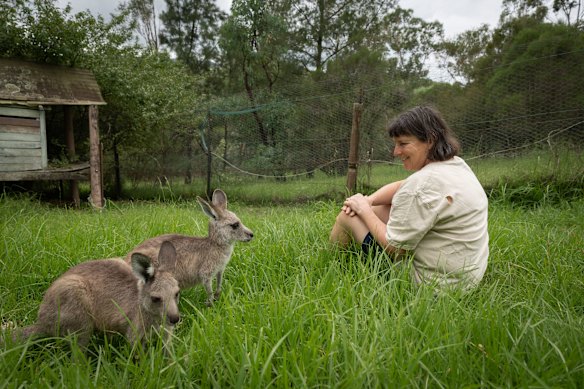
Some former WIRES volunteers have moved to new groups. Among them is Anna Culliton, who cares for kangaroos and wombats at her property in Kanimbla in the Blue Mountains. A WIRES member for 17 years, Culliton is now with Wildlife Carers Network Central West.
When Culliton received an email in September 2024 giving her a seven-day deadline to click a button to agree to a new WIRES constitution if she wanted to remain a member, she realised she did not agree and spent the week arranging to join a different local wildlife group.
“I always said I was in it for the wildlife and wasn’t interested in the politics … but sometimes you have to be interested in the politics,” Culliton says.
“You have to know what’s going on, otherwise you get bamboozled into having people in charge that you don’t really want to be in charge of you or the wildlife sector or the animals that you have in care.
“So I did get interested, and I did start following the emails, and I didn’t agree with a few things in the constitution, and I certainly didn’t agree with how it kind of got shoved in members’ faces.”
Culliton’s biggest reason for quitting was the prosecution of her friend, neighbour and mentor in kangaroo care, Tracy Dods, which made her question the direction WIRES was taking. Five other local WIRES volunteers also quit, Culliton says.
Dods was prosecuted by the RSPCA for aggravated animal cruelty for failing to take an eastern grey kangaroo in her care to a vet. WIRES representatives worked hand in hand with the RSPCA to build evidence and attended at the raid five years ago, as well as much of the original court case in the local court. She was acquitted on appeal earlier this month.
The appeal judge criticised WIRES for not raising any concerns with Dods before calling in the RSPCA, and described the behaviour by WIRES and RSPCA during the raid as “at times aggressive”.
The case became a cause célèbre for WIRES volunteers, dozens of whom turned up from around the state to support Dods at court hearings. Many were fearful about the implications of a guilty verdict for volunteers doing their best by animals and who might unintentionally make the wrong call.
Among the missing 1000 members, some may have quit wildlife care altogether, burnt out by the work. This is consistent with a NSW government review of the sector that found high turnover was a problem.
Others may have overlooked the email that Culliton baulked at responding to.
WIRES chief executive Leanne Taylor says the member attrition was “not unexpected” given the “more formalised process of registration” in September 2024, following two years of automatic membership renewal.
The WIRES impact report for 2024-25 paints a healthier picture of membership numbers than the figure heard in the Supreme Court. It suggests the organisation had 4673 volunteers, of whom 3480 were members across 29 branches. Taylor says the impact report includes members who did not accept the new constitution – both 944 who didn’t respond and 108 who wrote letters to object – as “authorised volunteer members”. (These volunteers, however, have no voting rights in the organisation.)
In 40 years of operation, instances where WIRES had reported concerns involving one of its own members to the RSPCA were “extremely rare”, Taylor says, but it was the appropriate course of action in cases of suspected mistreatment.
The bushfire millions
In 2020, the charity regulator published a report on three charities including WIRES that had raised substantial sums of money off the back of the 2019-20 black summer bushfires.
The regulator was satisfied that WIRES was spending bushfire donations on relevant activities, taking a “strategic and reasonable approach” to the disbursement of funds, and protecting the funds against fraud.
It noted a January 2020 statement from Taylor announcing WIRES would allocate funding to support all states and territories to assist animals affected by the bushfires, and that this was a change from WIRES being based solely in NSW.
The annual financial accounts reveal the spiralling cost of administration since then. In 2025, WIRES expenses reached $19 million and it had a structural deficit of $3.9 million. In 2019, its expenses were $3.3 million and it made a small surplus.
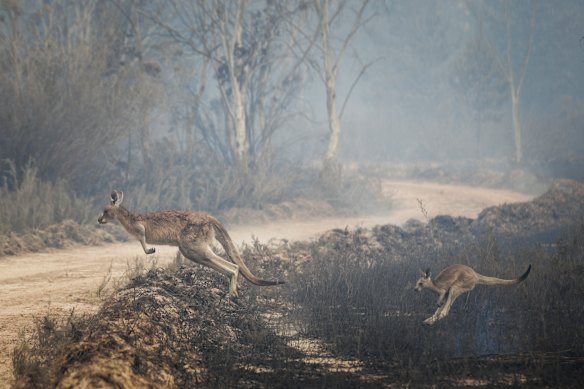
In 2019, before the bushfires, employee expenses totalled $2 million for nearly 40 full-time equivalent staff. In 2025, it totalled $8.1 million for nearly 77 full-time equivalent staff.
Dispersals from the bushfire fund and the balance remaining were not broken out in the 2025 financial accounts, as they had been in previous years. The NSW Supreme Court recently ordered the charity to redo its accounts and send them to members by the end of April.
Taylor says the money raised during the bushfires was not a “windfall” but a reflection of the trust the charity has built over decades. She denies that the money could have been transformative for the entire sector.
“No single organisation can deliver ‘generational transformation’ across an entire sector,” Taylor says. “That requires co-ordinated government policy, long-term funding, and habitat protection. What WIRES has done is step up, filling critical gaps, supporting the sector, and driving progress where it was urgently needed.”
Taylor says 42 per cent of the bushfire fund has been spent, and the rest has been committed to structured multi-year programs supporting long-term wildlife recovery.
Taylor criticises this masthead’s “ongoing framing” in its reportage on WIRES, saying that it rarely reflects the full context of the work being delivered and its impact, and risked undermining community confidence and affecting volunteers.
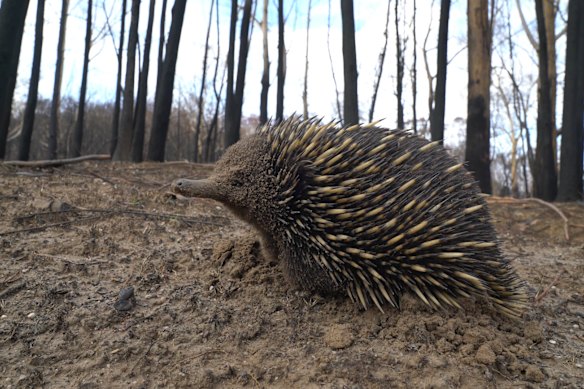
This context includes the WIRES Rescue Office, which operates 24 hours a day, 365 days a year, Taylor says, and the expanded emergency response capacity that includes a team of eight people with wildlife ambulances across NSW, Tasmania and South-East Queensland.
WIRES’ rehab facilities in NSW include a koala centre in Richmond, a native animal recovery centre in Randwick, a raptor centre in Fitzroy Falls that it purchased for $2.3 million, and a pre-release site in Coffs Harbour.
The organisation’s national grants program launched in 2020 has allocated $4 million to 369 wildlife rescue and rehabilitation projects across Australia, Taylor says, and WIRES also has grants for research and disaster relief. The early reports suggested most of the national grants flowed to Victoria.
WIRES has provided funding for the platypus rescue headquarters at Taronga Western Plains Zoo, the Australian Wildlife Conservancy for threatened species recovery on Kangaroo Island, habitat rehabilitation and protection of the grey-headed flying fox on the Mid North Coast, and a long-term partnership with the Tasmanian government.
Strengthening the sector
In NSW, WIRES represents about a third of the wildlife rescue sector. NSW parliamentary secretary for the environment Trish Doyle led a recent review into wildlife rescue and rehabilitation. The review resulted in $9 million in funding and a beefed-up role for the NSW Wildlife Council, the peak body that represents nearly every wildlife rescue group in the state besides WIRES.
During the 18-month review, Doyle travelled all over NSW and met hundreds of carers, vets and rehabilitators. While she found many “fantastic” individual carers and groups working under the WIRES umbrella, she also found the organisation was a “focal point of feedback”.
“Everywhere I went, every round table we held, every sanctuary I visited, every individual carer or vet that I spoke to, pretty much had a comment to make about WIRES,” Doyle says.
“Given that WIRES still has, to my understanding, about $60 million left from the bushfire donations that they received, we need to actually focus our efforts on strengthening the rest of the sector.”
The NSW Wildlife Council was the natural choice, Doyle said, because it was volunteer-run and already represented over half the state’s wildlife care groups.
Asked whether she had concerns about WIRES, Doyle says she had “certainly asked some pretty tough questions”. Was she satisfied with the answers? She would let “the recommendations speak for themselves”.
The sector nationally is seeking a more unified approach to wildlife care than the current fragmented state-based systems. Wildlife Victoria and other groups across NSW, Victoria, Queensland and Western Australia recently appealed to the federal government for national co-ordination of wildlife protection, rescue, treatment and rehabilitation.
Wildlife Victoria, the largest rescue group in that state, raised $18 million in 2020 after the black summer fires, and more recently it received a state government grant covering 7 per cent of its annual operational costs. It has never received funding from WIRES. Demand for Wildlife Victoria services has surged by 204 per cent over five years and chief executive Lisa Palma says it needs additional money.
Corporate irregularities
The NSW Department of Fair Trading required WIRES to convert from an association to a company because of its financial assets – mostly the remainder of the bushfire appeal, but also tens of millions a year in bequests.
This meant WIRES needed to update its constitution. It could have made minimal changes to its existing constitution, which dated from 2007. Instead, the charity decided to go for an extensive rewrite.
Taylor says the board-approved constitution included best-practice measures such as independent skilled directors, term limits, stronger legal compliance and clear dispute resolution processes.
“Opposing these changes is, in effect, opposing independent oversight, accountability and modern governance,” she says.
She says this masthead has “perpetuated the misinformation by suggesting there would be less oversight of donated funds, and this is factually incorrect”.
However, in 2024, Professor Sandra van der Laan, an independent accounting expert at the University of Sydney Business School, reviewed both constitutions and the charity’s financial accounts at this masthead’s request. It was van der Laan’s professional view that the board-approved constitution would have reduced oversight of the public gift fund that housed the bushfire money, and she also criticised WIRES for “unsustainable” spending on administrative costs.
Former WIRES treasurer Mary Macken says the 2007 constitution kept the organisation focused on the rescue and rehabilitation of wildlife and education, whereas the proposed new constitution was broader.
The WIRES board tried to get variations of its preferred constitution passed at three special general meetings, between September 2023 and July 2024, but it consistently failed to get the required 75 per cent majority. Then came the ultimatum – in September 2024, WIRES emailed members asking them to click a button to accept the constitution in order to remain as members.
About 1000 members who failed to click were left off the register that WIRES sent to the Australian Securities and Investments Commission. WIRES lodged its paperwork with both its preferred constitution and the 2007 one, and it operated under its preferred framework until April 2025.
In November 2024, WIRES members Katrina Emmett and Gary Henderson separately took action in the NSW Supreme Court to revert to a modified 2007 constitution and reinstate members. Mediation failed.
In April 2025, on new legal advice, WIRES admitted in an email to members that there had been irregularities in its company registration due to incorrect advice from its previous lawyers.
The organisation unsuccessfully tried to approve a new constitution in July and August 2025 – this time modelled more closely on the 2007 version but still with changes to the bushfire fund that members could not accept. In October, WIRES members finally endorsed a constitution, the modified 2007 framework, as Emmett and Henderson had requested.
In December 2025, WIRES applied to the Supreme Court to regularise the conversion to a company structure despite the charity’s registration error. This required the court to find there was no intentional wrongdoing or substantial injustice.
Emmett and Henderson were added to this case, since their matters overlapped. Neither opposed the court granting the application since the alternative could have led to WIRES being wound up.
Instead, they asked the judge to impose conditions. At a final hearing in late February 2026, with WIRES ultimately agreeing to most of it, Justice Francois Kunc made orders including for the charity to send court documents to the regulator, write to lapsed members inviting them to rejoin and redo its financial accounts to provide more transparency about the bushfire fund.
The regulator confirmed to this masthead that WIRES had met the first of its court-imposed deadlines on March 11, but due to secrecy provisions, it was unable to say what it would do with the information.
Kunc says in his judgment that he had a narrow task and it was not “to conduct a royal commission into the affairs of WIRES generally”. He noted that “there can be no doubt that the affairs of WIRES have been in turmoil for some time” regarding the constitution and the conversion.
Social media battleground
A group of concerned members has styled itself as Reclaim WIRES. A Facebook page with 160 members says it was “created to give members of WIRES NSW fairer input into the direction, governance and operations of the animal rescue company”. There is a related private group with nearly 500 members.
On the other side is Protect WIRES, which has 1000 followers. It says it represents the majority who have “had enough of the infighting, bickering and outside influence hurting WIRES & wildlife”.
Both groups claimed victory after the recent Supreme Court case. Protect WIRES says the judgment “clearly states that WIRES acted honestly. Its members, board and staff have been entirely vindicated”. Reclaim WIRES emphasises that the judge imposed conditions on WIRES, which would not have occurred without the intervention of members.
Taylor says Protect WIRES is not endorsed by WIRES. She says the behaviour of Reclaim WIRES includes targeted and personalised attacks, intimidation of volunteers and staff, legal challenges, attempts to undermine donor confidence and the spread of misinformation.
“This is not constructive criticism; it is sustained disruption,” she says. “Some of this has been directed at me personally. But my real concern is the toll it takes on volunteers, people who are simply trying to care for injured and displaced wildlife.”
Everyone agrees there is a toll on volunteers. Opinions may differ about the cause.
Get to the heart of what’s happening with climate change and the environment. Sign up for our fortnightly Environment newsletter.
Disclaimer : This story is auto aggregated by a computer programme and has not been created or edited by DOWNTHENEWS. Publisher: www.smh.com.au






