
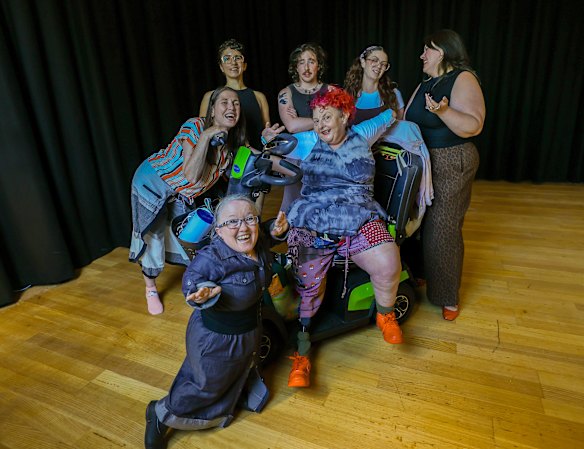

In an airy rehearsal space upstairs at Arts House, the cast of new play Specials gather. They jump between scenes and time frames – from the harrowing disability royal commission to flashbacks to the neglectful and depressing (and fictional) Shitty River Special School for disabled children. The cast play multiple roles across the two settings, a la Wizard of Oz.
Between scenes, director Tansy Gorman notes the lack of boundaries at the school – the teachers are forever grabbing students, handling them. One gets a student in a headlock. “Be as nasty as you want,” writer Kath Duncan tells actor Sonia Marcon, playing the headmistress.
“It scarred me,” says Duncan as the cast bring to life her childhood trauma. “Sorry to laugh,” she adds.
But the room is full of laughter. This is a comedy. There’s something cathartic in this frank depiction of state neglect.
Not all kids in “special schools” had bad experiences, but Duncan absolutely did. Born a double transverse amputee, she was placed at a special school in Sydney for kids between ages six and nine. She’s been developing the play since 2020, based on experiences and research. After a sold-out development season in 2024, the play is now fully realised.
“I’ve always had this very Dickensian view of my special school,” she says. “I hated it. It was a torture chamber.”
‘As an actor, I want to get out there and play characters without a disability.’
Sonia Marcon, actor
She describes it as a sad and neglectful place where kids with disabilities were shut away and ignored. The fences were ringed with barbed wire. There was no curriculum. And at the end of it all they’d be placed in menial work, such as weaving or assembling radio parts. “My favourite potential job was rewinding plastic wrapping material,” says Duncan.
Specials is driven by this rage – both at the treatment and the low expectations of kids like her. The system has come a long way, but for Duncan it’s telling that the Royal Commission into Violence, Abuse, Neglect and Exploitation of People with Disability, held between 2019 and 2023, was largely overseen by non-disabled people. It’s a line that finds its way into the play: “We’re not even trusted to run our own royal commission”.
The disability education system still exists. Does Duncan still feel the same about it?
“Burn it down,” she says. She walks that back just a bit – she acknowledges that there needs to be something in place, but she hates to think of kids being let down like she and her peers were.
Duncan, also an actor, has been typecast over the years. She reels off the kinds of roles she gets offered. An amputee. A shark attack victim. An NDIS client. This was why she was keen to see people with disabilities cast in able-bodied roles in Specials. She jokingly calls it “uncripping”, or “abling up”.
Things have changed in recent years, however, with Australian disabled performers becoming more prominent, more heard. In 2024, for instance, Geelong’s Back To Back Theatre, which draws its cast from the disabled community, won the Golden Lion at the 2024 Venice Biennale. The judges praised the company for “challenging the construction of our imaginations and our perception of normalcy”.
“Back To Back do great work,” says Duncan. “But you’ve got one company… getting a lot of the funding every year … I’d like to see it spread around a bit more.”
Everyone in the room groans when the subject of Melbourne Theatre Company’s 2024 production of Martyna Majok’s play Cost of Living comes up. The Pulitzer Prize-winning US play was critically acclaimed. But Duncan and her cast mates have a very different view: “Written by a carer, and it made us look like losers,” she says.
The cast of Specials are all disabled, as are a lot of the crew.
“As an actor, I want to get out there and play characters without a disability,” says Marcon.
“Like, why can’t we be Hamlet?” adds Oliver Ayres.
Ayres recalls being emotional on the first day of rehearsal for this show. “I’m so used to being the only one in the room,” he says. “It’s ironic – in a play that focuses on disability, this is the time when I don’t have to talk about it as much.”
The cast and crew believe that the work can be done to fix these problems.
“People ask how we do it, an entire cast and most of the crew with disabilities,” says Gorman. “You can do it. You just have to work harder.”
Specials is at Arts House from March 24-29
The Booklist is a weekly newsletter for book lovers from Jason Steger. Get it delivered every Friday.
 Will Cox writes fiction and arts criticism. He’s based in Merri-bek.
From our partners
Disclaimer : This story is auto aggregated by a computer programme and has not been created or edited by DOWNTHENEWS. Publisher: www.smh.com.au


