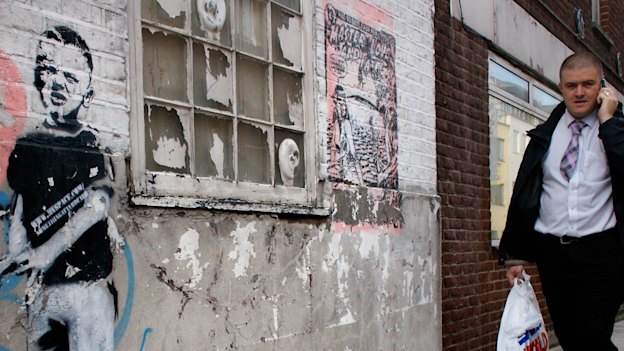
Some time in 2001, when street artist Banksy’s satirical stencil works had been popping up on London walls and railway overpasses for a year or so, I was working at a nearby design studio. Talking to a colleague about Banksy’s latest work, he told me that the artist was selling his stencils on paper and canvas. “I actually know him, if you wanted to meet him,” this workmate told me.
Banksy obviously wasn’t yet the phenomenon he would later become, but I had little interest in meeting him. I liked his works, but I wasn’t that fussed about the person himself. And wasn’t his anonymity what gave his work an extra frisson? Plus, he was hardly the first anonymous graffiti artist.
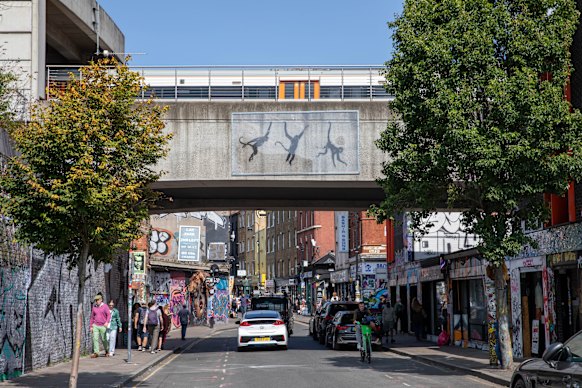
We know now, of course, that Banksy’s anonymity would become part of his “brand”, the reason his works garner such excitement when they appear on a public building or in a political hotspot overnight.
As his works grew bolder and more subversive, and fans and collectors of his work became more high-profile, interest grew in who the real Banksy was, and, naturally, the British tabloids tried to “unmask” him many times over the years.
There’s been much speculation – was the real Banksy musician Robert de Naja, founder of the Bristol trip-hop collective Massive Attack, already well known as a graffiti artist? Jamie Hewlett, co-founder of the “virtual” rock band Gorillaz? Even, hilariously, Neil Buchanan, the host of British kids’ art TV show Art Attack was a “suspect”. Then there’s the theory that Banksy is, in fact, a collective rather than a single artist.
Now a lengthy Reuters investigation has published a breathless account of how, over many months (and at presumably great cost), it has “revealed” that the elusive artist is… precisely who Banksy has long been thought to be: a Bristol man formerly known as Robin Gunningham, who has, reportedly, changed his name to one of the UK’s most common monikers – David Jones – to try to preserve his anonymity.
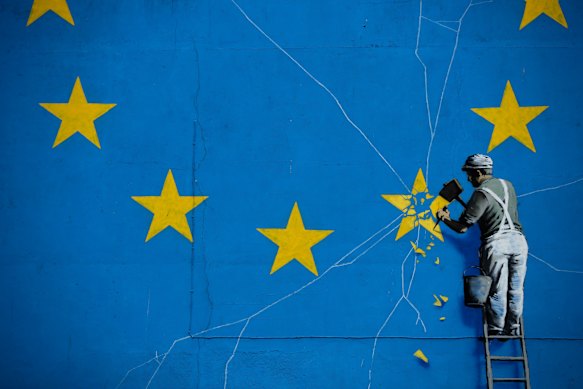
And he is likely, Reuters revealed, to be either friends with or working with de Naja. Their evidence is based on a 2022 trip the artist made to Ukraine, photographs from former associates, and a written confession and arrest documents from 2000.
Banksy’s lawyers responded to Reuters with a very on-brand vague statement that the artist “does not accept that many of the details contained within your enquiry are correct”, adding that he keeps his identity private for several reasons, among them his personal safety, and the fact that anonymity “protects freedom of expression by allowing creators to speak truth to power without fear of retaliation, censorship or persecution – particularly when addressing sensitive issues such as politics, religion or social justice.”
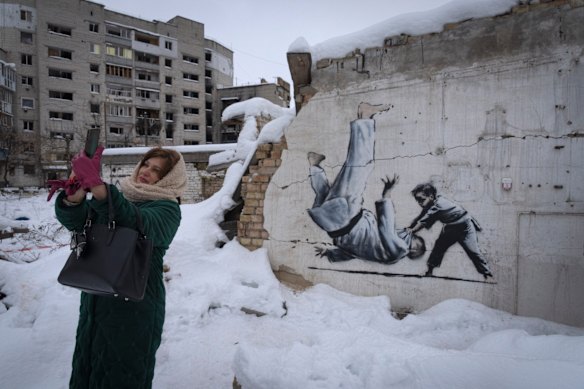
Apart from the fact that this months-long investigation seems a colossal waste of Reuters’ resources, what have we gained from it? A 20-year-old photo, evidence that Banksy was once arrested, confessed and paid his fine (the horror!) and proof that someone named David Jones and De Naja had been in Ukraine the same time Banksy’s seven murals appeared. (Only the visit to Ukraine is definitively “new” evidence.)
Aside from landlords whose walls were defaced in the day before such a thing would increase a property’s value, what is the point of “unmasking” Banksy?
In 2010, to promote his Oscar-nominated film Exit Through The Gift Shop, after much rigmarole, I secured an interview with Banksy. It took some wrangling, but Banksy – whoever he/she/they are – agreed to answer my questions via email. Of course, it could have been anyone, but my contact assured me it was the real deal.
Banksy discussed the documentary he directed, which tells the story of Thierry Guetta, a wannabe street artist and amateur filmmaker who tries to befriend Banksy and other street artists, but the script is flipped and the film becomes about Guetta himself. Like much of Banksy’s work, the film felt like a giant prank, but the artist maintained it was a genuine documentary following the rise of Guetta as a street artist named Mr Brainwash.
“If I’d written it myself, there would have been a car chase and lasers,” Banksy told me. “Making the film wasn’t a conscious attempt to expand my CV; I just had a story I wanted to tell. There’s no danger of a sequel or a clothing line,” he said. “I’d like to say I’m politically motivated but the reality is I’m just far too lazy for capitalism. If Banksy has become a brand, then it’s a brand that doesn’t believe in itself.”
Discussing his anonymity, he conceded that “there’s probably a contradiction in hiding your face while shooting off your mouth. My job requires a little light lawbreaking, so I don’t have much choice.”
How could we be sure, I asked in the email exchange, that we were talking to the real Banksy?
“Is this the real Banksy? That depends. If the interview makes me sound charming and intelligent, then it’s me,” he quipped. “If I sound like an idiot, I’ll say it was an imposter.”
Banksy wasn’t the first artist to create work anonymously – since the 1980s, messages of unknown origin known as the Toynbee Tiles have been appearing embedded in streets of major cities around the world; avant-garde music and art collective The Residents were at it in the 70s; Daft Punk famously hid behind their helmets for years, even local band TISM kept their identities private for decades.
But Banksy – ironically – is arguably the most famous.
Except, perhaps, for the Italian author who published for decades under the pseudonym Elena Ferrante. After achieving global fame and books sales in the tens of millions, an Italian journalist revealed the author’s real name – and there was an outcry. The journalist who “unmasked” her was accused of doxxing, and there was widespread backlash, many calling the act a violation of her privacy.
So why the need to [unmask] Banksy? Knowing his name neither adds or detracts from enjoyment of his art.
So why the need to do the same to Banksy? Knowing his name neither adds nor detracts from enjoyment – or otherwise – of his art. And in uncertain times, as the world is most certainly right now, anonymous artistic interventions should be considered something of a gift.
By the final paragraph of Reuters’ 8000-word investigation, even the authors seem to have come around to this view, quoting an art dealer who was at the 2018 Sotheby’s auction of Banksy’s Girl with Balloon, into which the artist had secretly built a device that shredded the work in front of stunned auctioneers and bidders.
Robert Casterline pulled out his phone to take photos, but there was someone blocking his view, he told Reuters – an “eccentric looking man with a broad neck scarf and thick eyewear”. The man wasn’t watching the artwork being shredded, instead he was watching the crowd’s reaction. Casterline tells Reuters that he realised later, looking at his photos from that night, that the glasses appeared to have a small camera built into them.
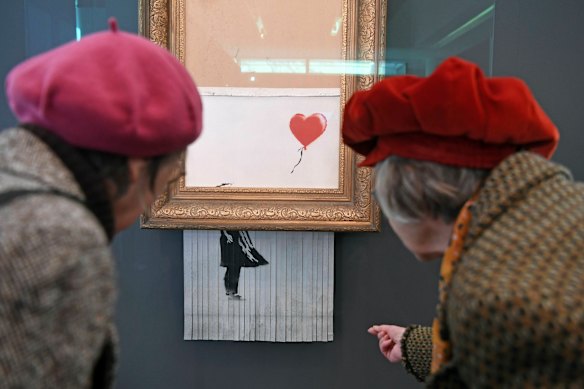
Banksy later posted a video of the stunt, seemingly shot from where the man was standing.
Casterline tells Reuters that he’s sure it was the same man identified in a 2004 photo as Robin Gunningham, but he has kept his own photos from that night private, telling Reuters: “I don’t want to be the guy who exposes Banksy.”
As Banksy himself (or her, or they) told me in 2010: “Since I was a little kid I wanted the power to become invisible, I seem to have that now, so why would I give it up?”
The Booklist is a weekly newsletter for book lovers from Jason Steger. Get it delivered every Friday.
Disclaimer : This story is auto aggregated by a computer programme and has not been created or edited by DOWNTHENEWS. Publisher: www.smh.com.au